For this young woman from Pangani, an international exhibition defines as “life-changing” to her and her community business group.
A total of four beneficiaries of Bahari Mali project from Tanga region and Pemba Island in Tanzania carried packs of products from their incubated blue economy businesses all the way to Dodoma region in central Tanzania for the annual international agriculture and food systems expo (Nanenane). The exhibition brings together a handful hundreds of sectoral exhibitors and tens of thousands of visitors for the nearly 10 days event. Of the four exhibitors from Bahari Mali project, Sophia from Pangani district in Tanga finds out what it means for her group and her personal growth to be given such platforms.
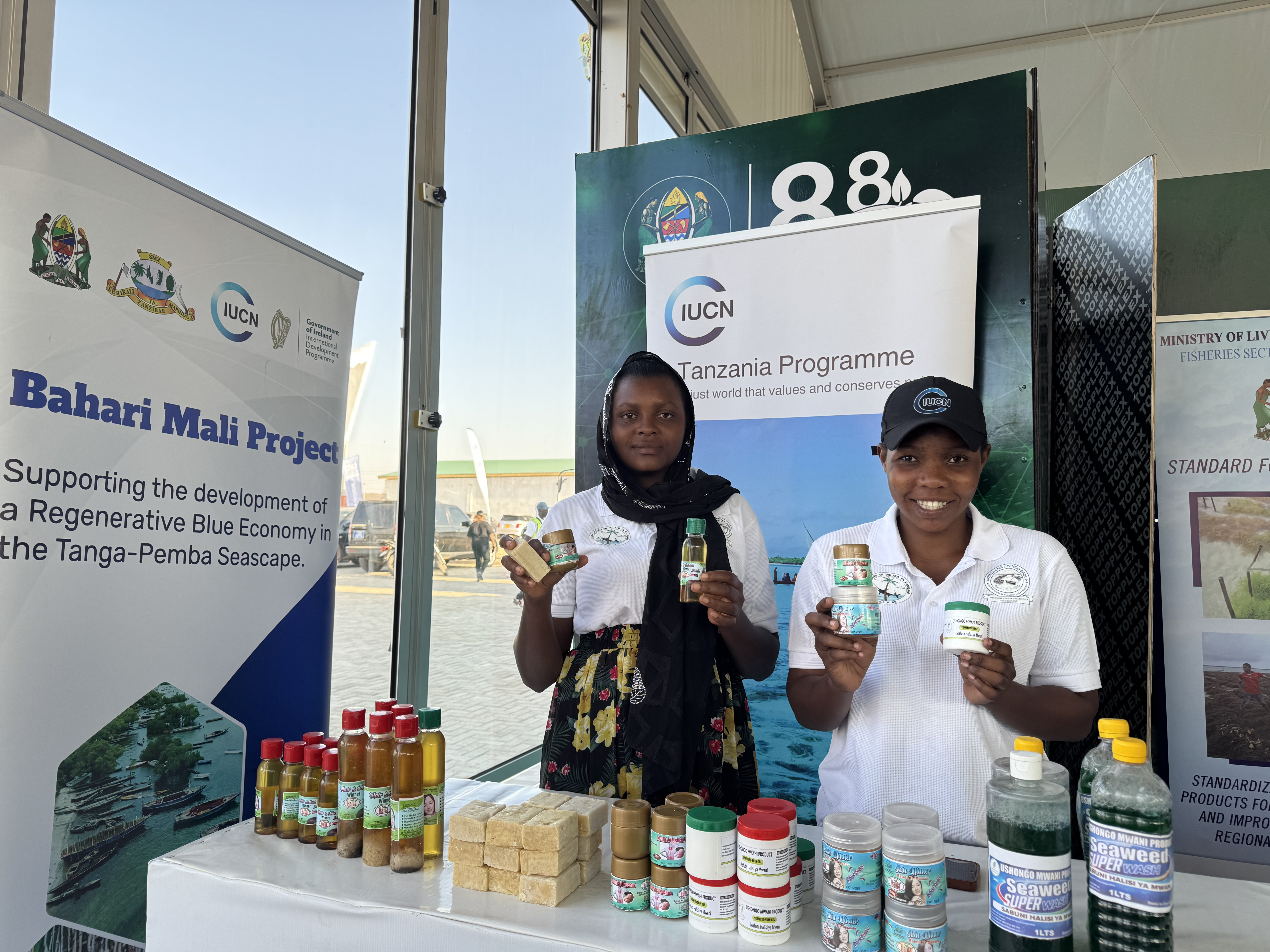
Sophia (on the right) from Tanga and another BEI beneficiary from Pemba posing for a photo at their selling point during Nanenane exhibitions in Dodoma.
Photo: IUCN Tanzania/Bahari Mali Project
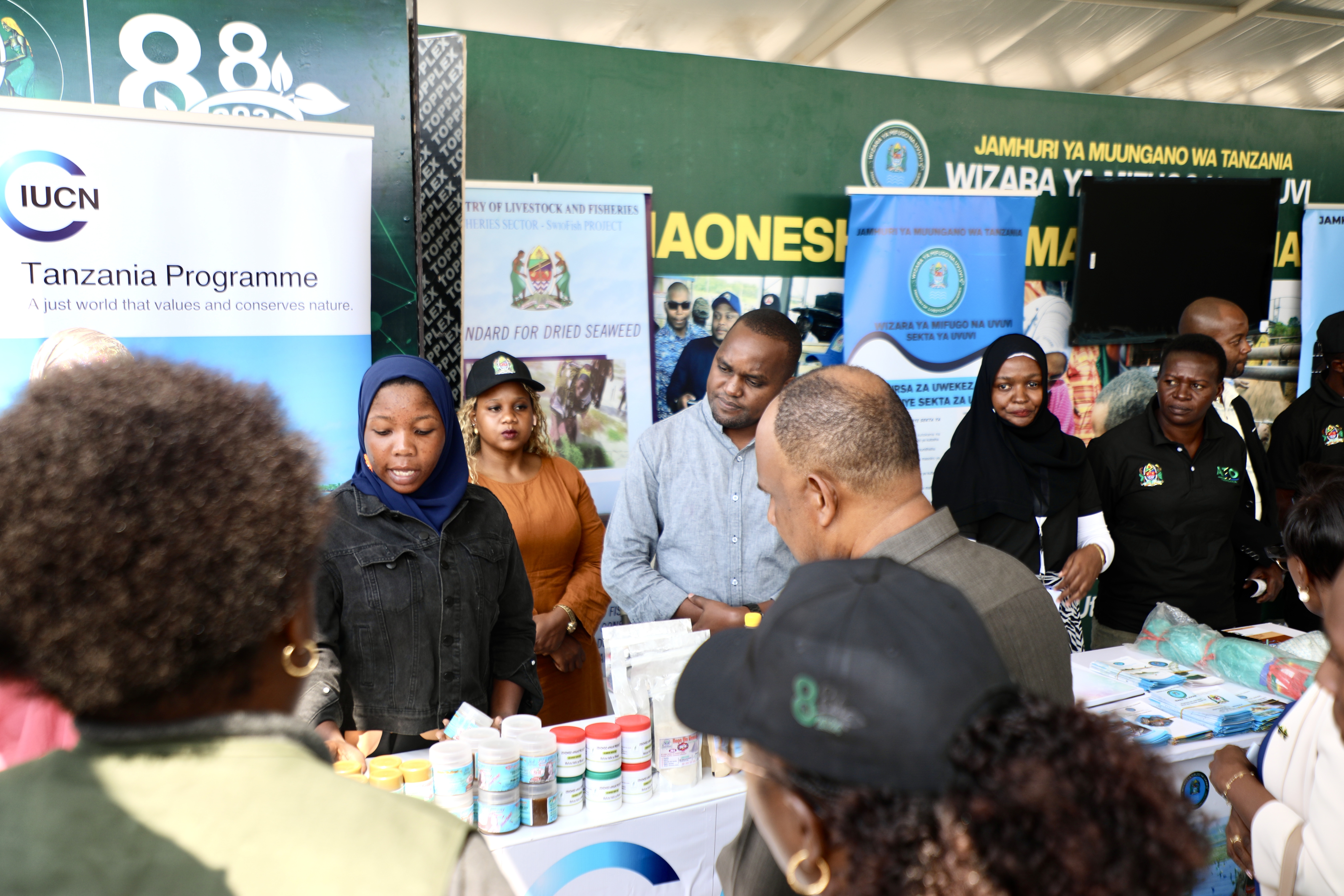
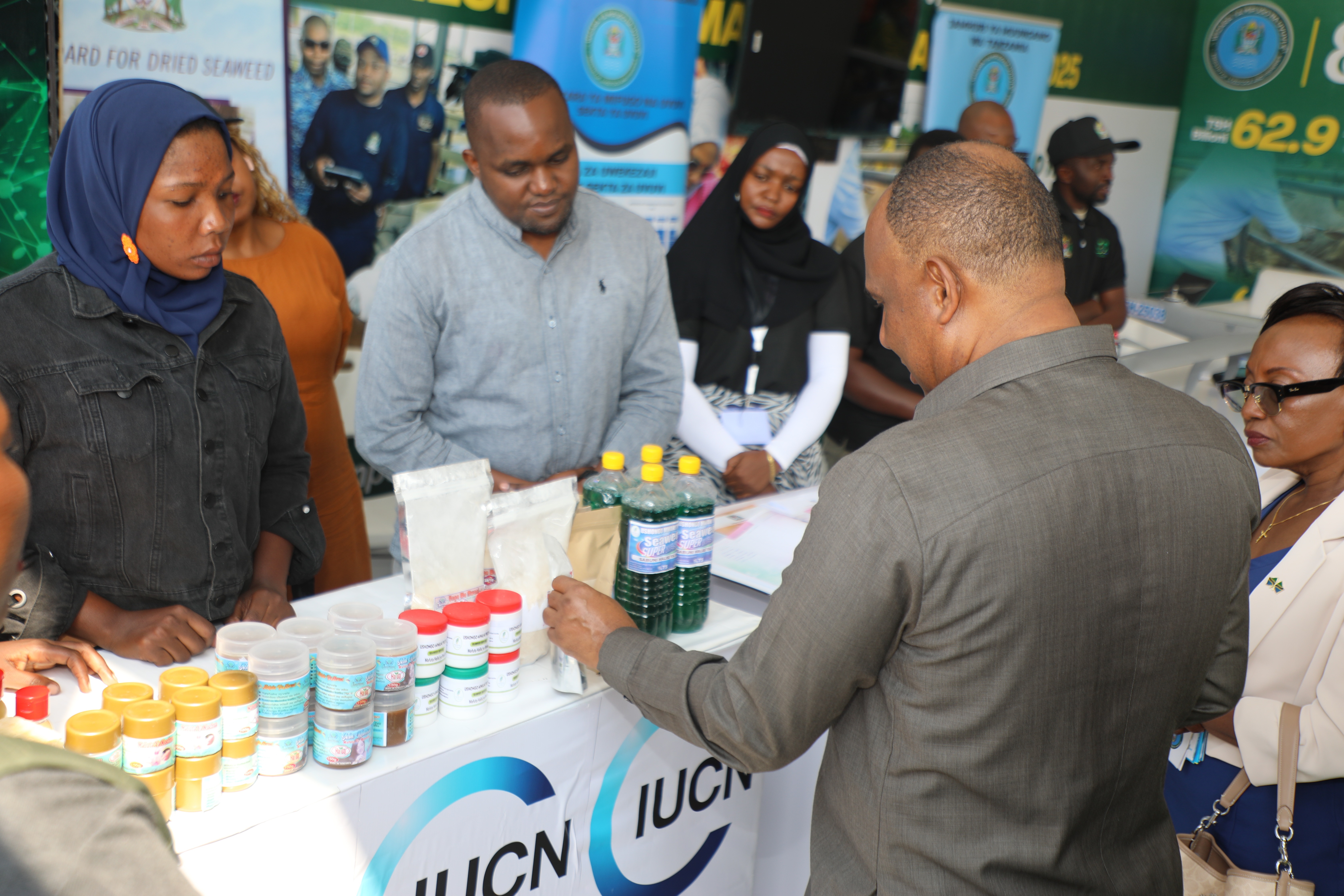
Sophia talking about her products to the Tanzania's ambassador to Italy, H.E Amb. Mbarouk when he visited her selling point in Nanenane exhibitions.
Photo: IUCN Tanzania/Bahari Mali Project
Sophia is a member of Umoja ni Nguvu group in Pangani district, Tanga. The group engages in seaweed farming along Pangani’s coast of Indian ocean, tapping into its blue economy opportunities to sustain their livelihoods. On a day-to-day basis, her group maintains a two acres farm of seaweed about 600 meters off the coast from their village. The group harvests and process the seaweed into different products including seaweed powder, oils, soap bars and even selling seaweed by-products.
Before the blue economy incubator program from Bahari Mali project, her group was only able to engage in farming but never processed the seaweed into products. The injection of incubation program and funding support from the project meant the business was set for the next stage. The growth was imminent, and in one year, the group has been able to showcase tangible outcomes.
When Sophia filled the boxes of seaweed products from Pangani to Dodoma, she not only carried the labour of love from her group but also carried the aspirations of the group to see through the next of level of their business growth. She was excited to meet what would greet her at the expo. She was determined to sell, learn and grow for the whole group she is carrying at her back, left in Ushongo village, Pangani, Tanga.
This exhibition was not like any other for Sophia. It was her first national-level exhibition that she stood behind a selling point towards customers. Her group has sold in several small-scale exhibitions including in their village open-market days, district and up to regional expo events. But never for her or even her group has the national-level experience been a reality. Overwhelmed at start but having been taught about clientele management from the incubation program, Sophia gained confidence and was able to engage with many customers, making the crucial sales possible for her group.
Sophia managed to sell all her products. But that is not what topped the joy she had from the expo. At the exhibition, she was able to learn from other seaweed producers, aqua-farming experts, business enablers and even customers on how she can unlock her group’s business for bigger opportunities. She was able to explore different packaging variations that can make their products go an extra mile on impressing the customer and get to hear from other seaweed products producers on how they make other products than what they have, including shampoo, sea moss, and fortified children food.
A learning curve like that is one of the benefits the Bahari Mali project instils when they support beneficiaries to participate in these events. Sophia and other representatives from project benefitting groups at the expo were able to make sales, learn from others and exchange knowledge and opportunities for business growth. This opens the doors of growth beyond incubation, making their ventures more profitable and overt-time, more sustainable.
Sophia was able to snatch back home with her even a bigger story, specifically for marketing her products to the Tanzania’s ambassador to Italy when he visited her point of sale. The ambassador commented on her products’ potential to make bigger sales in the international market. Exploring her products, the ambassador hinted to her that “these products are far sought in the European markets” adding that it will be a great opportunity for her group if they advance and adhere to the market standards, so they tap into the opportunities as soon as possible.
In her own words, Sophia says, “I never imagined a day where I will be the voice of my group, let alone marketing to such a high-level diplomat, other international customers and meeting so many business operators” This to her was clearly impossible for someone who could not afford attaining a high-school education and who only took care of a small piece of seaweed farm close to her home. From this expo, she sees a life full of possibilities, not only for her, but also for all the members of her group she left at the village. The sales, networking and learning has been “life-changing" as they will provide a trajectory of business growth that will change their lives for better.
The Bahari Mali project is supporting these community groups in their blue economy ventures through the Blue Economy Incubation (BEI) program to benefit the people and planet across Tanga-Pemba seascape. The overarching goal of the project is to unlock the development of a blue economy that contributes to long-term, effective, equitable, and inclusive conservation of coastal and marine biodiversity, as such those services improves the lives of surrounding communities, in line with contributing towards Tanzania’s development and conservation agendas.


Disclaimer
Opinions expressed in posts featured on any Crossroads or other blogs are those of the authors and do not necessarily reflect the opinions of IUCN or a consensus of its Member organisations.

The Bangladesh Forest Department (BFD) and IUCN Bangladesh, with support from Agence Française de…

Each year, International Women's Day is an opportunity to recognise the women advancing change in…

On 14 January 2026, in Dhaka, the Bangladesh Forest Department and IUCN Bangladesh formally signed…