Inside the ReSea Project's Conservation Leadership Program in Tanzania
Under the project’s Blue People pillar, a wave of change in ocean governance is rising across the Tanga–Pemba seascape. In April, at the Fisheries Education and Training Agency (FETA) in Bagamoyo, the Conservation Leadership Program brought together emerging leaders from coastal communities to strengthen their skills, confidence, and influence. Through targeted capacity building and peer learning, participants are now better equipped to shape equitable governance systems and drive a resilient, community-led regenerative future.
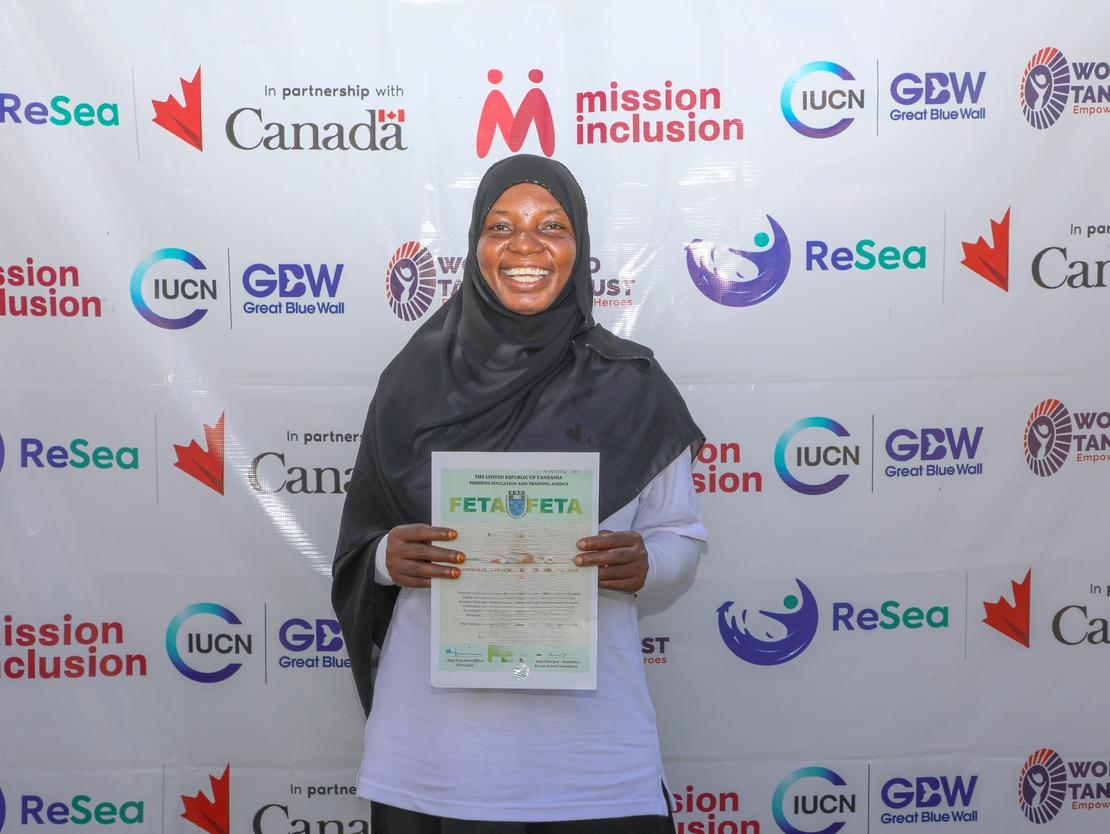
A conservation leadership program graduate holding her certificate after her graduation ceremony at FETA grounds, Bagamoyo, Tanzania
Along Tanzania’s coastline, the future of ocean governance is being shaped not only by policies and institutions, but by people, including community leaders, practitioners, and changemakers stepping into roles of influence. Under the ReSea project’s Blue People pillar, the Conservation Leadership Program is investing in a new generation of leaders equipped to steward marine ecosystems while advancing inclusive, community-led development.
The ReSea (Regenerative Seascapes for People, Climate, and Nature) project, implemented by International Union for Conservation of Nature (IUCN) in partnership with Mission Inclusion and funded by Global Affairs Canada, is a multi-country initiative working across the Western Indian Ocean region. In Tanzania, its work is anchored in strengthening the connection between healthy ecosystems and resilient coastal livelihoods, ensuring that conservation and development go hand in hand. By integrating ecosystem restoration, sustainable economic pathways, and community empowerment, ReSea is helping to reframe how seascapes are managed by placing people at the centre of lasting solutions.
It is within this vision that the Conservation Leadership Program takes shape. Across many coastal communities, governance systems have historically left women and youth at the margins of decision-making, despite their central role in fisheries, coastal economies, and community resilience. This imbalance not only limits equity but also constrains the effectiveness of conservation efforts. The program responds by moving beyond participation toward meaningful influence, supporting emerging leaders to actively shape the systems that govern their resources and futures.
In April, this ambition took a tangible step forward with the launch of the program’s curriculum at the Fisheries Education and Training Agency (FETA) in Bagamoyo. Bringing together emerging leaders from the Tanga–Pemba seascape, the program created a space for shared learning grounded in real-world coastal challenges. The setting itself is significant. As a national centre for fisheries training, FETA offers a practical and context-rich environment where leadership development can directly connect with Tanzania’s marine realities.
The curriculum is designed to be both rigorous and responsive, combining technical knowledge with leadership development and peer exchange. Participants engage with concepts of inclusive marine governance, sustainable resource management, and blue economy opportunities, while also building the confidence and agency needed to navigate complex decision-making spaces. Just as importantly, the program fosters a network of leaders who can learn from one another, collaborate across communities, and sustain momentum beyond the training itself.
What distinguishes the Conservation Leadership Program is its emphasis on translating learning into action. Participants are not only equipped with new skills but are supported to apply them within their communities, influencing governance processes, strengthening local initiatives, and contributing to more equitable and effective conservation outcomes. In doing so, the program advances a broader shift from top-down approaches to community-led stewardship, and from short-term interventions to long-term, regenerative systems change.
As ReSea continues to unfold in Tanzania, the Conservation Leadership Program stands out as a critical investment in people. By strengthening leadership where it matters most within coastal communities, the initiative is helping to ensure that the future of Tanzania’s seascapes is not only ecologically sustainable, but also inclusive, resilient, and locally driven.


Disclaimer
Opinions expressed in posts featured on any Crossroads or other blogs are those of the authors and do not necessarily reflect the opinions of IUCN or a consensus of its Member organisations.

The Bangladesh Forest Department (BFD) and IUCN Bangladesh, with support from Agence Française de…

Each year, International Women's Day is an opportunity to recognise the women advancing change in…

On 14 January 2026, in Dhaka, the Bangladesh Forest Department and IUCN Bangladesh formally signed…