Greater Flamingo: Shrimply Pink Perfection
This Species of the Month, we wade into Mediterranean wetlands to discover one of their most iconic inhabitants, the greater flamingo.

Tall, proud and strikingly pink, the greater flamingo (Phoenicopterus roseus), steps through the murky waters of a Tunisian wetland, looking for its next meal. It has recently migrated from Italy with its colony in search of a more abundant wetland. All across the Mediterranean, from Southern Europe to North Africa to West Asia, greater flamingos flock to salt marshes, lagoons and saline lakes. The iconic bird peppers the horizon, colourful congregations brightening our Mediterranean landscape.
 Greater flamingos are social birds. They live, feed, and breed in massive colonies that can comprise anywhere from a few thousand to over 200,000 pairs. These enormous gatherings aren't just about comfort or convenience: they're a survival strategy. The greater the number of birds, the stronger the chance of surviving an attack from a predator. Sentries scan the area while the majority of the birds bury their heads in the water to feed, alerting their otherwise occupied peers if danger appears.
In Spring, like with so many other animals, romance comes knocking. Wetlands become a whirlwind of coordinated courtship displays, as male and female flamingos gather in groups of hundreds, performing elaborate synchronised routines of postures, head-flagging, and wing displays. Turns out flamingos invented the flashmob long before we did. These displays serve a crucial function: they allow birds to assess each other's quality and fitness based on plumage colour and the elegance of their movements. More vibrant feathers and more impressive dancers are more likely to successfully attract a mate.
 Once a pair bonds, they will be monogamous - but only for that breeding season. Come the following year, each flamingo is free to find a new mate, and they often do. This flexibility is likely an adaptation to the unpredictability of their wetland habitats, where water levels, food availability, and breeding success fluctuate dramatically from year to year. As a result, there are more couple changes in a flamingo colony than on Love Island.
Flamingos only lay one egg per year. Both parents share incubation duties for 27 to 36 days as the egg rests in a conical nest made of hardened mud. When the chick hatches, it's fed a nutrient-rich liquid secreted from the parents' digestive glands, called crop milk. The chicks stay in the nest for about a week before joining creches (nurseries) with other young, which helps protect them while parents forage. Flamingos understand that it truly takes a village. Young flamingos fledge – develop the feathers necessary to fly - at around 10 to 12 weeks and leave the breeding grounds by 80 to 140 days of age.
 When these baby flamingos are born, they are not pink. Unlike their vibrant progenitors, when they hatch, they are grey and white. And they'll stay that way for roughly two years, gradually developing their famous rosy hue as they moult their feathers each year. That is, if their situation allows them to. For their colouring is not an anatomical transformation, but rather a result of their diet.
The greater flamingo’s main course consists of tiny crustaceans, particularly shrimp-like organisms that are loaded with carotenoid pigments, especially a compound called cantaxanthin. These pigments get absorbed into the birds' feathers, skin, and legs, giving them that signature hot-pink colour. In essence, flamingos are quite literally what they eat.
If they are unable to obtain these crustaceans, they fade to white or pale pink. This is why flamingos in zoos and captivity often lose their vibrant pink unless their diet is specifically supplemented with these pigments. The vividness of a wild flamingo’s plumage is an indication of the quality of their habitat.
The greater flamingo's most distinctive feature, beyond its colour, is its bent bill. This isn't a design flaw; it's a work of evolutionary engineering. The bill is specially adapted for filter feeding in shallow waters. Flamingos use their webbed feet to stir up sediment and mud, then dunk their heads (sometimes submerging completely) to filter out food particles. The bill contains specialised filter structures called lamellae that strain out water while retaining food, a brilliantly efficient system for processing huge volumes of muddy water.
Their diet is surprisingly varied. While they do feed primarily on small invertebrates like brine shrimp, amphipods, and insect larvae, they also consume algae, diatoms, seeds, and even mud itself, from which they extract bacteria and organic matter. This dietary flexibility is crucial to their survival in habitats where food availability changes seasonally and unpredictably.
By churning up sediments and consuming enormous quantities of organisms, flamingos can actually reshape their wetland habitats, at least temporarily. They are nature's custodians of these shallow wetlands; like a crew of hot pink gardeners, they tend to the wetland, keeping them healthy.
 Greater flamingos are extraordinarily long-lived. These birds can live for 40 years or more in the wild, which means a flamingo you might see today could potentially breed for several decades. This longevity, combined with relatively high adult survival rates, makes populations somewhat resilient, but also means that breeding failures in any given year can have long-term consequences for population health.
The species is sensitive to breeding disturbances. Human presence near nesting colonies, pollution, and habitat degradation can cause birds to abandon their nests, disrupting their breeding. Additionally, like many wetland species, greater flamingos face threats from habitat loss. Water-level fluctuations can have particularly strong negative impacts: too much rain floods nests, while droughts can dry out entire lakes, causing mass die-offs of chicks.
Nonetheless, the greater flamingo population is increasing, and they are considered Least Concern by the IUCN Red List. A positive population trend is always a joy to see. Even more so with the greater flamingo, as all the colour they bring with them brightens the world.
Until next month!
Beguiled by these blushing beauties,
Talia, from the IUCN Med communications team
Disclaimer
Opinions expressed in posts featured on any Crossroads or other blogs are those of the authors and do not necessarily reflect the opinions of IUCN or a consensus of its Member organisations.
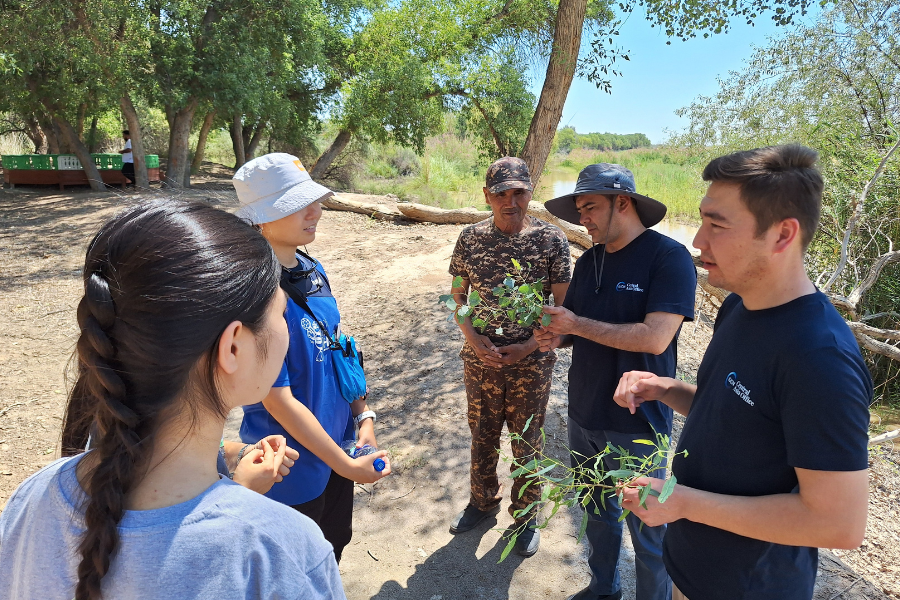
In Kashkadarya, Khorezm and the Republic of Karakalpakstan, local communities are helping turn…
The third in a five-part series, this webinar brought together speakers from across West and…

This week, the Yerevan Municipality hosted the inaugural ceremony marking the establishment of the…