IUCN at the Eighth GEF Assembly
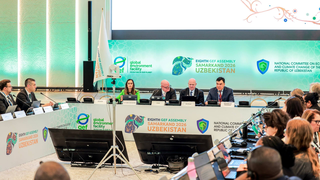
IUCN is participating in the Eighth Global Environment Facility (GEF) Assembly and Associated Meetings, to be held from May 30 to June 6, 2026 in Samarkand, Uzbekistan.
Held once every four years, the Assembly is the highest governing body of the GEF. Ministers, heads of international organisations, business and civil society leaders, and Indigenous Peoples will come together with GEF Implementing Agencies to chart an accelerated path toward global environmental goals.

As a GEF Implementing Agency, IUCN helps countries turn global environmental commitments into action by mobilising funding and harnessing the strength of its unique global network of governments, civil society organisations, Indigenous Peoples’ Organisations, and experts.
Since becoming an accredited GEF Implementing Agency in 2014, IUCN has built a portfolio of 73 approved and active projects worth USD 366.6 million in grants, with a further USD 100 million across 18 projects currently under preparation. Together, these investments are delivering measurable benefits for nature, climate, and people around the world. Through initiatives that strengthen civil society leadership, support Indigenous Peoples-led conservation, and apply science and knowledge tools, IUCN helps ensure that environmental action is inclusive, evidence-based, and transformative.
IUCN will participate in the following engagements at the GEF Assembly to contribute its science, expertise, and global network to the future of GEF investments, as well as share successful conservation initiatives, and advance collaborative solutions for nature and climate.
High-level roundtables
IUCN Director General Grethel Aguilar will participate as a speaker in the following high-level roundtables. See the full Assembly program.
June 4 | 16:00-17.30, (Room: Ballroom): How can the GEF leverage the Conventions and its family of funds to deliver on the 2030 Goals?
June 5 | 9:00-12:00, (Room: Ballroom): Science, Integration, and Systems Transformation
June 5 | 9:00.12:00, (Room: Diamond): Leaving no one behind: civil society, women, and Indigenous Peoples
Side events
IUCN is leading or co-organising the following side events. See the full side event schedule.
June 3 | 17:00-18:00, (Room: Onyx): Panama setting the global decadal agenda for area-based conservation: IUCN World Protected and Conserved Areas Congress 2027
June 4 | 10:00-11:00, (Room: Emerald): The dryland dividend: unlocking finance and synergies across the Rio Conventions for sustainable drylands
June 4 | 12:30-13:30, (Room: Zyrcon): Transforming food systems through regenerative landscapes: a shared outcomes framework for aligning action on policy, finance and environment
June 4 | 14:00-15:00, (Room: Onyx): Regional cooperation for connected landscapes in Central Asia and Eastern Europe under GEF-9
June 4 | 18:30-19:30, (Room: Agate): Whole-of-society approach: Advancing locally-led solutions through innovation, inclusion and partnership
June 4 | 18:30-19:30, (Room: Zyrcon): Scaling mountain ecosystem restoration and biodiversity finance in Central Asia
June 5 | 13:30-14:30, (Room: Ballroom): From protection to prosperity: Enabling conditions for advancing primary forest conservation
June 5 | 15:00-16:00, (Room: Onyx): South‑South and triangular cooperation for biodiversity resilience in LDCs and fragile states in West Africa
June 5 | 15:00-16:00, (Room: Zyrcon): Scaling-up CSO-led environmental solutions for transformational change – Launch of the GEF Small Grants Program CSO Challenge Program
June 5 | 16:30-17:30, (Room: Agate): Indigenous leadership delivering global environmental benefits: scaling impact through GEF-7 and GEF-8 — Pathways to GEF-9
June 5 | 16:30-17:30, (Room: Zyrcon): Powering transformational conservation and accelerating environmental outcomes: Insights from eastern and southern Africa
Learning stations & breakout sessions
June 3 | 9:00-10:15, (Room: Diamond): Strategies to successfully engage the private sector at the global, national and local level
June 3 | 10:30-13:00, (Room: Diamond): Learning Station: Catalysing Nature Systems Transformation through Integrated GEF Approaches
June 5 | 11:30-13:00, (Room: Zyrcon), Breakout Session A: Private Sector Engagement (Collective Action)
Key messages
- The GEF is unique among global environmental funds in its mandate to serve six multilateral environmental agreements, including the three Rio Conventions. This uniquely positions the GEF to catalyse the kind of integrated and transformative action that IUCN delivers through its unparalleled network of state and non-state actors working together for people and nature.
- As a Union that brings together governments, civil society organisations, Indigenous Peoples’ organisations and experts, IUCN is proud to support initiatives that elevate and strengthen the role of civil society organisations in advancing our shared environmental goals. These include the new GEF SGP Civil Society Organisation Challenge Program, providing direct grants to outstanding civil society-led conservation initiatives.
- IUCN recognises that Indigenous Peoples are among the world’s most effective stewards of nature, with generations of knowledge, practices and governance systems that have sustained ecosystems and biodiversity over centuries. Through partnerships, inclusive governance and direct support to Indigenous-led initiatives, IUCN works to ensure that conservation delivers lasting benefits for both people and nature, as in the GEF Inclusive Conservation Initiative supporting Indigenous Peoples-led conservation in 12 countries.
- IUCN believes that lasting conservation outcomes depend upon decisions grounded in science. IUCN’s flagship science-based tools – including the IUCN Red List of Threatened SpeciesTM and the IUCN Global Standards for Nature-based Solutions – help guide investments, policies and conservation action toward a more sustainable and resilient future.