February 28
COP 15 is over, now what? Translating the Kunming-Montreal Global Biodiversity Framework
 After a global pandemic and 4 years of negotiations and consultations, Parties adopted the Kunming-Montreal Global Biodiversity Framework (KM-GBF) as part of a ‘package’ of 6 decisions to support its implementation, including decisions on the monitoring framework, capacity building, resource mobilisation, planning monitoring and review, and digital sequence information (DSI). The time now is for implementation. The IUCN Programme, Nature 2030, sets its ambition in a decadal timeframe (2021 – 2030) and provides a roadmap for the Union that significantly contributes to the Goals and Targets set in the KM-GBF.
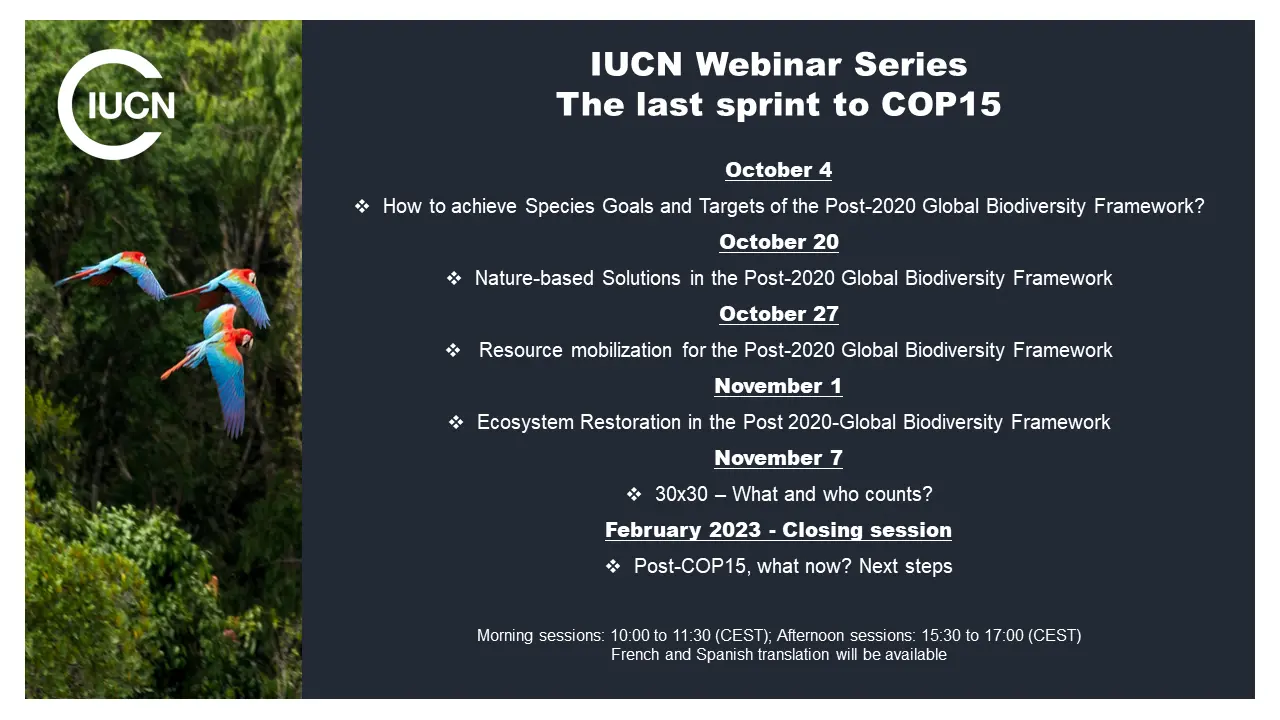
This event, the last of the series “The last sprint to COP15”, will provide participants IUCN’s take on the new framework, highlight how the IUCN Programme and tools contribute to its implementation. IUCN experts will discuss some ongoing work and future plans for reaching Targets closest to IUCN’s heartland.
Agenda
- The Kunming-Montreal Global Biodiversity Framework : IUCN’s take - Sonia Peña Moreno, Director, International Policy Centre
- How can IUCN’s Programme and tools contribute to the implementation of the GBF
- Nature 2030 and IUCN Resolutions - Victoria Romero, Policy Officer, Biodiversity
- Spatial planning and Restoration (targets 1 and 2) - Marcos Valderrabano, Programme Manager, Red List of Ecosystems
- 30 x 30 (target 3) - Swati Hingorani, 30x30 coordinator and Stephen Woodley, Thematic Vice Chair, Science and Biodiversity Policy
- Species targets (targets 4, 5 and 6) - Dao Nguyen, Senior Advisor, Species Conservation Policy
- Nature based Solutions (targets 8 and 11) Veronica Ruiz, Programme Manager, EcoDRR
- Contributions for Nature Platform - Laure Denos, Senior Science Policy Expert
- Q&A / Discussion - moderated by Céline Preitner
- Closing Remarks - Sonia Peña Moreno, Director, International Policy Centre
 IUCN explained the species components of Goal A, and Targets 4, 5, 6 (and 9). Experts also presented how the
  In preparation for the fifteenth meeting of the Conference of the Parties to the Convention on Biological Diversity (CBD COP15), IUCN aims to raise greater awareness and understanding of NbS and its potential to protect and restore biodiversity and deliver ecosystem services. This event provided a briefing on the concept, application and policy uptake of NbS and discuss opportunities and concerns. Experts and government representatives from IUCN State Members will share their experience and discuss the relevance of NbS to the GBF, specifically supporting countries in reaching Targets 8 and 11.
 How will we fund the implementation of the Post-2020 Global Biodiversity Framework? This webinar explores existing and possible new mechanisms to understand different options to solve this critical issue. IUCN will explain the resource mobilization components of the post-2020 Global Biodiversity Framework, including Target 18 on reforming harmful subsidies and other incentives for biodiversity and Target 19 on domestic and international financial resources.
 There is a lot at stake at COP15: the post-2020 Global Biodiversity Framework (GBF) should lead the world towards becoming nature-positive by 2030 and restoration of degraded ecosystems is crucial to reverse nature loss.
  Fairly governed and effectively managed protected and conserved areas are essential for biodiversity conservation and human well-being. They can also help mitigate and adapt to the impacts of climate change. Indigenous peoples’ dedicated lands and territories are proven as particularly effective in preserving biodiversity, landscape integrity, and maintaining unique cultures and knowledge.