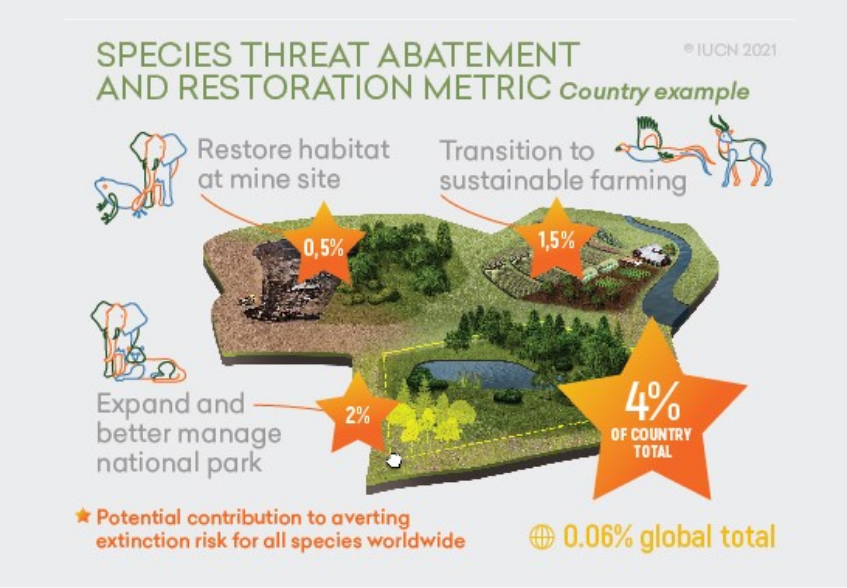
The Species Threat Abatement and Restoration (STAR) metric is a science-based tool designed to measure, in a spatially explicit way, the reduction in species global extinction risk that could be achieved through conservation actions (threat abatement and habitat restoration).

Towards delivery of rapid, high integrity, nature-positive outcomes 

Drawing from the comprehensive global species assessments provided through the IUCN Red List of Threatened Species™, IUCN along with 60 conservation organisations derives the Species Threat Abatement and Restoration (STAR) metric, which enables governments, businesses and civil society organizations to assess their contributions toward global goals for reducing species extinction risk through specific actions in specific places. 

STAR is based on global Red List data and identifies potential opportunities for threat abatement and restoration; where possible (Mair et al. 2021), these estimates can be further refined through local calibration using verified species and threat information (see case study: Mair et al. 2026b). Mair et al. (2026b) (Submitted / Accepted) proposes a conceptual framework for the implementation of the Species Threat Abatement & Restoration metric’s threat abatement component.

STAR is available through the Integrated Biodiversity Assessment Tool (IBAT). There are available guidance for private sector, governments, and civil society organisations. In addition, STAR is a core component of IUCN’s Rapid High-Integrity Nature-positive Outcomes (RHINO) approach, which provides a broader framework and technical guidance for setting robust, science-based biodiversity targets and implementing verifiable actions for species and ecosystems.

Methods are also being developed to complement species-focused STAR analyses with information from the IUCN Red List of Ecosystems, as well as to support the application of STAR across value chains and broader nature-positive implementation frameworks.

More information about STAR can be found here.


IUCN Flagship Report Series - Agriculture and conservation: living nature in a globalised world

The IUCN Flagship Report Series was launched in 2021 to demonstrate the importance of conserving nature for human well-being and all life on Earth, bringing nature conservation into mainstream political and economic decision-making. The report is available in English and Arabic.

Biodiversity and agriculture in the Mediterranean region: a species conservation perspective

This report identifies the potential opportunities to reduce regional species extinction risk through abatement of agricultural threats in the Mediterranean. 

BIODEV2030

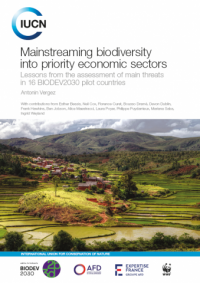
In the BIODEV2030 project, implemented in 16 countries, the STAR metric has been applied to identify and rank main threats to biodiversity at national level, relying on the IUCN Classification of threats v3.3 (IUCN Red List of Threatened Species) Agricultural practices are in most countries linked with these threats. This science-based step allowed to lay robust foundation for sectoral policy reforms, notably in the agricultural sector. 

Sustainable agricultural practices and the STAR metric

A methodological exploration of the feasibility of reflecting more sustainable agricultural practices (for example the ones listed in Oberc and Arroyo (2020)) into lower Estimated STAR scores has been conducted. It proposes a methodological pathway forward to do so. This would allow to assess at different scales (from global to local) the potential of adopting more sustainable agricultural practices into a reduction of species’ global extinction risk. 

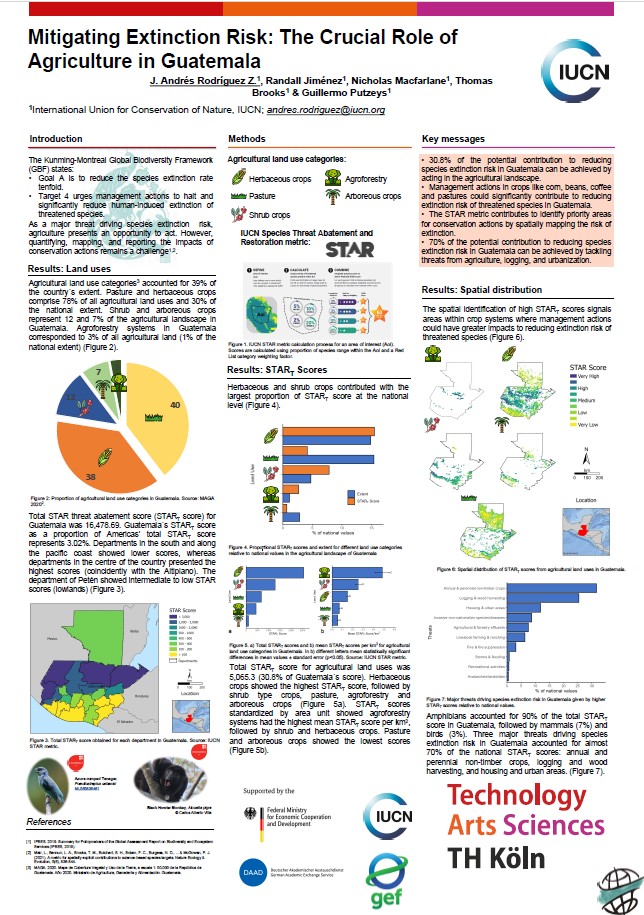
Mitigating Extinction Risk: The Crucial Role of Agriculture in Guatemala

A study analyses the role that agriculture can play in reducing species extinction risk in Guatemala. 

Find out more by downloading the factsheet: Mitigating Extinction Risk: The Crucial Role of Agriculture in Guatemala

Calibrating the STAR metric on the ground
Other additional work