What is it?
The regenerative Blue Economy is an emerging concept of an economic model that actively protects and restores marine and coastal ecosystems whilst benefitting society. Based on IUCN’s work, a proposed definition of a Regenerative Blue Economy is “an economic model that combines rigorous and effective regeneration and protection of the ocean and marine and coastal ecosystems with sustainable, low or no-carbon economic activities, ensuring fair prosperity for people and the planet, now and in the future”.
The ocean supports over 3 billion people and contributes $2.6 trillion annually to the global economy (OECD 2025). Yet, economic activities in marine and coastal areas, known as the Blue Economy, have traditionally prioritised economic growth over sustainability. This has often led to resource overexploitation and marginalised vulnerable communities, particularly in Small Island Developing States.
Marine ecosystems are facing severe threats, largely induced by human activities. Every day, between 9 and 14 million metric tons of plastic enter the ocean (UNEP 2021). A third of global fish stocks are overfished (FAO 2024), while approximately 50% of mangroves and 30% of wetlands have been lost due to habitat destruction (IPBES 2025). Warmer temperatures are causing ocean acidification, with up to 99% of corals at risk under a 2°C warming scenario (IPCC 2019).
Offering an alternative to the business-as-usual model of the “brown” Blue Economy and going beyond the “sustainable” Blue Economy model, which seeks to reduce the environmental impact of traditional maritime sectors, a Regenerative Blue Economy aims for the highest level of sustainability. It presents a shift from exploitation to conservation, promoting restoration and revitalisation, while restricting activities deemed incompatible with climate and biodiversity goals, such as oil exploration and deep-sea mining.
Five founding principles underpin the IUCN Regenerative Blue Economy definition:
• protecting, restoring and regenerating marine and coastal ecosystems;
• creating an innovative, inclusive, equitable and solidarity-based economic model;
• adopting inclusive and transparent governance;
• decarbonising activities while generating positive impacts on ecosystems and advancing circular economy; and
• acting for and with island states, Indigenous Peoples and coastal communities.
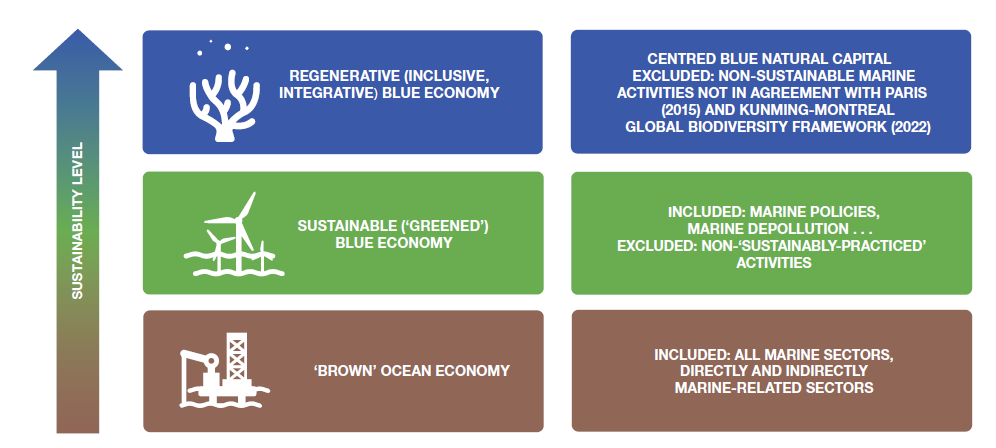
Possible sectors and scope of the Blue Economy, sustainable Blue Economy and Regenerative Blue Economy. Source: IUCN