SADC, IUCN, and BirdLife Africa launch regional vulture conservation strategy
Johannesburg, South Africa, 1 September 2025 – The Southern African Development Community (SADC), the International Union for Conservation of Nature (IUCN), and BirdLife Africa convened a regional workshop to initiate implementation of the newly endorsed SADC Vulture Conservation Strategy and Action Plan (2025–2035). The gathering brought together representatives from SADC Member States, conservation partners, and technical experts to address the severe decline in vulture populations across the region, driven by poisoning, collision and electrocution by energy infrastructure, and habitat loss among other factors.
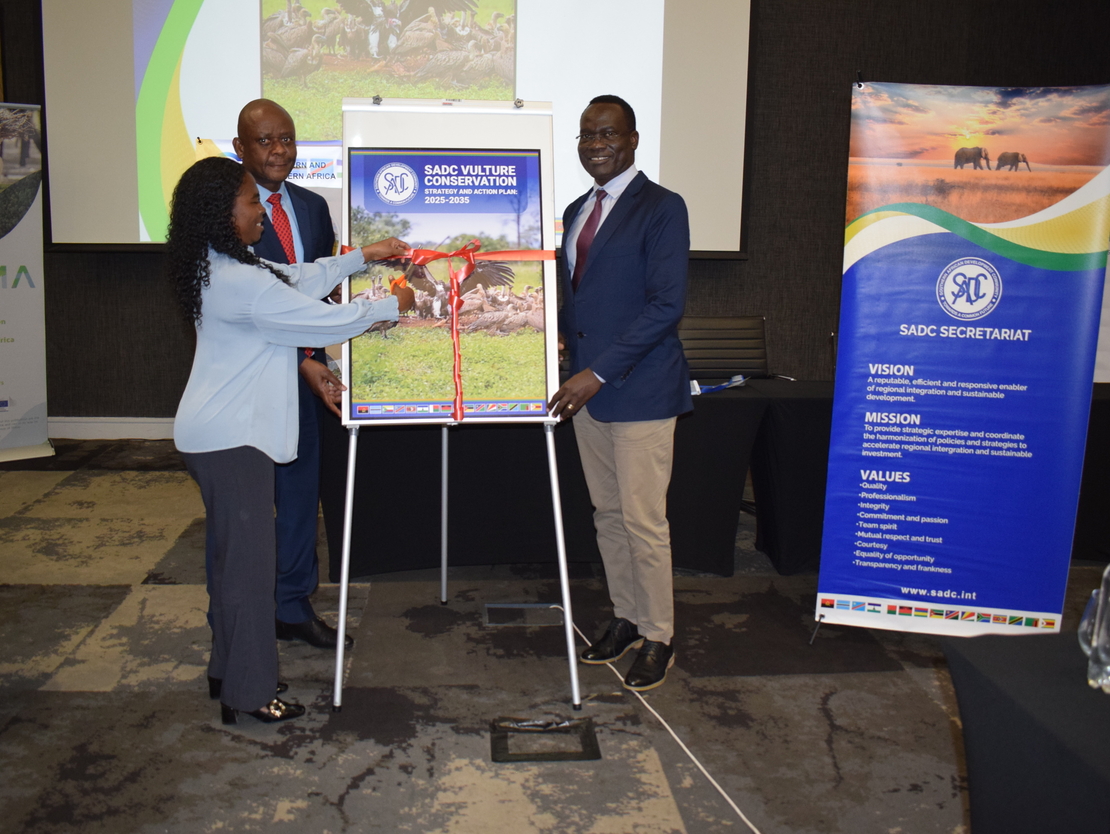
The recently approved Strategy represents a comprehensive regional framework developed through an evidence-based, collaborative process that builds upon existing national and international commitments. These include the Convention on Migratory Species Multi-species Action Plan to Conserve African-Eurasian Vultures, various National Biodiversity Strategies and Action Plans, and the Kunming-Montreal Global Biodiversity Framework.
The workshop served as a platform to officially launch the Strategy and deepen understanding of its four foundational pillars: threat reduction, enhanced data collection and conservation measures, stakeholder engagement, and implementation mechanisms. Participants engaged in detailed discussions on reversing vulture mortality trends and restoring critical habitats through coordinated regional action.
"We extend our gratitude to our esteemed partners and to South Africa for hosting this important workshop. The SADC vulture conservation strategy is a milestone that highlights the urgency of our mission. Vultures are not just birds; they are an important part of our ecosystem, and their rapid decline is a silent alarm for the health of our environment. The adoption of this strategy is a great achievement, and I urge all Member States to commit to its implementation. SADC's role will be to mobilize the necessary resources, ensuring this isn't just a plan on paper but a movement that safeguards our ecosystems for generations to come," stated Domingos Gove, the Director of the Food, Agriculture and Natural Resources (FANR) Directorate at the Southern Africa Development Community (SADC).
"A strategy on paper will not save our vultures. We need to turn political will into tangible action and resources. It is a call to all sectors from government to agriculture, to act decisively and preserve our ecosystems for future generations," said Attale Ravaoarimalala, representing Madagascar as the current SADC Chair.
"South Africa is honored to welcome all participants to this workshop. The launch of the SADC Vulture Conservation Strategy presents a crucial opportunity for collective action to address the significant threats these magnificent birds face from poisoning to electrocution and collision with energy infrastructure. Vultures know no boundaries, and neither should our efforts to protect them. By working together, we can ensure a future where both people and nature thrive," stated Mukondi Matshusa from South Africa's Department of Forestry, Fisheries and the Environment.
"Building on our long-standing partnership with SADC, IUCN has worked with BirdLife, CMS, and BIOPAMA to create a key strategy that provides regional guidance for vulture conservation. This initiative supports ongoing work through the SADC Transfrontier Conservation Areas Programme and has already advanced new partnerships to secure the technical and financial support needed for success," noted Luther Anukur, IUCN Eastern and Southern Africa Regional Office Regional Director.
“Across Africa, the decline of vulture populations is indeed worrying. The launch of the SADC vulture conservation strategy is indeed timely, coming on the heels of a groundbreaking study by BirdLife which highlights the value of ecosystems services provided by vultures in the Southern Africa region, worth USD 1.8 billion per year. BirdLife will continue to collaborate with partners and stakeholders to advance conservation efforts in the region”, said Dr Kariuki Ndang’ang’a, Regional Director for Africa, BirdLife International.
During the workshop, member states present, presented their commitments on the SADC Vulture Strategy. Additionally, the workshop achieved several key outcomes, including establishing a shared understanding of the implementation roadmap, forming agreement on the structure and mandate of a Regional Vulture Strategy Steering Group, and strengthening alignment between national conservation plans and the regional Strategy. Participants also developed clear next steps and timelines for both national and regional implementation activities.
Vultures play an important role in maintaining healthy ecosystems across Southern Africa, and their conservation represents both an ecological imperative and a regional priority for sustainable development.
Notes for the editor:
SADC in brief
SADC is an organisation of 16 Member States established in 1980 as the Southern African Development Coordinating Conference (SADCC) and later, in August,1992 transformed into the Southern African Development Community (SADC). The mission of SADC is to promote sustainable and equitable economic growth and socio-economic development through efficient, productive systems, deeper cooperation and integration, good governance and durable peace and security; so that the region emerges as a competitive and effective player in international relations and the world economy. Member States are Angola, Botswana, Comoros, Democratic Republic of Congo, Eswatini, Lesotho, Madagascar, Malawi, Mauritius, Mozambique, Namibia, Seychelles, South Africa, United Republic of Tanzania, Zambia, and Zimbabwe.
About IUCN
IUCN is a membership Union uniquely composed of both government and civil society organisations. It provides public, private and non-governmental organisations with the knowledge and tools that enable human progress, economic development and nature conservation to take place together.
Created in 1948, IUCN is now the world’s largest and most diverse environmental network, harnessing the knowledge, resources and reach of more than 1,400 Member organisations and around 17,000 experts. It is a leading provider of conservation data, assessments and analysis. Its broad membership enables IUCN to fill the role of incubator and trusted repository of best practices, tools and international standards.
IUCN provides a neutral space in which diverse stakeholders including governments, NGOs, scientists, businesses, local communities, Indigenous Peoples’ organisations and others can work together to forge and implement solutions to environmental challenges and achieve sustainable development.
Working with many partners and supporters, IUCN implements a large and diverse portfolio of conservation projects worldwide. Combining the latest science with the traditional knowledge of local communities, these projects work to reverse habitat loss, restore ecosystems and improve people’s well-being. www.iucn.org
About BirdLife
BirdLife International is the only global Partnership conserving birds and all life on our planet. We exist to give one voice to nature, and to unite and strengthen conservation across borders. We’re made up of over 120 worldwide conservation organisations and a Global Team. We work side by side, tackling some of the natural world’s most pressing issues. Together, we are the global authority on birds. We have regional offices in Amman, Brussels, Cambridge, Dakar, Nairobi, New York, Quito, São Tomé and Príncipe, Singapore, Suva and Tokyo and more than 13 million individual members and supporters. Find out more at: www.birdlife.org/how-we-work
Media contacts:
SADC Secretariat - Ms. Barbara Lopi, Head of Communication and Public Relations, SADC Secretariat [email protected] and cc to [email protected]
IUCN ESARO - Ng’endo Machua, Regional Communications Officer, IUCN Eastern and Southern Africa region – [email protected]
BirdLife Africa - Lewis Kihumba, Communications Manager, BirdLife Africa, [email protected]

The Bangladesh Forest Department (BFD) and IUCN Bangladesh, with support from Agence Française de…

Each year, International Women's Day is an opportunity to recognise the women advancing change in…

On 14 January 2026, in Dhaka, the Bangladesh Forest Department and IUCN Bangladesh formally signed…