IUCN launches new publication on agricultural support, biodiversity, and trade
Abu Dhabi, United Arab Emirates, 11 October 2025 (IUCN) – Today at the IUCN World Conservation Congress 2025, IUCN launched a new publication, titled “Agricultural support, biodiversity, and trade: Examining connections to repurpose harmful incentives,” which presented new findings on linkages between biodiversity trends and agricultural subsidies across multiple countries.
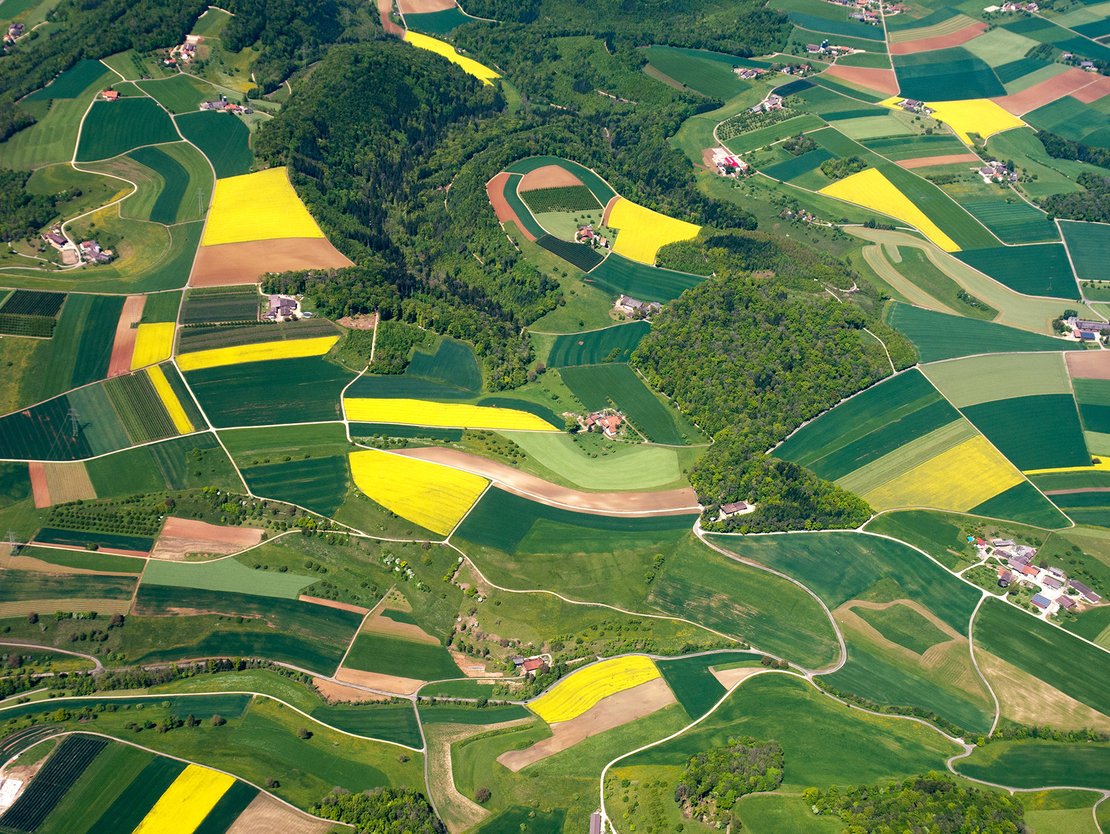
Agricultural landscape in Aargau, Switzerland
The publication was launched today at a “Hot Off the Press” Forum event at the IUCN World Conservation Congress 2025, where experts and economists from IUCN convened to present findings from the publication and discuss correlations between support to agricultural producers and threatened species.
The publication explores recent trends in agricultural support, agricultural threats to species, aiming to answer questions like, “What do we know about the relationships between support to agricultural producers, trade distortion and threats to species? How can incentives be reshaped to be more biodiversity-friendly?” The results found by the authors were striking: the correlation between the level of support to agricultural producers per hectare of agricultural land and number of species threatened by agriculture per hectare of country area is positive and statistically highly significant.
The publication’s findings are consistent with existing literature, demonstrating how agriculture is one of the largest drivers of land use change and species decline globally:
Agricultural policies and trade agreements have shaped agricultural production and productivity over the last several decades, helping countries make progress towards improved food security and other social goals such as poverty alleviation. At the same time, agriculture has emerged as one of the leading threats to nature, in part driven by the same policies that have encouraged increased intensity and geographic extent of agricultural production. The numbers speak for themselves: about 37% of the world’s land area is devoted to agriculture and no fewer than 34% of species assessed on the IUCN Red List of Threatened Species have agriculture documented as a threat.
However, the publication makes it clear that agriculture, food security, and the integrity of nature are not inherently in tension. In fact, the opposite is true: agricultural productivity is highly dependent on ecosystem services, including pollination, soil formation, water provision, and genetic diversity. Without intact ecosystem services, the agricultural sector is at risk, and subsequently, so is the food security of the global population. Therefore, the publication concludes, agricultural policies need to go beyond exclusively considering traditional indicators like agricultural output, trade distortion or economic productivity—they must also consider nature and ecosystem services. By doing so, agriculture can meet the food security and socioeconomic needs of people without sacrificing biodiversity, land health, or climate.
The findings are relevant not only to the studied countries, but to global sustainability goals. For example, Target 18 of the Kunming-Montreal Global Biodiversity Framework (KM-GBF) aims to identify, eliminate, phase out or reform incentives, including subsidies, harmful for biodiversity, by at least US $500 billion per year by 2030. The publication points out that by repurposing harmful agricultural incentives, Parties to the United Nations Convention on Biological Diversity (CBD) would make major strides towards achieving Target 18 while also contributing to progressively closing the US $700 billion per year financing gap for biodiversity, supporting KM-GBF Target 19 and Goal D in the process. In other words, eliminating harmful subsidies and perverse incentives in agricultural policy has immense potential to improve the status of biodiversity worldwide and enable countries to meet their commitments under the CBD.
“It is only by decoupling food systems from the degradation of nature that we can hope to halt the loss of biodiversity by 2030 and achieve recovery and restoration by 2050. We need to mainstream biodiversity into agricultural policies to encourage more sustainable production practices,” said Antonin Vergez, Senior Economist at IUCN and lead author on the paper. “In addition, repurposing harmful incentives is a crucial lever for biodiversity funding. The political economy of repurposing harmful incentives is a an under-studied and often overlooked challenge. I invite researchers, farmers, NGOs and policy-makers to harness this challenge to find the right pathways to better align agricultural policies with biodiversity at national or regional level.”
The full publication is available online through the IUCN Library.
Acknowledgements
The authors wish to thank the Australian Permanent Mission at World Trade Organization and the Agence Française de Développement under the France-IUCN Partnership for their support.
Disclaimer
The views expressed in this work do not necessarily reflect those of IUCN, Australian Department of Foreign Affairs and Trade, Agence Française de Développement, or other participating or supporting organisations.

The Bangladesh Forest Department (BFD) and IUCN Bangladesh, with support from Agence Française de…

Each year, International Women's Day is an opportunity to recognise the women advancing change in…

On 14 January 2026, in Dhaka, the Bangladesh Forest Department and IUCN Bangladesh formally signed…