People of the Oceans Breakthrough: Landmark Step for Indigenous Leadership at IUCN World Conservation Congress
The “People of the Oceans Breakthrough” session, organised by the ReSea initiative, brought together Indigenous Peoples, local communities, government, and supporting organizations from around the world to chart a collective path forward for ocean-climate action. Held in a dynamic, interactive fishbowl format, the discussion marked a pivotal step toward shaping a People of the Oceans Breakthrough - a shared vision to ensure that Indigenous and local coastal peoples’ knowledge, rights, and leadership anchor the global ocean agenda.
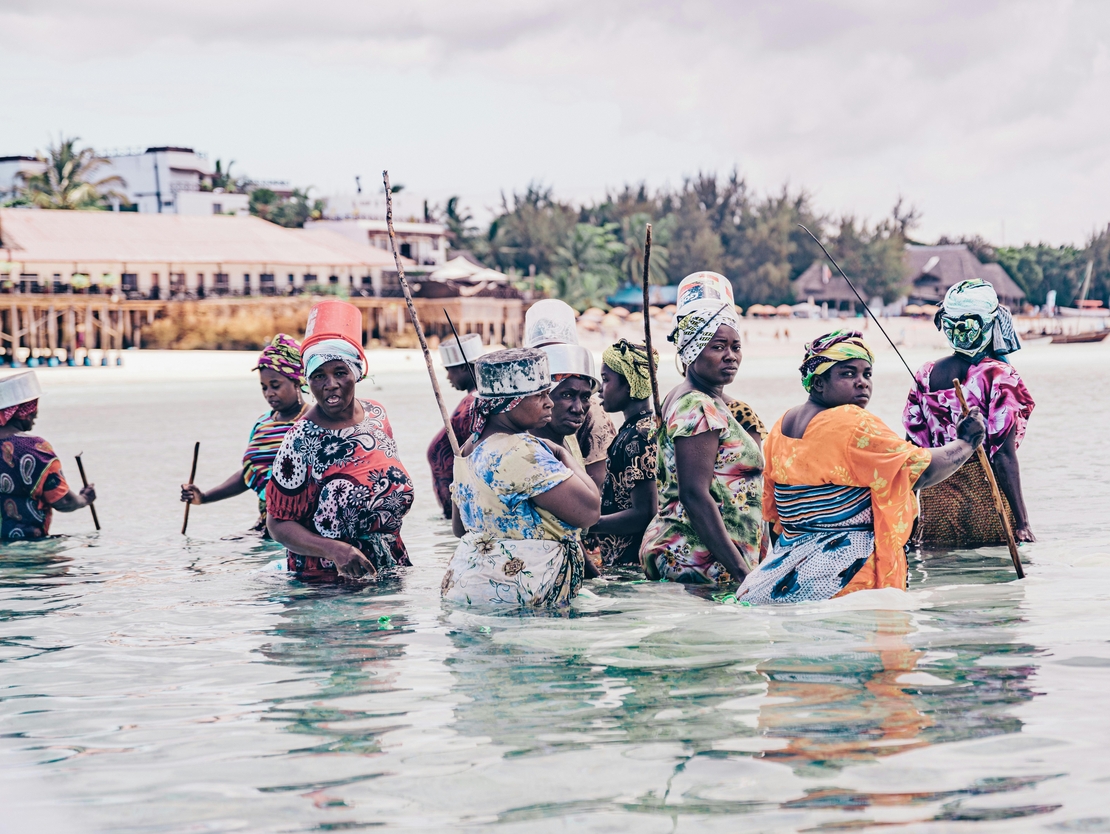
12 October 2025 | IUCN World Conservation Congress | Abu Dhabi, UAE
Setting the Tone: Voices and Song
The session opened with the voices of the ocean performed by Kevin Chang (Kuaʻāina Ulu ʻAuamo (KUA)) from Hawai‘i performing a song celebrating the deep connection between people, culture, and the ocean. The melody set a reflective and powerful tone for a conversation rooted in relationship and reciprocity.
In opening remarks, Thomas Sberna and Vatosoa Rakotondrazafy (both IUCN) called for a coordinated ocean-climate community that moves “from commitment to implementation” - with People of the Ocean at the centre. “Local stakeholders are best placed to drive forward this agenda. The Ocean Breakthrough must be informed by and developed for Indigenous Peoples and Local Communities.” – Thomas Sberna.
“We have the Ocean Breakthrough, the Mangrove Breakthrough, and soon the Seagrass Breakthrough, but none of these can be truly effective without the local heroes of the ocean. That is where the People of the Ocean was born.” - Vatosoa Rakotondrazafy
Recognizing Ocean Peoples’ Governance and Rights
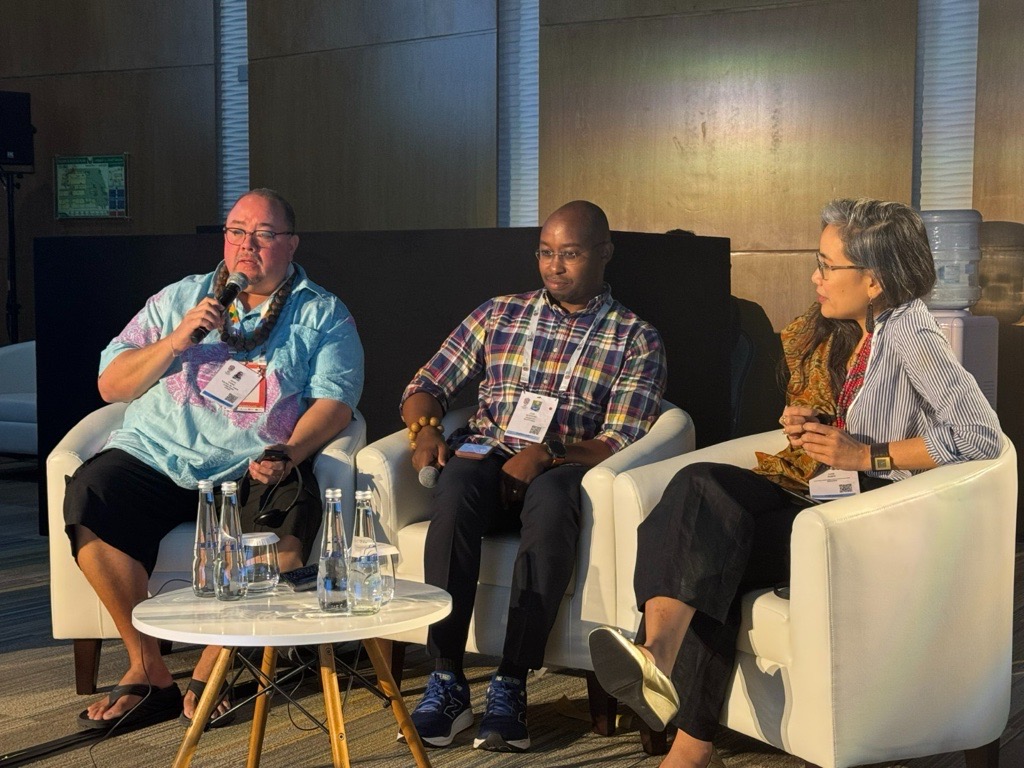
The first fishbowl discussion, moderated by Pamela Castillo (Wildlife Conservation Society), explored how Indigenous governance systems and territories can be recognized within international frameworks such as the 30x30 target and OECMs (Other Effective Area-Based Conservation Measures).
June Rubis (ICCA [territories and areas conserved by indigenous peoples and local communities] Consortium) framed the discussion by reminding participants that for many coastal Indigenous Peoples, “the ocean is not a separate territory.” Governance, she said, is not about ‘management’, but “about care and relationships.”
“IPLCs (Indigenous Peoples and Local Communities) are visible as stakeholders, but invisible as caretakers.” – June Rubis
Panelists emphasized that strong customary governance is already in place across many ocean territories. The challenge lies in recognition, not re-invention.
“IPLC-led conservation doesn’t start with international frameworks. It starts with villages and ongoing systems and cultures.” – Alifereti Tawake, LMMA (Locally-Managed Marine Area) International Network. Remmy Safari (Oceans Alive Foundation, Kenya) underscored the need to go beyond token inclusion: “It’s not just about giving communities a seat at the table – it’s about giving them a voice and recognizing their actions.”
“With good, strong governance systems, 80% of the problems will be solved. What we need to add is good management.” – Jose Monteiro, ReGeCom (Representative & Effective Community Conservation), Mozambique.

From Recognition to Action: Inclusive Pathways for 30x30
A recurring message was that government-led Marine Protected Areas (MPAs) alone cannot achieve global targets.
Speakers advocated for IPLC-led and co-managed marine areas to count toward conservation goals, and for stronger legal recognition of customary tenure and decision-making power.
“How will governments deliver 30x30 without working with their people? … Ultimately, it’s about building an aspect of our economy that supports our people to stay in its place and care for it,” – Kevin Chang (Kuaʻāina Ulu ʻAuamo (KUA)).
June Rubis noted that at the UN Convention on Biological Diversity (CBD) level, more inclusive definitions under 30x30 would be beneficial, with indicators that reflect self-determination, gender equity, and traditional governance - not just biodiversity data.
In a call to action, Thomas Sberna noted that the People of the Ocean have a great opportunity: “People of the Ocean have the opportunity to claim the ocean as theirs - as it is. Anyone can apply for OECMs if they meet the criteria.”

Direct Access to Finance and Women’s Leadership
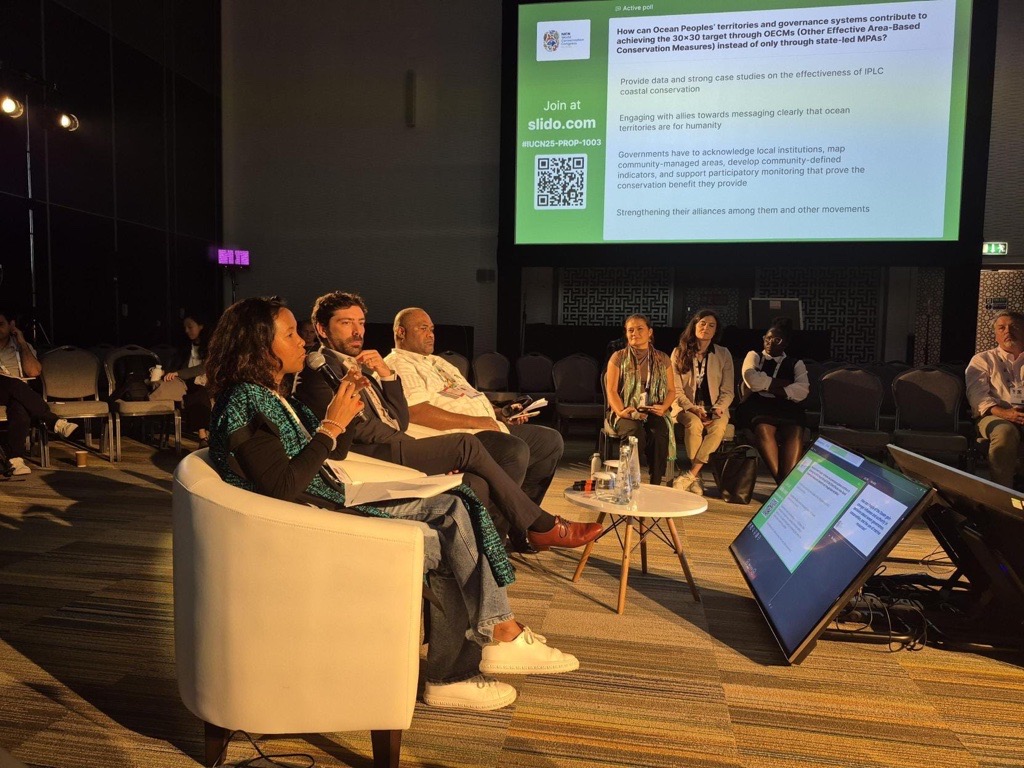
The second fishbowl session centred on enabling direct access to finance, well-being, and leadership capacity, with a particular focus on Indigenous women and youth.
Sara Omi (Indigenous Expert, Emberá) opened with a powerful framing statement on the intersection of gender, territory, and justice: “Women are seen as vulnerable, but they are on the frontline of action. Access to finance for Indigenous women is key - and this must be linked to recognition of their rights.”
Participants highlighted how systemic barriers - such as land tenure inequalities - exclude women from decision-making and funding opportunities. They called for reforms to ensure that climate finance reaches community institutions directly and flexibly.
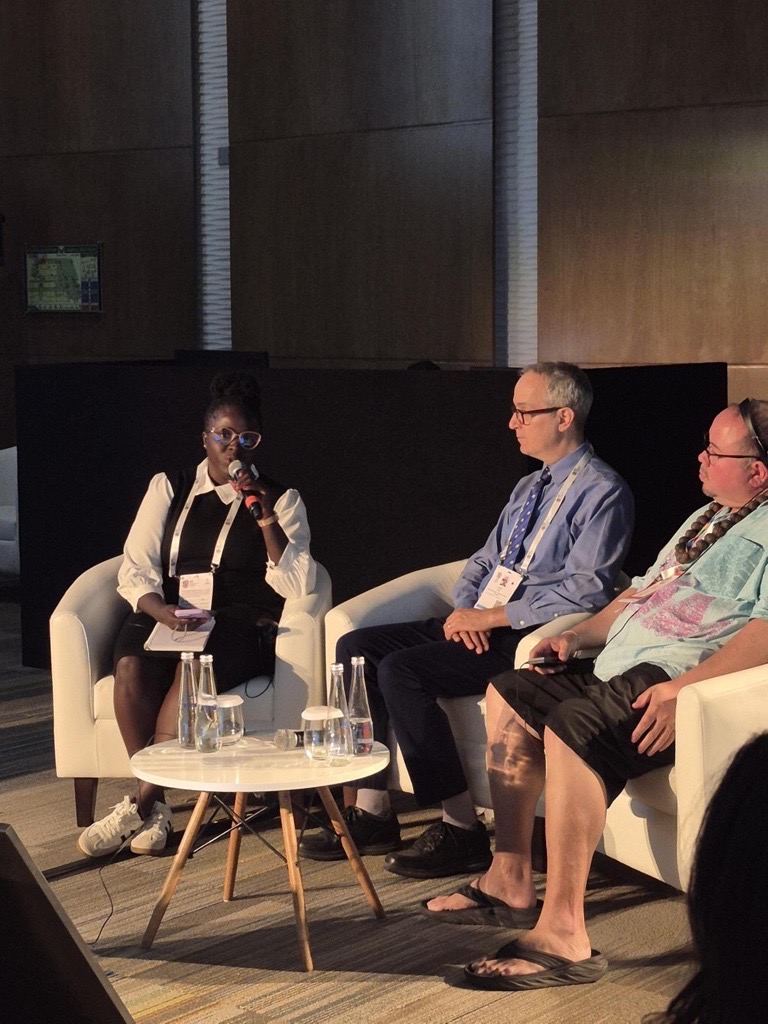
“When we talk about direct access, it is important to start understanding not from the Global North. We need to think about what we want to invest in as the Global South.” – Audience participant.
Kerry Max (Global Affairs Canada) joined the fishbowl to share an example from Canada on how the government is delivering funding to indigenous organisations, as well as the continued challenges of balancing donor rules and safeguards and the need for flexible funding.
An audience participant also outlined how Indigenous Peoples groups need to talk in the language of mitigation and adaptation when accessing funding – to translate the work community groups are already doing to international targets. “People of the Ocean already have the knowledge. They have mangroves and corals - they want to invest in these.” - Participant reflection
Magdalyne Were (Mission Inclusion) noted the importance of transparency and shared information: “Governments must strengthen information sharing with communities to encourage access, and donors must fund according to local needs.”
Emerging Priorities
By the end of the session, participants had co-identified priority areas for the People of the Oceans Breakthrough:
- Recognition and Rights – Direct acknowledgment of IPLC governance and customary marine territories.
- Direct Access to Finance – Flexible and just funding models that empower local communities and women.
- Knowledge and Capacity – Strengthening community-led science, monitoring, and traditional knowledge systems.
- Leadership and Representation – Ensuring IPLCs lead in ocean governance at national and international levels.
- Well-being and Livelihoods – Building regenerative blue economies that sustain culture and nature together.
“Governance of the Ocean Peoples needs to be recognized by governments – being recognized and respected as a first step.” – Closing reflection
Looking Ahead: A Historic Moment
As Vatosoa Rakotondrazafy concluded, the 12th of October marked “a historical moment — the beginning of the People of the Oceans Breakthrough, a movement where all friends of marine IPLCs are welcome to join and support.”
Participants agreed to continue shaping this collective agenda through shared platforms such as CBD COP16, and the UN Decade of Ocean Science.
For more information or to contribute to the People of the Oceans Breakthrough, contact:
📧 [email protected]
🌐 https://iucncongress2025.org/programme/people-oceans-breakthrough-identifying-key-priorities-ocean-peoples-climate-action
What is ReSea?
The Regenerative Seascapes for People, Climate & Nature (ReSea) project is a response to increasing vulnerabilities in the marine and coastal ecosystems of the Western Indian Ocean due to climate change, biodiversity loss, urbanization and population growth, among others. Implemented in partnership between IUCN and Mission Inclusion, and supported by Global Affairs Canada; ReSea promotes Nature-based Solutions for Climate Adaptation in a coastal network of regenerative seascapes to enhance climate resilience and stimulate gender-responsive socio-economic development of coastal communities.


The Bangladesh Forest Department (BFD) and IUCN Bangladesh, with support from Agence Française de…

Each year, International Women's Day is an opportunity to recognise the women advancing change in…

On 14 January 2026, in Dhaka, the Bangladesh Forest Department and IUCN Bangladesh formally signed…