Supporting biodiversity and livelihoods in transboundary World Heritage sites in Africa
IUCN is inviting proposals to scale up green economy solutions that generate sustainable livelihoods while strengthening conservation outcomes in selected Transfrontier Conservation Areas in Southern Africa which includes several World Heritage sites.
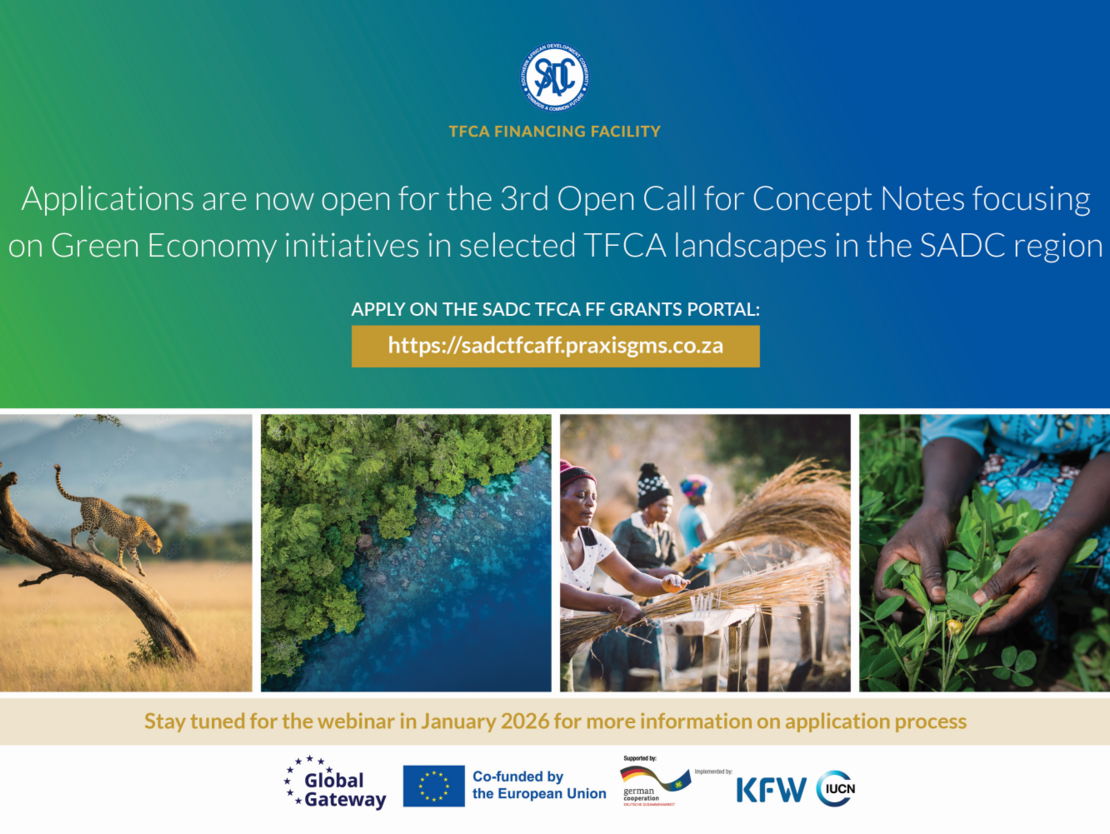
The SADC TFCA Financing Facility is a financing mechanism that provides sustainable funding for conservation and management actions in support of the SADC TFCA programme, supported by the German Government (€44 million, KfW and BMV) as well as the European Union (€10 million, NaturAfrica).
The primary objective of the latest call is to achieve sustainable economic benefits that contribute to landscape sustainability while enabling the achievement of conservation goals in six of the 12 Transfrontier Conservation Areas (TFCAs), including two that overlap with World Heritage sites for which IUCN just released its latest conservation outlook assessments and recommendations:
- Kavango Zambezi:
- ǂKhomani Cultural Landscape
Grants will range from a minimum of EUR 300 000 to a maximum of EUR 950 000, with at least 10% co-financing required, and support transboundary projects.
=> Apply here (deadline 31 March 2026) <=
As of December 2025, the Transfrontier Conservation Areas recognized by the Southern African Development Community (SADC) include at least 10 sites recognized on the UNESCO World Heritage List both for their cultural and natural values, including iSimangaliso Wetland Park – Maputo National Park, Barberton Makhonjwa Mountains, Tsodilo and the Richtersveld Cultural and Botanical Landscape. Collectively these sites protect some of Africa’s most iconic wildlife, but also some of the highest concentrations of rock art in the world. While most of them are not transboundary, their effective management often requires transboundary coordination, including for the conservation of ecological corridors, as highlighted in the 2025 IUCN World Heritage Outlook.
To date, the SADC TFCA Financing Facility has supported the following transboundary World Heritage landscapes:
Maloti-Drakensberg Park (Lesotho/South Arica): 65 rangers and environmental monitors trained on human rights and law enforcement, employment of community environmental monitors, equipment (vehicle, binoculars, GPS, tents for rangers), fire control operations, clearance of invasive alien plants, and 60 temporary workers for creation of fire belts (World Heritage info; project info). Upgrading eco-tourism facilities along the Giants Cup 5-Day Hiking Trail.
Maputo National Park (Mozambique): improving tourism facilities, community-led maintenance of 150km of fences to avoid elephant-human conflicts (World Heritage info; project info).
Selous Game Reserve (Tanzania): strengthen protection of wildlife corridors managed by local communities, purchase of drones, construction of ranger outputs and water reservoir (World Heritage info; project info).
About the SADC TFCA Financing Facility (TFCA FF)
The SADC TFCA Financing Facility (TFCA FF) is a regional financing mechanism established to provide sustainable funding for conservation and management actions in Transfrontier Conservation Areas (TFCAs) in the Southern African Development Community (SADC). The Financing Facility was established to become a flexible, responsive, demand and performance driven financing mechanism, with the unique purpose of supporting the establishment and sustainable development of TFCAs. The Federal Ministry for Economic Cooperation and Development (BMZ) of the German Government, through KfW Development Bank, provided initial funding for establishment of the TFCA Financing Facility. The long-term vision is for the TFCA Financing Facility to be funded by several international cooperating partners and other innovative financing models to reach an initial resource mobilisation target of EUR 100 million by 2026. The International Union for Conservation of Nature (IUCN) is the Project Executing Agency (PEA) for the TFCA Financing Facility through its IUCN Eastern and Southern Africa Regional Office.
About IUCN and the World Heritage Convention
Since the inception of the World Heritage Convention in 1972, IUCN has played a unique role as the official advisory body under the World Heritage Convention on natural World Heritage. This involves leading the technical recommendation of all new nominations of natural and mixed World Heritage sites, monitoring the status of existing natural and mixed World Heritage sites and the newly added Preliminary Assessment process to provide direct advice on the feasibility of potential nominations to state parties.
IUCN also works independently on the Convention to support World Heritage sites globally though our extensive network of programmes and policies led though our central Secretariat team, our expert commissions, and our member organisations.
Find out more about IUCN's work on World Heritage here.

Source: SADC TFCA


In Kashkadarya, Khorezm and the Republic of Karakalpakstan, local communities are helping turn…
The third in a five-part series, this webinar brought together speakers from across West and…

This week, the Yerevan Municipality hosted the inaugural ceremony marking the establishment of the…