Experts call for more attention to African wild pigs
In February 2026, experts from the IUCN Species Survival Commission convened at Suyian Soul Camp, on Suyian Ranch, central Kenya, to reassess Africa’s five wild pig species for The IUCN Red List of Threatened Species™. The two-day meeting strengthened conservation strategies, introduced new trapping methods, and issued a formal call for increased research to protect these ecologically vital, yet often neglected, species.
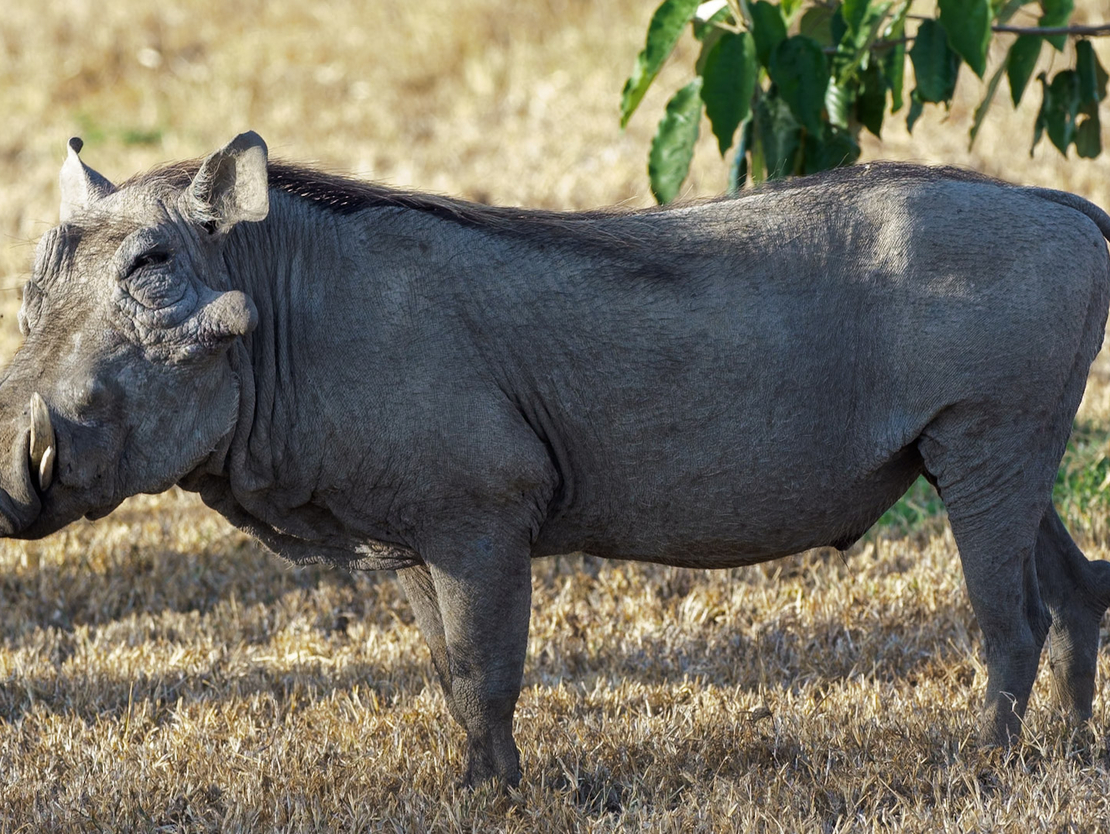
A desert warthog (Phacochoerus aethiopicus) at Suyian Ranch
During 4-5 February 2026, conservationists and researchers from the IUCN Species Survival Commission gathered at Suyian Soul, on Suyian Ranch, Laikipia County, central Kenya, for the 2nd African Wild Pigs Meeting. The primary objective was to reassess the five species of African wild pigs for The IUCN Red List of Threatened Species™, as the last assessments were conducted a decade ago (2016).
The meeting brought together experts from Belgium, Benin, France, Germany, Italy, Kenya, Madagascar, Mexico, the Netherlands, South Africa, and Switzerland, strengthening a working group established in 2019 to stand up for these often-overlooked species. The IUCN SSC Wild Pig Specialist Group and participants exchanged data on taxonomy, ecology, and threats to determine updated degree of threat statuses. These will be submitted to IUCN by mid-2026.
The meeting concluded with specific recommendations for the IUCN Red List reassessments, noting a downward trend for all species due to habitat loss and hunting pressure:
- Giant Forest Hog (Hylochoerus meinertzhageni): Experts suggest raising its status to “Near Threatened” globally. While currently "Least Concern," its populations are increasingly lost and fragmented. The eastern subspecies (H. m. meinertzhageni) is recommended for “Vulnerable” status due to severe hunting and its probable disappearance from Rwanda and Burundi.
- Common Warthog (Phacochoerus africanus): This species remains at “Least Concern”, as it is widespread and even expanding its range and abundance in South Africa. A decline is, however, present globally. Its role as a reservoir for African Swine Fever remains a critical management point.
- Desert Warthog (Phacochoerus aethiopicus): Recommended to remain “Least Concern” but in decline. Noted as being largely unstudied, significant knowledge gaps exist regarding its ecology, behaviour, distribution, and abundance.
- Bushpig (Potamochoerus larvatus): Currently listed as “Least Concern”, this status is maintained with a decreasing trend. While relatively common, it faces heavy hunting for bushmeat and as a response to crop-raiding. There has been a dramatic, unexplained population drop in areas like Uganda’s Kibale National Park.
- Red River Hog (Potamochoerus porcus): Suggested to remain “Least Concern” with a decreasing trend. Though it adapts well to mosaic habitats, it is suffering from high hunting pressure in West and Central Africa. Considered a key species for the Congo Basin forests that requires urgent further study.
Besides reassessing the status, the meeting featured several presentations focusing both on scientific knowledge and practical field methodology:
- Humane Trapping: Pietro Pontiggia (Pig Brig) demonstrated an efficient, safe, and humane net-capture system. This method was recognized as a vital tool for future research and population control.
- Innovative Research: Topics included bivariate distance sampling for population counts, the "snout index" for differentiating the two warthog species, and an anthropological look at the Malagasy bushpig.
- Possible reintroduction of the desert warthog into South Africa by Hugo Bezuidenhout.
- WildPigBase and citizen science: Led by Yvonne de Jong, the group discussed updating species databases and integrating data from apps like iNaturalist, while addressing the associated risks of public data.
- An update on current knowledge, approaches, and tools to assess the role of African suids in the epidemiology and ecology of African swine fever led by Ferran Jori (CIRAD)
- An overview of the studies implemented on the Malagasy bushpig by Rianja Rakotoarivony (WCS Madagascar)
The meeting culminated in a formal declaration—the Suyian Soul Call in Favor of African Wild Pigs Conservation. The participants highlighted that these species are essential for ecosystem functioning and food security but remain scientifically neglected. The IUCN SSC Wild Pig Specialist Group, therefore, calls for increased attention to African wild pig research and conservation.
The meeting was facilitated by the IUCN SSC Centre for Species Survival Cologne Zoo, the IUCN SSC Wild Pig Specialist Group, and support from the Pig Brig Company, Nuremberg Zoo, European Association of Zoos and Aquaria, and Zoological Society of London, along with the hospitality of Anne Powys and Suyian Soul Camp staff.

The Bangladesh Forest Department (BFD) and IUCN Bangladesh, with support from Agence Française de…

Each year, International Women's Day is an opportunity to recognise the women advancing change in…

On 14 January 2026, in Dhaka, the Bangladesh Forest Department and IUCN Bangladesh formally signed…