IUCN Mozambique leads discussions on resilience, partnerships and governance at ocean conferences in Maputo
The Mozambican capital, Maputo, became the epicentre of regional dialogue on ocean sustainability with the concurrent opening of two major complementary forums. The 3rd Crescendo Azul (Growing Blue) Conference, an international platform for dialogue on ocean governance and the blue economy, kicking off alongside the 4th Marine Biodiversity Conference, a technical-scientific event that promotes annual debate on marine conservation in Mozambique through the unique integration of science, art, and culture.
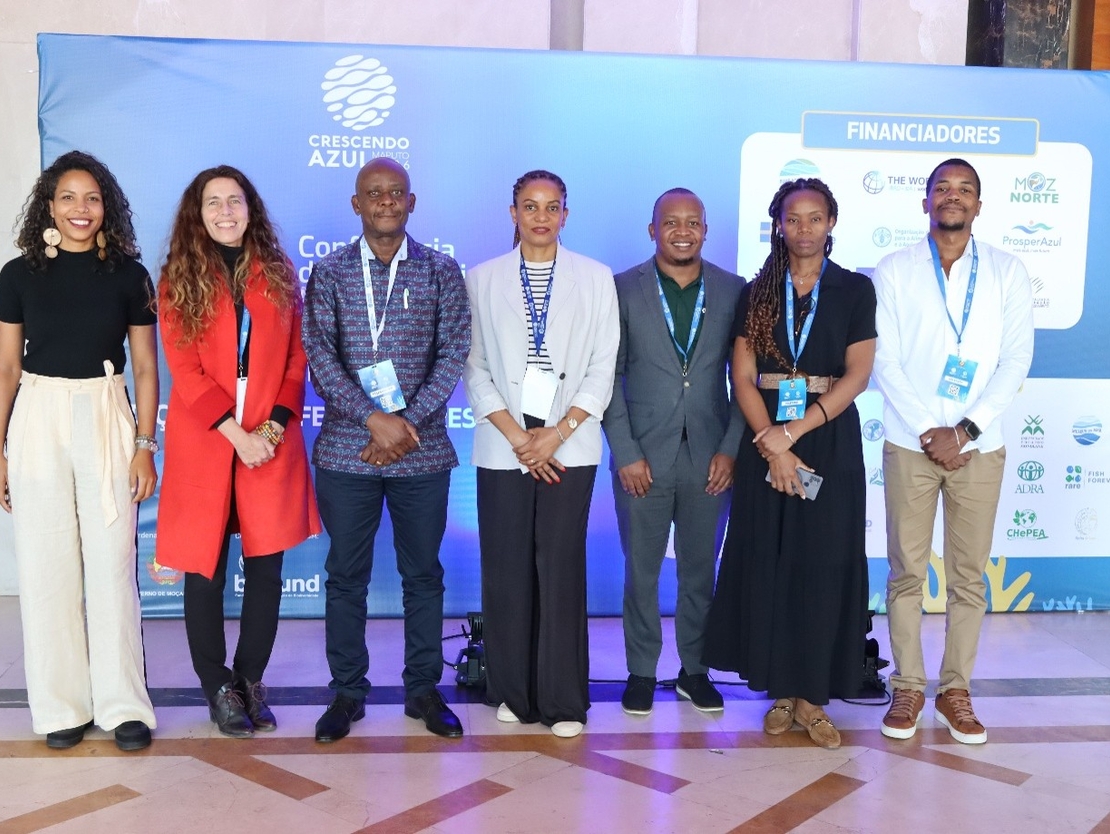
IUCN Mozambique Team at the Conference in Maputo.
The parallel convening of these events showcases our strategic priority in strengthening collaboration, facilitating critical knowledge exchange, and advancing sustainable solutions for the country's marine ecosystems. The opening session was led by H.E. Daniel Chapo, President of the Republic of Mozambique, who underlined the urgency of acting. He stated, “The world is no longer discussing whether the blue economy is important but is discussing how to accelerate the implementation of this economy for our people." On the sidelines of the event, the President also inaugurated the SADC Regional Fisheries Monitoring, Control and Surveillance Centre (MCSCC), a joint effort of Member States to curb IUU fishing (Illegal, Unreported, and Unregulated fishing), an event attended by Domingos Gove, the IUCN Mozambique Country Representative.
“The world is no longer discussing whether the blue economy is important but is discussing how to accelerate the implementation of this economy for our people." H.E Daniel Chapo, the President of Republic of Mozambique.
The convenings received co-funding from the IUCN via the ReSea and CORE RESTOR projects, backed respectively by Global Affairs Canada and Iris Aid.
IUCN’s key moments at the Conference
Aligned with its 20-year strategic vision for a regenerative blue economy, IUCN Mozambique contributed to the discussions through the ReSea and CORE RESTOR projects. The organization's experts led crucial panels around Ocean governance, Nature based Solutions and regenerative blue economy:
Global Governance (BBNJ Agreement):Barkha Mossae - Regional Regenerative Blue Economy Manager and Tara Pelembe -Programme Manager, Coastal and Ocean Resilience (COR) Mozambique joined the Mozambique National Director of Maritime Affairs, Felismina Antia, to discuss the BBNJ Agreement. The panel coincided with the celebration of the approval of the ratification of the agreement by the Mozambique Council of Ministers.
- Marine resources and Nature-Based Solutions (NbS): In the panel dedicated to shared marine resources, Bilardo Nharreluga - Nature Based Solutions Officer, advocated for the use of approaches aligned with the IUCN Global Standard for Nature-based Solutions as effective tools for climate change adaptation.
- Resilience in the Inhambane seascape: Domingos Gove, IUCN Mozambique Country Representative, and Bendita Donaciano Lopes, the Secretary of State for Inhambane Province, explored pathways for sustainable coastal development. ESUDER (Superior School on Rural Development, ReSea's partner) reinforced the importance of connecting academia to local communities.
- Science for marine conservation: Carla Manjate Rombe -Programme Manager facilitated a scientific session on Biodiversity and Anthropogenic Impacts, creating space for researchers, students and conservation practitioners to discuss evidence on species diversity, water quality and pollution, and how science can better inform marine and coastal conservation in Mozambique.
- Ecosystem-based adaptation and biodiversity: Denise Nicolau - Regional Coastal and Ocean Ecosystems Manager contributed as a keynote speaker in the debate session “Conserving with Value: Nature-based Solutions, Coastal Communities and Incentives”, highlighting the importance of placing people at the heart of conservation to achieve real and tangible benefits.
- Youth empowerment: The team celebrated the appointment of Ceiça Chioze, a young Mozambican marine scientist, to IUCN's latest cohort of Great Blue Wall Fellows
- For IUCN, the conference yielded two historic cooperative milestones strengthening national conservation efforts: IUCN and ProAzul (Mozambique Blue Economy Fund) partnership: Signing of a Memorandum of Understanding (MoU) between IUCN and ProAzul to strengthen institutional cooperation. BIOFUND (Mozambique Fund for Biodiversity), a member of IUCN) also signed a separate agreement with ProAzul, in the same event.
- Historic commitment to Other Effective Area-Based Conservation Measures (OECMs): In an unprecedented collective effort, IUCN joined seven other partners -Conservation International (CI), Food and Agricultureal Association (FAO), Likhulu (Mozambican NGO working in marine), RARE (a US NGO working with artisanal fisheries in Mozambique), ReGeCom (Rede para a Gestão Comunitária de Recursos Naturais – a Mozambican Civil Society network), Wildlife Conservation Society (WCS) and World Wildlife Fund (WWF),to sign a formal commitment to support the implementation of the OECM process in Mozambique, aligning local communities with the national and international biodiversity agenda, under Target 3 of the Global Biodiversity Framework.
The conference closed with strong collaboration and shared purpose among students, researchers, NGOs, businesses, government officials, and political leaders. IUCN acknowledges the organizers' leadership and urges institutions, civil society, and the private sector to build on this momentum so that marine conservation delivers durable benefits for nature and the people of Mozambique.


In Kashkadarya, Khorezm and the Republic of Karakalpakstan, local communities are helping turn…
The third in a five-part series, this webinar brought together speakers from across West and…

This week, the Yerevan Municipality hosted the inaugural ceremony marking the establishment of the…