New UNESCO–IUCN stocktake identifies more than 30 potential areas for World Heritage across South-East Asia
More than 30 areas across South-East Asia have been identified as potential future candidates for World Heritage recognition, according to a new regional framework released by UNESCO and the International Union for Conservation of Nature (IUCN). The report highlights a remarkable opportunity to strengthen global recognition and conservation of some of the region’s most important natural landscapes, ecosystems, geoheritage and biodiversity hotspots over the coming decade.
The publication, World Heritage & Nature: Regional Framework for Priorities in South-East Asia provides practical guidance to support 11 countries in the region to identify priorities for natural World Heritage in the next 5 to 10 years. It takes stock of priorities identified in earlier IUCN World Heritage gap studies, other scientific research, and spatial prioritization frameworks such as Key Biodiversity Areas.
The report highlights how South-East Asia’s natural World Heritage already recognize the most significant habitat for tigers, the world’s largest flower, unique tower-karst landscapes, and sacred places which inspired people for generations. The about 20 natural sites include Komodo National Park in Indonesia, Tubbataha Reefs Natural Park in the Philippines, Gunung Mulu National Park in Malaysia, and the transboundary Phong Nha–Ke Bang National Park and Hin Nam No National Park shared by Viet Nam and Lao People's Democratic Republic, to name but a few.
Yet, natural and mixed World Heritage sites remain significantly underrepresented compared with cultural sites. And almost 40% of States Parties do not have any World Heritage sites that are inscribed for their nature conservation values. IUCN considers that addressing this imbalance requires practical and enhanced support to States Parties, including for the identification of potential sites, the preparation and revision of Tentative Lists and the use of the new Preliminary Assessment mechanism.
Among the opportunities identified are tropical forests in Cambodia’s Cardamom Mountains, Malaysia’s Taman Negara National Park, extensions of Thailand’s Dong Phayayen-Khao Yai Forest Comple, Mount Popa in Myanmar, and important marine and coastal ecosystems across the Coral Triangle.
South-East Asia contains four global biodiversity hotspots and supports some of the world’s highest concentrations of endemic and threatened species. The report stresses that stronger recognition and protection of these places as World Heritage could contribute significantly to global biodiversity conservation while supporting sustainable development, scientific research and nature-based tourism.
The report also calls for further research on marine ecosystems, coral reefs, mangroves, migratory species and other underrepresented natural features that may hold Outstanding Universal Value.
This report is intended for national World Heritage focal points, site managers, heritage professionals and representatives of civil society and local communities. It seeks to encourage stakeholders to rediscover the natural heritage around them, deepen their understanding of its significance, and take meaningful steps towards its long-term protection and sustainable management.
Inclusion in this report does not imply or guarantee future inscription on the UNESCO World Heritage List. Any potential nomination remains subject to the procedures established under the World Heritage Convention and its Operational Guidelines, and to rigorous, case-by-case evaluation of a property's potential Outstanding Universal Value, requiring any site to meet highest standards of global significance, integrity and protection and management
Besides this stocktake based on existing studies, full regional gap studies have recently been developed for Oceania (2025), Africa (2020) and Central Asia (2020).
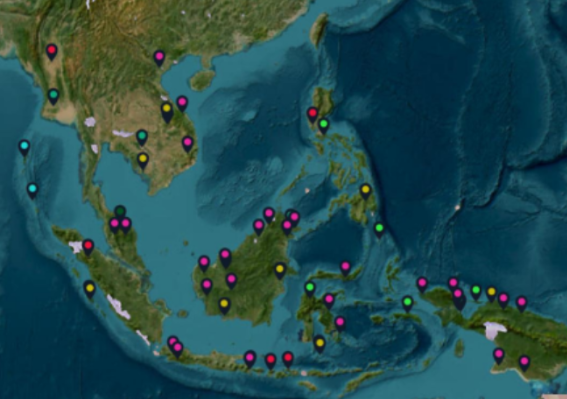
Figure 1: Sites identified in IUCN gap studies not yet inscribed on the World Heritage List or Tentative Lists, including Volcanoes (2019; red), Islands (1991; light blue), Terrestrial biodiversity (2013; light green), Forests (2003; dark green), Wetlands (1997; turquoise), Indicative List (1982; yellow), Protected Areas (2000; pink). Light blueshaded areas show existing natural and mixed World Heritage properties. Note that several areas have been mentioned in several gap studies.
About IUCN and the World Heritage Convention
Since the inception of the World Heritage Convention in 1972, IUCN has played a unique role as the official advisory body under the World Heritage Convention on natural World Heritage. This involves leading the technical recommendation of all new nominations of natural and mixed World Heritage sites, monitoring the status of existing natural and mixed World Heritage sites and the newly added Preliminary Assessment process to provide direct advice on the feasibility of potential nominations to state parties.
IUCN also works independently on the Convention to support World Heritage sites globally though our extensive network of programmes and policies led though our central Secretariat team, our expert commissions, and our member organisations.
Find out more about IUCN's work on World Heritage here.


In Kashkadarya, Khorezm and the Republic of Karakalpakstan, local communities are helping turn…
The third in a five-part series, this webinar brought together speakers from across West and…

This week, the Yerevan Municipality hosted the inaugural ceremony marking the establishment of the…