Enhancing CSO capacity in monitoring, evaluation, and results-based reporting
On 6-7 May 2025, IUCN organised a 2-day training on results-based management (RBM) and reporting for 30 participants including seven women from 15 CSOs. Financed by the EU project “Strengthening CSO capability to scale up sustainable freshwater fisheries in Cambodia” and CEPF, the objective was to strengthen CSO capacity in four key areas:
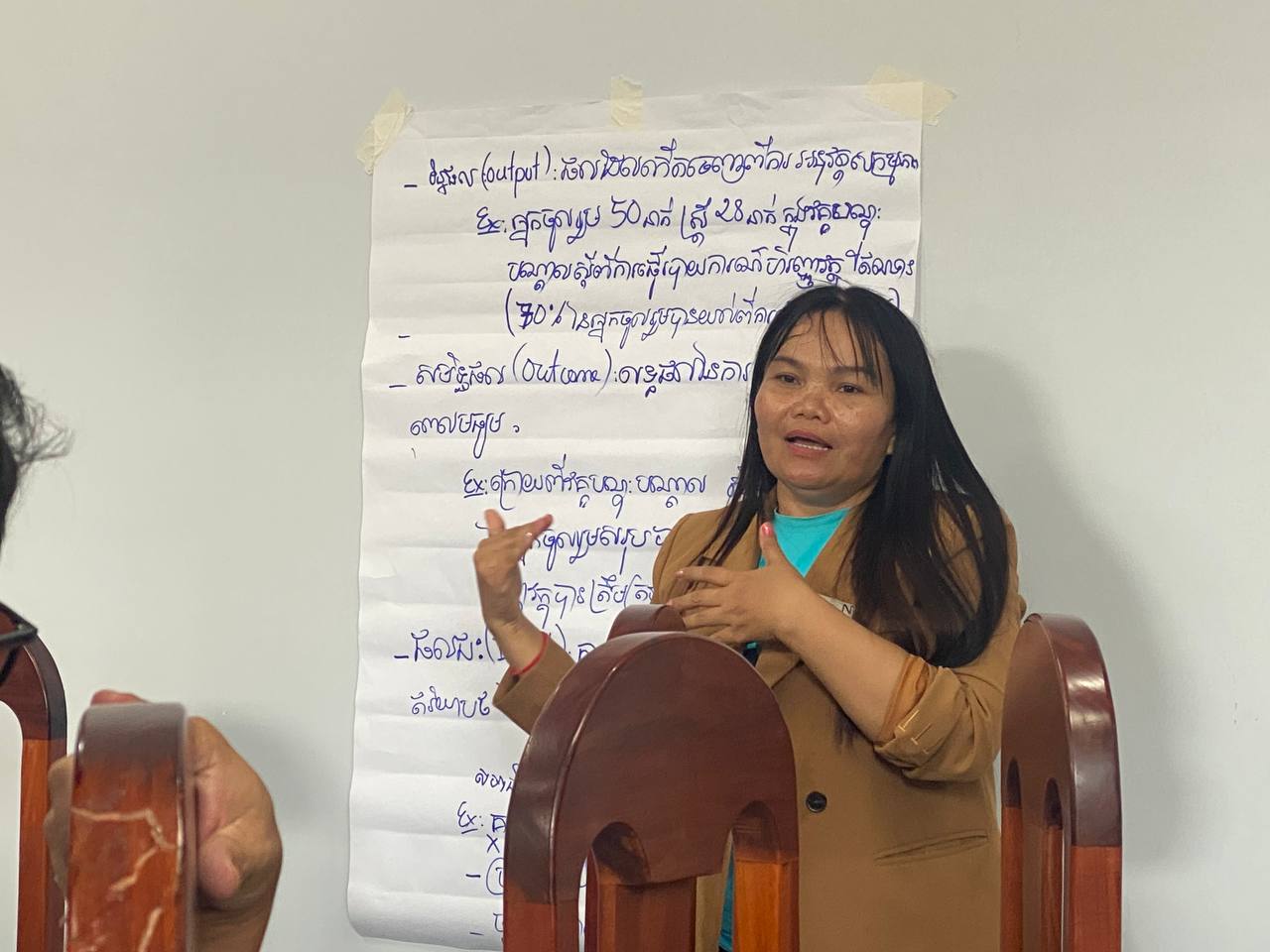
Photo: Participants joined group discussion at the training © IUCN Cambodia

Photo: A participant shared discussion results at the training © IUCN Cambodia
- Understand M&E fundamentals in project management
- Clarify RBM and its relevance to report writing
- Differentiate between activity-based and results-based reports
- Practise results-based reporting through hands-on exercises and real-world case studies
The training was attended by the Culture and Environment Preservation Association (CEPA), Fisheries Action Coalition Team (FACT), 3S Rivers Protection Network (3SPN), Trailblazer Cambodia Organization (TCO), Forest and Livelihood Organization (FLO), Nature Life Cambodia, Fishing Cat Ecological Enterprise Co., Ltd., Cambodian Rural Development Team (CRDT), My Village, Action for Development Cambodia (AFD), Indigenous Youth Association (IYA), Sansom Mlup Prey, and Non-Timber Forest Products (NTFP), and other CSOs.
Participants actively engaged in group discussion and learned to differentiate project outputs, outcomes, and impacts. The post-training evaluation showed strong knowledge improvement.
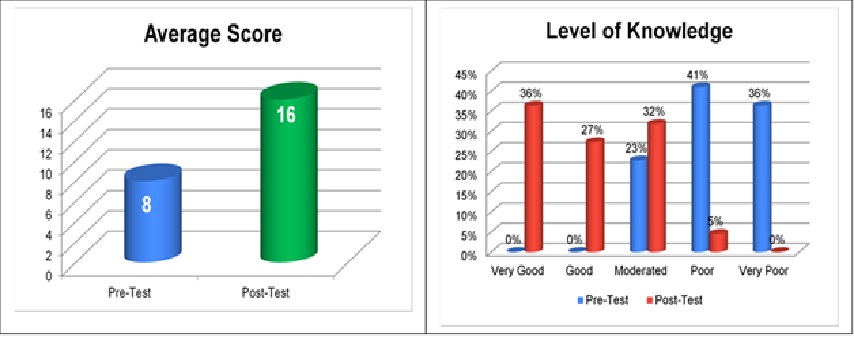
Prior to the training, the average score of participants’ understanding was 8/21 vs. 16/21 after the training, representing a 100% improvement. The chart shows that 63% of participants showed good or very good understanding after the training. However, 37% showed moderate or limited understanding, which can be explained by their very low starting point. 77% of them had shown poor or very poor understanding before the training.
The training equipped CSO staff with practical skills and knowledge for effective project implementation. To sustain performance, participants recommended follow up training, mentoring, advanced courses for experienced learners, peer-to-peer learning within organizations, ongoing technical support, and regular assessments.

The Bangladesh Forest Department (BFD) and IUCN Bangladesh, with support from Agence Française de…

Each year, International Women's Day is an opportunity to recognise the women advancing change in…

On 14 January 2026, in Dhaka, the Bangladesh Forest Department and IUCN Bangladesh formally signed…