Marajó: Where Mangroves Inspire the Future
Join us to celebrate the International Day for the Conservation of the Mangrove Ecosystem from Brazil’s first IUCN Green List site

A vital ecosystem worth celebrating
Every July 26 marks the International Day for the Conservation of the Mangrove Ecosystem - a day that invites us to recognize and value one of the most productive and strategic ecosystems on the planet. Mangroves are not only natural barriers against sea level rise and climate change: they are also nurseries for wildlife, natural filters that purify water, and a source of livelihood for thousands of coastal communities.
Brazil holds the largest continuous belt of mangroves in South America. At one end of this coastal stretch—on Marajó Island, in the state of Pará—flourishes an exemplary model of community-based conservation and environmental innovation.
Soure: A Brazilian model of conservation leadership
The Soure Marine Extractive Reserve is located in the municipality of Soure, on Marajó Island, the largest river-maritime island in the world. This territory, historically inhabited by traditional fishing communities, was recognized as a federal conservation unit in 2001, under the category of marine extractive reserve, which promotes the sustainable use of natural resources by its residents.
In 2024, this area took a historic step by becoming the first in Brazil to obtain certification from the IUCN Green List—an international distinction recognizing protected areas that meet excellence standards in governance, planning, management, and conservation of natural values.
Tech4Nature: Innovation with community roots
This achievement is framed within the context of the Tech4Nature project, a global alliance between the International Union for Conservation of Nature (IUCN) and Huawei, which aims to demonstrate how technology can be a powerful tool for conserving biodiversity and empowering communities.
In Brazil, the project is being implemented in Soure through a collaborative network composed of IUCN, Rare Brazil, ICMBio, the Federal University of Pará (UFPA), and the local association ASSUREMAS. Together, they have launched the initiative Amazon Coast Watch: Empowering Communities for Climate Resilience and Species Conservation.
This initiative focuses on three main areas of action:
Real-time climate monitoring
With project support, UFPA has designed and installed a low-cost sensor capable of collecting data on water temperature, humidity, wind, sea level, and rainfall in the estuarine zone. This technology allows real-time observation of atmospheric and oceanic conditions and has also been key in predicting tidal patterns for 2025 and 2026, which has facilitated field planning for ecological monitoring activities.
Despite technical challenges—such as high humidity that affects the durability of components—the system has managed to record over two months of continuous tide data. Additionally, an educational version of the sensor is being developed by UFPA to bring this knowledge into schools and community spaces.
Mangrove and crab monitoring
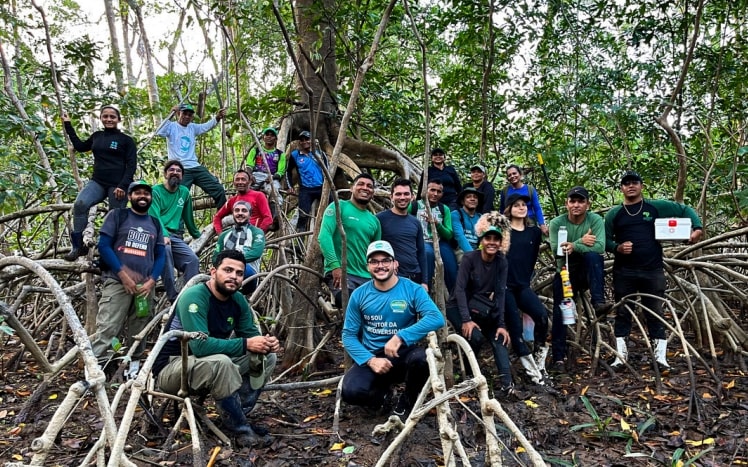
As part of ICMBio’s Monitora Program, nine sampling units have been established across three stations along the reserve to monitor mangrove vegetation and the caranguejo-uçá (Ucides cordatus), a species vital to both ecological balance and the local economy. The monitoring protocol ensures technical rigor while remaining participatory, incorporating the knowledge of local fishers.
The caranguejo-uçá is both an ecological indicator and a cultural symbol. Since October 2024, the project has conducted over 1,050 interviews with fishers, collecting data on catches, weights, sizes, and fishing zones. Despite challenges—such as low participation in biometric measurements due to time constraints—a solid database has been established, and a new census of caranguejeiros has been conducted, estimating 168 active fishers.
Community participation and local empowerment
The strength of the Tech4Nature project lies not only in its sensors, but in the people who power them. Through community meetings, visual materials, field signage, UV-protective shirts, and digital tools, the project has succeeded in building trust and a sense of shared responsibility within the community.
A Rare Brazil´s campaing "Cuidando de Quem Cuida" (“Caring for Those Who Care”) campaign and the "Green July" events have been key platforms for sharing results, ensuring participatory accountability, and recognizing those most committed to monitoring. All of this reinforces the project’s central principle: technology must serve people and nature—not the other way around.
A project that leaves a legacy and looks to the future
Amazon Coast Watch is part of the second global phase of Tech4Nature, alongside countries like Mexico, China, Turkey, and Kenya. In Brazil, it has succeeded in consolidating a collaborative ecosystem among government, academia, civil society, and the community, with tangible impacts on mangrove conservation.
Moreover, it has opened the door to new processes, such as developing artificial intelligence tools to count crab burrows using imagery, and has encouraged the submission of new collaboration proposals with ICMBio, beyond the project’s original scope.
Thriving mangroves, strong communities
Today, from Soure, we celebrate a mangrove ecosystem that is not only protected but also monitored, understood, and valued. We celebrate a community that has made conservation a collective path and shows that local knowledge—when combined with innovation and technical support—can transform territories and generate hope.
The Soure model is not just replicable—it is inspiring. In a world searching for climate change solutions, this Amazonian experience reminds us that the most powerful answers are born from the alliance between technology and the heart of the communities who depend on—and care for—their ecosystems.
“With the results obtained, it will be possible to better understand the transformations affecting mangroves, and thus promote more effective actions to conserve this ecosystem.”
— Lucas Gadelha, Environmental Agent, ICMBio Soure


Disclaimer
Opinions expressed in posts featured on any Crossroads or other blogs are those of the authors and do not necessarily reflect the opinions of IUCN or a consensus of its Member organisations.

The Bangladesh Forest Department (BFD) and IUCN Bangladesh, with support from Agence Française de…

Each year, International Women's Day is an opportunity to recognise the women advancing change in…

On 14 January 2026, in Dhaka, the Bangladesh Forest Department and IUCN Bangladesh formally signed…