The Copenhagen Organic Summit 2025
Held in Copenhagen Royal Library’s “Black Diamond” in August 2025, this year’s Organic Summit focused on a key EU objective – how to achieve 25% organic production and consumption by 2030. Currently organic agriculture covers 10.5% of the EU land area, but production and consumption figures vary widely from country to country and from crop to crop.
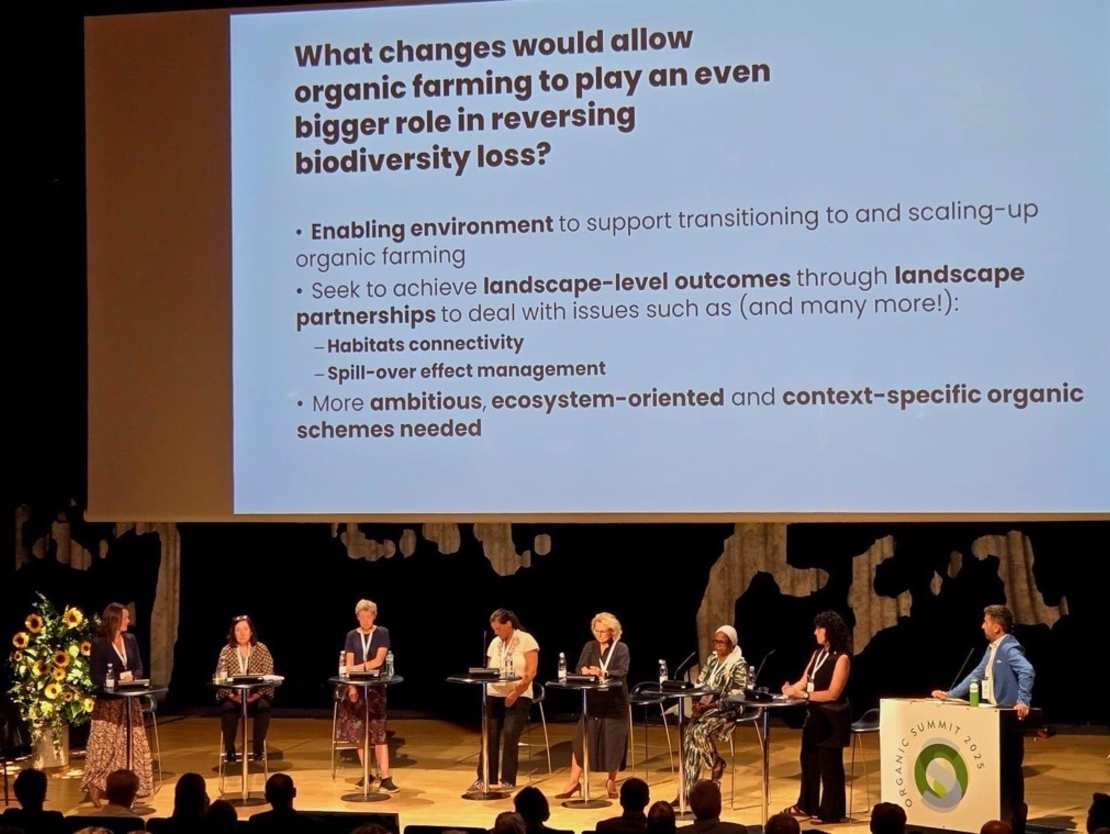
In the face of accelerating biodiversity loss, the way we produce food has never been more critical. Agricultural systems are widely recognized as the single largest driver of biodiversity decline globally, due to land use change and unsustainable intensification leading to habitat loss, pollution, and soil degradation. As a result, the IUCN Red List consistently highlights agriculture-related pressures as major threats to species across taxa and ecosystems.
So, as the Summit’s objective implies, is organic farming the answer? When implemented with ecological integrity and landscape-level ambition, I argue that it offers a credible and scalable solution to restore and/or conserve biodiversity and build resilient food systems.
What is organic farming?
Unlike conventional systems, organic agriculture avoids synthetic pesticides and fertilizers, prohibits genetically modified organisms, and supports ecological processes such as natural pest control, nutrient cycling, and pollination. These practices create healthier soils, cleaner water, and more diverse habitats.
A meta-analysis by Tuck et al. in 2014 found that organic farms support, on average, 30% more species richness than conventional farms. From pollinators and soil microbes to birds and native plants, organic systems foster a richer tapestry of life.
Organic farming often also maintains landscape features such as hedgerows, cover crops, and diversified cropping systems which are essential for above- and below-ground biodiversity. Practices such as crop rotation, composting, and reduced tillage enhance soil health and microbial diversity, laying the foundation for resilient ecosystems.
But we should remember that organic farming is not a silver bullet on its own. It is most beneficial when embedded within broader agroecological and landscape-level strategies.
Organic agriculture and Nature-based Solutions
At IUCN we developed, maintain and support the adoption of the Global Standard for Nature-based Solutions (NbS) which provides a framework for harnessing nature to address societal challenges. Organic agriculture aligns closely with this standard, particularly in biodiversity, soil health, and ecosystem measures.
Organic systems preserve agrobiodiversity, reduce chemical inputs, and promote animal welfare. When combined with biodiverse landscape elements, they support natural pest enemies and reduce the need for chemical control. According to the European Commission (DG AGRI, 2023), organic arable farms save 75–100% on plant protection product costs per hectare – so there are both ecological and economic benefits.
How can organic farming be even better for biodiversity?
Organic farming must aim for landscape-level outcomes. Ecological processes and species conservation operate at scales larger than a single farm, and organic farmers are really keen to understand the outcomes they contribute to at farm level and beyond, as well as to manage landscape level issues that they face.
Organic farms can serve as biodiversity refuges, but without connecting ecological corridors their contribution to species movement is limited. Neighbouring conventional farms cause pesticide drift and water pollution, undermining the gains of organic farming. A coordinated landscape approach through multistakeholder landscape partnerships and processes helps amplify benefits and minimize negative crossovers.
Organic agriculture also works best alongside other regenerative practices. Agroecology, agroforestry, and generally diversified landscapes are vital to making organic truly regenerative.
The key message is clear: to benefit biodiversity, organic schemes must be ambitious, outcomes-based, and context-specific.
A foundation, not the ceiling
Organic agriculture is a necessary foundation of what sustainable food systems must become, but it cannot be the ceiling. While it represents a meaningful shift away from input-intensive conventional farming, not all organic systems are created equal. The diversity within organic production standards is vast, ranging from highly diversified agroecological farms to large-scale monocultures that meet certification criteria but offer limited biodiversity benefits.
As part of IUCN’s Vision for a just world that values and conserves nature, transforming food and agricultural systems is one of eight critical global shifts. Organic farming should be seen as a tool, not an end in itself—for regenerating ecosystems and supporting species conservation.
The Copenhagen summit represented a timely opportunity to recognize organic agriculture’s potential as a driver of system transformation. But its success depends on integration into broader policies, landscape-scale strategies, incentives based on measurable outcomes, and socially inclusive approaches that are locally adapted and biodiversity-positive. Taking that approach, organic farming can be the cornerstone for a biodiversity-based agricultural future.
As I said in my conclusion at the Summit:
Clearly organic farming is part of the solution to the interlinked climate, biodiversity and pollution crisis and contributes to many other positive environmental and social results, alongside delivering nutritious food and improved livelihoods. Even more value could be derived from organic farming if we align it as much as possible with the IUCN Global Standard for Nature-based Solutions.


The Bangladesh Forest Department (BFD) and IUCN Bangladesh, with support from Agence Française de…

Each year, International Women's Day is an opportunity to recognise the women advancing change in…

On 14 January 2026, in Dhaka, the Bangladesh Forest Department and IUCN Bangladesh formally signed…