Great Blue Wall National steering committee convenes in Moheli and inaugurates a training centre to strengthen Coastal and Ocean Resilience as part of the ReSea Project
The Great Blue Wall (GBW) National Steering Committee (NSC) convened in Moheli, Union of the Comoros on 24th April 2026, bringing together government representatives, technical experts, community leaders, development partners, and regional networks to strengthen coordination and guide the next phase of implementation of the Great Blue Wall initiative in the country.
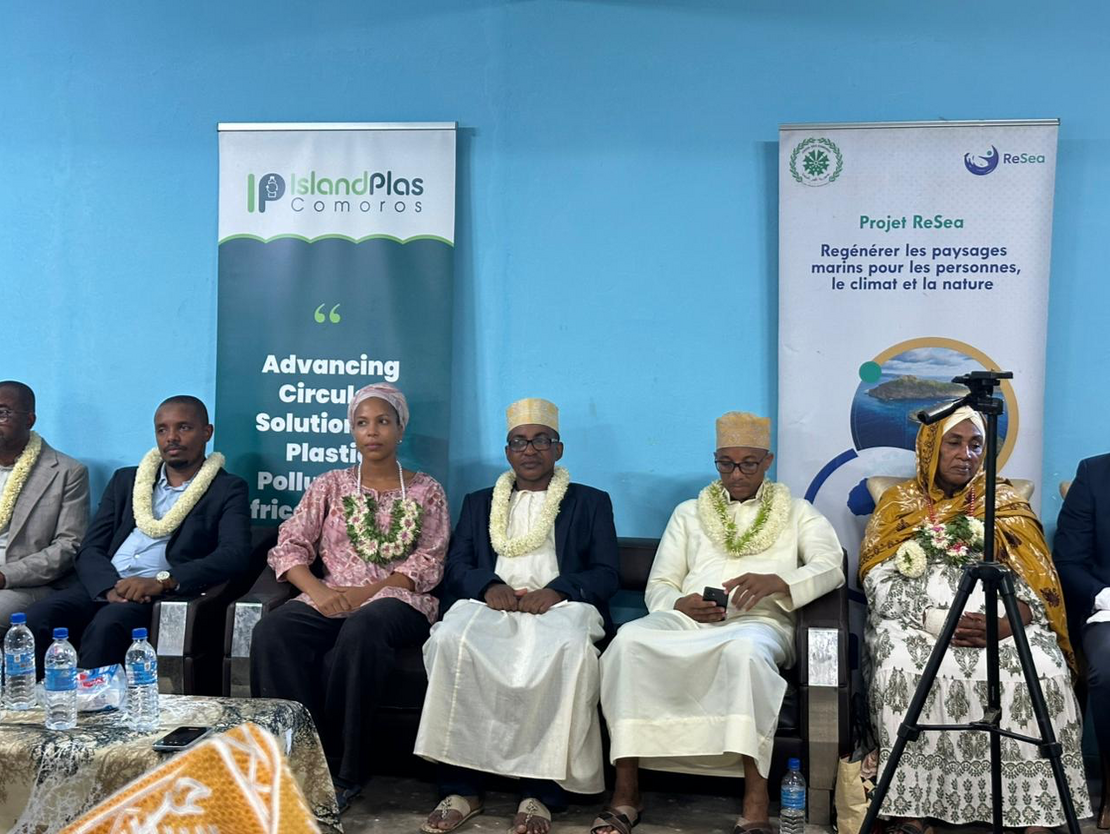
Hosted under the leadership of the Ministry of Environment in charge of Tourism, the meeting provides a platform to review progress achieved since the establishment of the NSC in January 2025 and to align national priorities with ongoing GBW-supported initiatives, including IslandPlas, ReSea, BBNJ, and WIOCOR.
The meeting strengthens coordination and shared ownership of Great Blue Wall implementation in the Union of the Comoros by bringing together government institutions, technical partners, and community leaders to advance governance, nature-based solutions, gender-responsive blue economy approaches, and regional collaboration. Discussions focus on priority actions for 2026 while showcasing progress across GBW-aligned initiatives, including IslandPlas , ReSea, BBNJ, and WIOCOR. A key highlight of the programme is the inauguration of a fisheries training and skills centre in Moheli, supporting local capacity building in fisheries value addition, entrepreneurship, and community-based coastal stewardship, while reinforcing the importance of coordinated action to strengthen long-term coastal and ocean resilience.
A major milestone of the programme was the inauguration of a fisheries training and skills centre in Mbatse Village, Moheli, established through the ReSea Project with support from Global Affairs Canada as a long-term investment in coastal livelihoods and ocean resilience. The centre will serve as a practical hub for capacity building, equipping youth, women, and small-scale fishery actors with skills in fisheries value addition, entrepreneurship, sustainable resource management, and community stewardship. Beyond training, the facility creates space for knowledge exchange and locally driven solutions, reinforcing the role of communities in strengthening coastal resilience and protecting marine ecosystems.
"This gathering in Moheli Islands marks a turning point. With the new training centre in Mbatse village and strong national coordination, we are building lasting coastal resilience — from the ground up, with communities at the heart. This community training centre is a tree of knowledge and skills that we are planting today, from which we hope to reap valuable fruits for our local communities. " Says Said Ahamada, Coastal and Ocean Resilience Interim Programme Manager IUCN Comoros. Comoros is demonstrating strong leadership in advancing the Great Blue Wall vision, turning national coordination into tangible action on the ground in Moheli.
Through the collective impact of IUCN-supported initiatives such as ReSea, IslandPlas, BBNJ, and WIOCOR, we are seeing how regional collaboration can translate into real investments in coastal resilience, skills development, decision making and ecosystem value and restoration. we are seeing how regional collaboration can translate into real investments in coastal resilience, including the inauguration of the fisheries training and skills centre in Mbatse Village with support from ReSea project, which strengthens local capacity, livelihoods, and community stewardship This is a clear example of how the Western Indian Ocean is moving from ambition to implementation, with communities at the centre of ocean solutions – added Denise Nicolau, The Regional Manager, Coastal and Ocean Ecosystems, IUCN Eastern and Southern Africa Regional Office.
The meeting is expected to strengthen alignment among institutions involved in GBW implementation and support an agreed roadmap for coordinated action in the coming year.
Through this process, the Union of the Comoros continues to position itself as a key factor in advancing ocean resilience, marine governance, and locally driven solutions across the Western Indian Ocean.


In Kashkadarya, Khorezm and the Republic of Karakalpakstan, local communities are helping turn…
The third in a five-part series, this webinar brought together speakers from across West and…

This week, the Yerevan Municipality hosted the inaugural ceremony marking the establishment of the…