The ‘crown jewels’ of our planet are facing rising climate threats: some thoughts from Busan
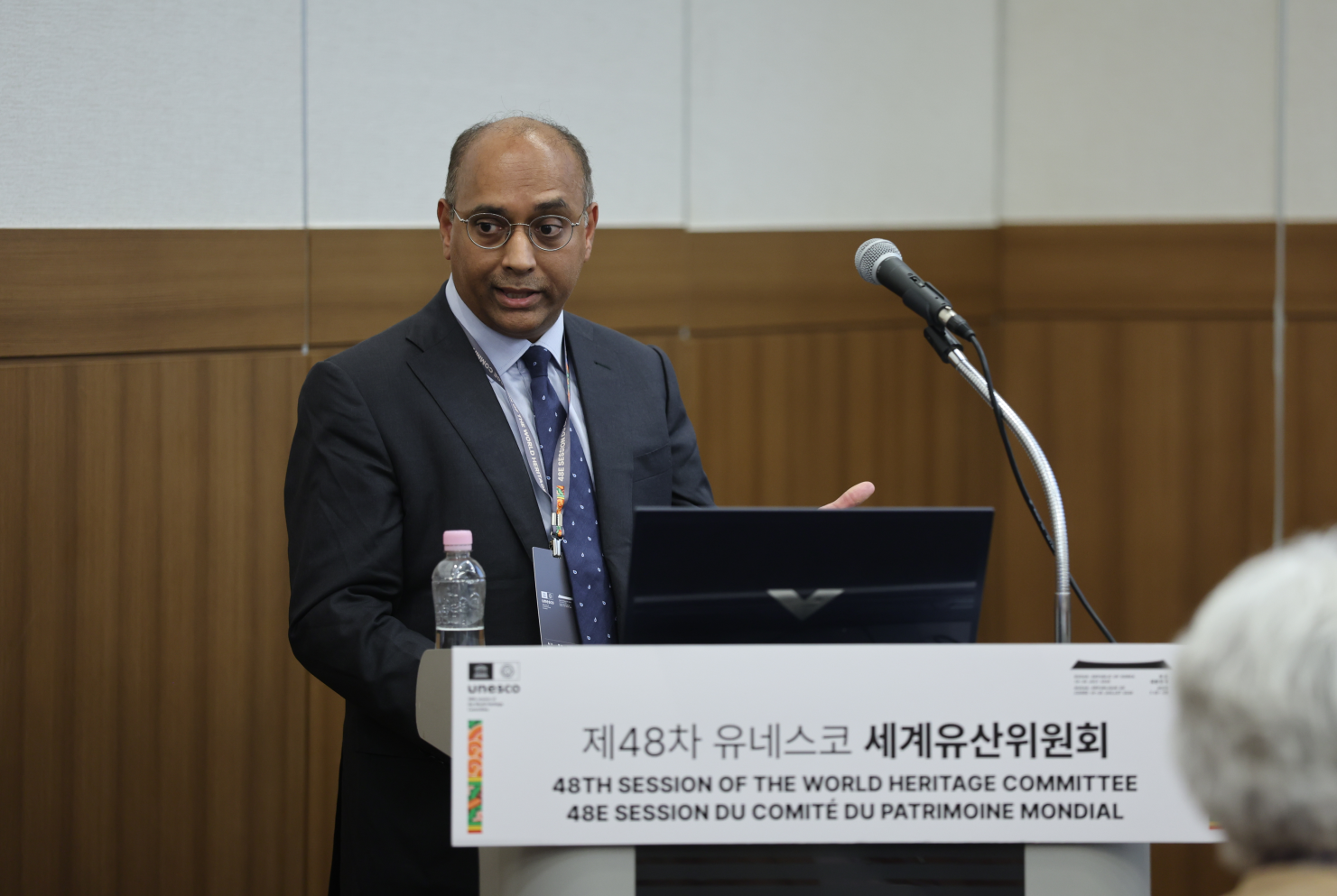
Dr. Sandeep Sengupta, Head, Global Climate Policy, IUCN, speaking at a side event during the 48th Session of the World Heritage Committee.
Photo: © UNESCO / KHS
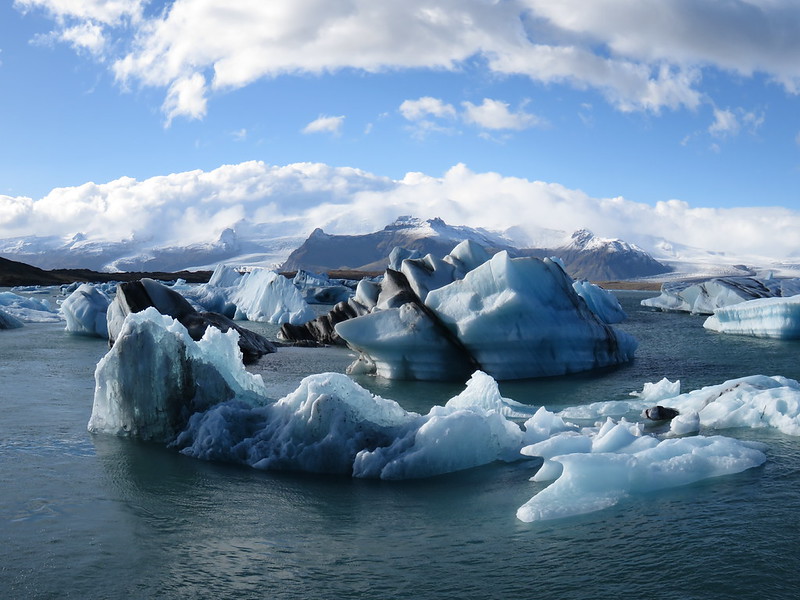
Vatnajökull National Park - Dynamic Nature of Fire and Ice, Iceland
Photo: © IUCN / Bastian Bertzky
Last week I had the opportunity – for the first time – to participate in the 48th session of the World Heritage Committee (48COM), which, this year, was held in the beautiful coastal port city of Busan in South Korea. The Committee is responsible for the implementation of the 1972 World Heritage Convention and oversees the famous World Heritage List, which – as of this Committee session – now includes 1,273 cultural, natural and mixed sites from 173 countries.
Ranging from the Taj Mahal in India, the Pyramids of Egypt, and the Great Wall of China for cultural sites, to the Galápagos Islands in Ecuador, the Serengeti National Park in Tanzania, and the Grand Canyon in the USA for natural sites, the areas inscribed on this World Heritage List are often described as the ‘wonders of the world’, the ‘best of the best’, the ‘crown jewels’ and ‘global treasures’. They are chosen because they possess Outstanding Universal Value (OUV) that belongs to all of humanity. What happens in – and to – them, therefore, matters to us all.
IUCN plays a crucial role in the World Heritage system, as one of the only three official Advisory Bodies named in the Convention, and the only one tasked with providing independent technical advice and expert guidance on nature. This includes evaluating nominations, monitoring existing sites, and recommending sites for the ‘List of World Heritage in Danger’ – a designation that can get triggered in the face of specific ascertained or potential dangers to their OUV.
Rising concerns about climate change
What struck me in the time I spent in Busan is the extent to which climate change is now emerging as a dominant and cross-cutting concern for the 196 States Parties that have ratified the World Heritage Convention. Although it was not on the formal agenda as such, in intervention after intervention, State Party representatives highlighted climate change prominently in the spectrum of pressures, threats and impacts that are affecting the World Heritage sites situated on their territories.
To some extent, this is not surprising. There is, after all, hardly any country or sector in the world today that is not being affected by the adverse effects of climate change – manifested through rising temperatures and sea-levels, melting ice-caps, increasing floods, droughts, heatwaves and wildfires, and various other extreme weather events. But the fact that so many States Parties called this out among other threats was still noteworthy.
The UNESCO World Heritage Centre, which serves as the secretariat to the Convention, in its own joint report with the Advisory Bodies on the ‘State of Conservation of World Heritage properties’ (delivered under Agenda Item 7 at the meeting) noted climate change and climate hazards as one of the most frequently referenced factors or threats that had been observed in site-specific State of Conservation (SOC) reporting over the last five years (2021-2025) across all World Heritage sites. It also flagged that this was a cross-cutting factor that often interacted with and multiplied other threats.
IUCN’s own work on this issue paints an even more alarming picture. The fourth edition of the IUCN World Heritage Outlook – which is the most comprehensive assessment of all natural World Heritage sites globally – identified climate change as not only the largest current threat to natural World Heritage worldwide, but also the fastest growing one. Launched at the IUCN World Conservation Congress in Abu Dhabi last year, the report revealed that 43% of all natural World Heritage sites (117 of 271) are highly threatened by climate change today – up from 33% in 2020, 25% in 2017, and 14% in 2014, when previous versions of the report were published.
Among the sites affected by climate change are iconic places such as the Great Barrier Reef in Australia, the Sundarbans National Park in India, the Monarch Butterfly Biosphere Reserve in Mexico, and the Jungfrau-Aletsch Glacier in the Swiss Alps, to name but a few. A report that IUCN released jointly with UNESCO in 2022 also projects glaciers to disappear from 30% of the 50 World Heritage sites that currently host them by 2050.
While glacier and coral reef systems are the ones that immediately come to mind while thinking of climate change, it is important to note that these are not the only ecosystems at risk. A range of other natural World Heritage sites encompassing wetlands, forests, tidal mudflats, islands and cave systems, are today facing serious climate threats as well.
Indeed, the SOC analysis presented in Busan highlighted that World Heritage sites affected by climate-related hazards have increased by 40% since 2015. Projections further indicate that the number of sites facing additional climate-related pressures could triple by 2050. In other words, climate change is not a problem that is going away any time soon. If anything, these trends underscore the urgent need for effective and coordinated action across the World Heritage system.
So, how is the World Heritage system responding?
What I saw in Busan suggests a mixed picture. On the one hand, there is undoubtedly great awareness among States Parties of the threat that climate change poses, as well as a willingness to vocalise this, as was seen above. At the formal level, the General Assembly of States Parties to the Convention – the highest governing body of this Convention – adopted a Policy Document on Climate Action for World Heritage in 2023, updating a previous 2007 policy document on the topic.
The 2023 policy document clearly notes climate change as ‘one of the most significant threats to World Heritage’ and sets out an outcome-oriented framework for developing goals and targets at national and heritage site levels to galvanize action. A process to prepare a ‘Guidance Document’ to facilitate the effective implementation of this policy has also now been initiated.
Separately, under the ICCROM-IUCN World Heritage Leadership programme, a Climate Action Toolkit is being jointly developed by the World Heritage Centre and the Advisory Bodies to support States Parties and site managers to integrate climate change in the management strategies of World Heritage sites.
Yet, significant gaps remain. As my IUCN World Heritage team colleagues shared with me, SOC reporting is currently not ensuring effective and consistent consideration of climate change impacts between World Heritage sites. There is lack of sufficient guidance to support consistent consideration and decision-making on climate change under the Convention, which contributes to disparities in site-based reporting. In particular, there is a key unresolved question on the ability of the List of World Heritage in Danger to consider climate change affected sites, especially given the growing scale of sites facing both climate threats and impacts. Furthermore, while the Committee has taken a range of positions related to climate action, these have not been matched by equal attention to implementation options.
The main elephant in the room also remains largely unaddressed. With global greenhouse gas (GHG) emissions – the primary cause of climate change – continuing to rise, and the collective ambition of current national mitigation commitments remaining well below what is required to keep the 1.5°C goal of the Paris Agreement alive, it is almost certain that the world will now ‘overshoot’ this critical temperature rise threshold – with all the concomitant negative impacts on vulnerable communities and ecosystems, including on World Heritage. Noting, in particular, the permanent and irreversible losses and damages that are likely to entail in some cases, including loss of OUV, how can, or should, the World Heritage system respond to this inadequacy of mitigation ambition when its sites get directly hit?
Presently, under Article 4 of the World Heritage Convention, each State Party has not only a duty to protect, conserve and transmit to future generations the World Heritage that is situated on its territory, but to ‘do all it can to this end, to the utmost of its own resources’. How then, does this duty translate to their obligations under the United Nations Framework Convention on Climate Change (UNFCCC) and the Paris Agreement – the principal international treaties set up to address climate change – to which nearly all States Parties are also a Party? And what happens when the delivery of their obligations under the two processes stands in contradiction? How should other relevant sources of international law, including the recent Advisory Opinion on State Obligations on Climate Change delivered by the International Court of Justice (ICJ), for example, be taken into account in the determination of State obligation and duty?
While much of the focus of the World Heritage system so far has been on promoting measures to enhance climate resilience and adaptation at the site level, if the overall global situation on climate change does not alter, the World Heritage Convention may inevitably need to engage on some of these more politically-sensitive and complex questions of regime linkage, international law and international norms. While operating within its own mandate, and being respectful of that of other intergovernmental processes, it will need to contemplate coming up with more creative and effective responses to these larger climate questions in a manner that is constructive but robust. It will also need to develop strategic messaging that can communicate its concerns at the highest levels on behalf of the World Heritage sites that it ultimately exists to serve. A harsher alternative would be for the Convention to remain silent and do nothing as climate change irreversibly erodes the OUV of its most vulnerable sites, or to only tinker at the edges, both of which could risk and undermine its credibility.
A new IUCN initiative on World Heritage and climate change
Cognizant of the importance of this entire topic, and of the multiple entry points and levels through which the issue of climate change and World Heritage can be examined, IUCN introduced a new initiative in Busan, which aims to ‘Advance a Strategic Approach to Climate Change within the World Heritage Convention’. At a dedicated side-event held on 21 July, it also invited the views and inputs of participants on this topic.
Supported by the Australian government, the aim of this project is to examine how and where the World Heritage system can appropriately interact with relevant processes of the UNFCCC and the Paris Agreement to encourage greater ambition and action on climate change to reduce the threat to World Heritage sites. It will also review and synthesise available climate-related data within the IUCN World Heritage Outlook and SOC reports to identify options for improving consistency and effectiveness of climate-related inputs for decision-making; and develop evidence-based, practical recommendations and reform options that can support more consistent consideration of climate change across the Convention’s mechanisms. The primary output is intended to be a technical report, informed by structured consultations, that is complementary to and aligned with the Convention’s 2023 Climate Policy Document and any guidance developed under it.
When the World Heritage Convention was established in 1972, climate change was not the pressing global issue that it is today. Indeed, its effects were hardly evident and did not need to be taken into account. The reality now is very different though. It, therefore, demands fresh thinking to ensure that the Convention is able to satisfactorily meet the challenges and requirements of the future. If the ‘crown jewels’ of our planet are to be saved from the rapidly rising threat of climate change, the World Heritage system, as a whole, will need to speak and act more decisively on it. All stakeholders will need to play their full part in this process.

Disclaimer
Opinions expressed in posts featured on any Crossroads or other blogs are those of the authors and do not necessarily reflect the opinions of IUCN or a consensus of its Member organisations.
In Kashkadarya, Khorezm and the Republic of Karakalpakstan, local communities are helping turn…
The third in a five-part series, this webinar brought together speakers from across West and…

This week, the Yerevan Municipality hosted the inaugural ceremony marking the establishment of the…