Stephanie Mansourian has been an environmental consultant for close to 20 years and is also a research associate with Geneva University and an external scientific collaborator with Lausanne University ...
IUCN COMMISSION GROUP
IUCN WCPA Ecosystem Restoration Task Force

Group leadership

Dr Stephanie MANSOURIAN-STEPHENSON
Co-Chair
Stephanie Mansourian has been an environmental consultant for close to 20 years and is also a research associate with Geneva University and an external scientific collaborator with Lausanne University (both in Switzerland). Her work in the last 20 years has spanned several environmental topics, including forest restoration, REDD+, environmental governance, protected areas, sustainability partnerships, air pollution, among others. She was at the forefront of the development of forest landscape restoration (FLR) at the time when she was managing WWF’s related programme. Since then, and based on her observations of FLR programmes and projects, she carried out her PhD specifically on governance challenges related to FLR, an issue that is gaining increasing recognition in broader ecosystem restoration. In her work, she takes an integrated approach and seeks to span disciplines wherever possible. As a consultant her clients include NGOs, environmental conventions, UN agencies and foundations. She leads the IUCN-WCAP Restoration Task Force, is member of the UN Decade on Ecosystem Restoration Science Task Force, a member of the Society for Ecological Restoration's Science and Policy Committee and serves on the board of a Swiss environmental foundation.

Ms Juliana ECHEVERRI
Co-Chair
Co-chair
Juliana has over 15 years of experience in biodiversity conservation, ecosystem restoration, and policy implementation in various roles and contexts. Currently, she serves as a Policy Research Associate for the Global Restoration Initiative at the World Resources Institute (WRI), where she supports the Restoration Enable Strategy and manages multiple projects, collaborating closely with country representatives and partners to strengthen enabling conditions for landscape and ecosystem restoration. Previously, she was part of the High Ambition Coalition for Nature and People team, where she assisted over 120 countries with capacity building and technical support. Juliana has also held advisory and technical roles with international organizations such as GIZ, WCS, and IUCN, providing policy and technical support across Latin America, particularly in Brazil, Colombia, Ecuador, and Peru. In her work, she promotes collaborative, team-based approaches and leverages multi-actor processes to empower stakeholders at all levels, strategically aligning key themes and synergies.
Co-chair
Juliana has over 15 years of experience in biodiversity conservation, ecosystem restoration, and policy implementation in various roles and contexts. Currently, she serves as a Policy Research ...
Today as Parties to the Convention on Biological Diversity (CBD) seek to implement the Kunming-Montreal Global Biodiversity Framework (GBF), it appears all the more important to coordinate and identify synergies between different targets as well as with other conventions (notably those on climate change and desertification). Although Target 2 focuses specifically on restoration, the important role of restoration appears across targets 1-3 and should be fully considered in efforts to meet these targets using an area-based lens. Other relevant targets include Targets 4, 8, 11 and 12 of the GBF.
The task force will produce three sets of outputs: technical guidance notes, policy briefs and scientific articles in response to identified needs.
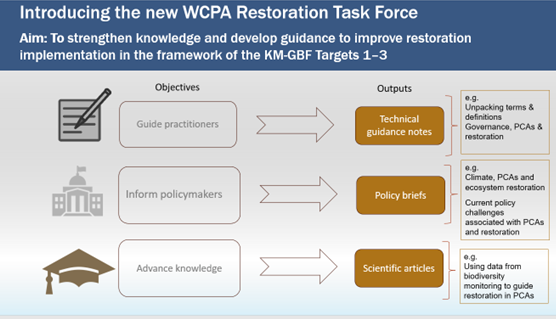
Restoration Task Force Fact Sheet
Draft list of restoration guidance of relevance to protected areas
Putting People at the Center of Ecosystem Restoration

IUCN WCPA Technical Notes
Other brief
2026
Aim: This technical note provides practical guidance on applying AI to participatory ecosystem restorationwithin, around, and between protected and conserved areas (PCA, as defined by IUCN), with the…
Other brief
2025
The aim of this technical note is to raise awareness of the challenges and solutions for monitoring ecosystem restoration in and around protected and conserved areas, and to assist restoration…

Other brief
2025
Whilst tensions about justice continue to hamper restoration projects, some important lessons have been learned about how best to avoid these problems. In particular, there is strong evidence that…