Kyung-Sik Woo is a geologist and a Professor Emeritus at Kangwon National University, Korea. He is a member of the National Academy of Sciences. He established the IUCN WCPA Geoheritage Specialist ...
IUCN COMMISSION GROUP
IUCN WCPA Geoheritage Specialist Group
Overview and description
Description:
As recognised in the current 20-year strategic vision for the Union, nature includes both non-living components (including geodiversity) and living components (i.e. biodiversity). Applying a whole ...
Group leadership

Prof Kyung Sik WOO
Commission Member
Kyung-Sik Woo is a geologist and a Professor Emeritus at Kangwon National University, Korea. He is a member of the National Academy of Sciences. He established the IUCN WCPA Geoheritage Specialist Group and has served as the Chair since 2013. He has carried out several World Heritage evaluations for IUCN since 2009. He was the President of International Union of Speleology from 2013 to 2017. He has published more than 300 scientific papers, including the palaeoclimatic study in Nature in 2014.
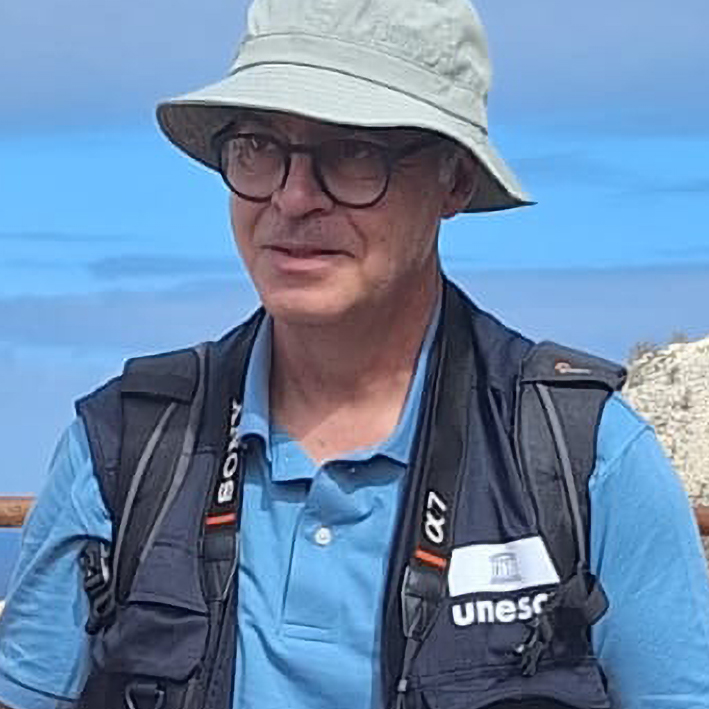
Prof José BRILHA
Commission Member
José Brilha is a geologist and full professor at the University of Minho, Portugal. He is Chairholder of the UNESCO Chair on Geodiversity and Geoconservation and a member of the Scientific Board of the UNESCO's International Geoscience Programme (IGCP). He was involved in the initiatives for establishing UNESCO's International Geodiversity Day.
José B. R. Brilha is a full professor in the Department of Earth Sciences at the University of Minho in Portugal. He holds a PhD in Geological Sciences from the University of Minho and the Université de Poitiers in France. His professional activities focus on geodiversity, geoheritage, and geoconservation. He is Chairholder of the UNESCO Chair on Geodiversity and Geoconservation and a member of the Scientific Board of the International Geoscience Programme (IGCP), under UNESCO. He has participated in missions to evaluate and revalidate UNESCO Global Geoparks and geological World Heritage Sites in countries such as China, Japan, Iceland, the UK, France, Spain, and Brazil. He was involved in the initiatives for establishing International Geodiversity Day, which was approved by the 41st Session of the UNESCO's General Conference in 2021. He has coordinated and contributed to various national and international research projects related to geoheritage inventories, geoconservation strategies, and geotourism. He was co-founder and Editor-in-Chief of Geoheritage (Springer), the first international journal dedicated to this subject. He has contributed to numerous international publications, some of which were produced under the auspices of the International Union for Conservation of Nature (IUCN), of which he is a member of the World Commission on Protected Areas and two of its Specialist Groups: Geoheritage and World Heritage. Alongside teaching and research, he has held various academic management positions at the University of Minho, including Director of the Earth Sciences Research Centre, Vice-President of the School of Sciences, and President of the School Board of Sciences. He has also supervised postgraduate students specialising in geoconservation at several universities.
José Brilha is a geologist and full professor at the University of Minho, Portugal. He is Chairholder of the UNESCO Chair on Geodiversity and Geoconservation and a member of the Scientific Board of ...

Dr Meng WANG
Commission Member
Meng is a senior paleoenvironmental geologist at the Chinese Academy of Sciences and the first Chinese scientist to hold the European EurGeol title. Founding President of the Young Earth Scientists (YES) Network spanning 5,000+ members across 149 countries, he researches ancient climates during the critical dinosaur-to-bird transition and leads global geoheritage initiatives. He serves on UNESCO's YoU-CAN steering committee and the World Young Scientist Summit, championing youth-led science in support of the UN's SDGs 2030.
I am a senior geologist in paleoenvironment from Chinese Academy of Sciences and the first Chinese with the European professional Geologist title as EurGeol. My research is quantificational rebuilding the paleoclimate form Late Jurassic to Early Cretaceous in Jehol Biota, North East of China by TEX 86, which is the most evolutionary transition period from the dinosaur to the early bird. I’m founder member and currently President of Young Earth Scientists (YES) Network found in 2008 during the launching event of the International Year of Planet Earth (IYPE) in UNESCO -Paris. This position offered me a tremendous chance to be exposed to the whole international community of geo-sciences and climate action, to young and senior geologists both from academy and industry. Now YES Network has more than 5000 memberships from 149 countries and 55 official National Chapters. We are working on so many interdisciplinary projects and initiatives all over the world. It will help me to linked with the countries in different stages of development and let the young generation to work together for the goals related to SDGs 2030, which is so urgent for all world. I am leading several research and consulting projects on geoheritage and natural heritage, especially the location with the fossils from China to Global. The visibility of my young geo-community grow so much that I was invited to be head of Chinese Delegation for G20 Youth Summit 2016 in China in connection with G20 Summit and Lead the section on Green Life and Sustainable Development. I am appointed as the member of Steering Committee of Young UNESCO Climate Action Network (YoU-CAN) and the Executive Secretary of World Young Scientist Summit, which are the global platforms for all young and early career scientist with the support letters from President Xi Jinping and UN Secretary General, Mr. Antonio Guterres. A serous of topics on global healthy, climate adaptation, new materials, resilience city, bio2bio were highly concerned and organized as slide events of WYSS as the implement of UN Sustainable Development Goals 2030.
Meng is a senior paleoenvironmental geologist at the Chinese Academy of Sciences and the first Chinese scientist to hold the European EurGeol title. Founding President of the Young Earth Scientists ...
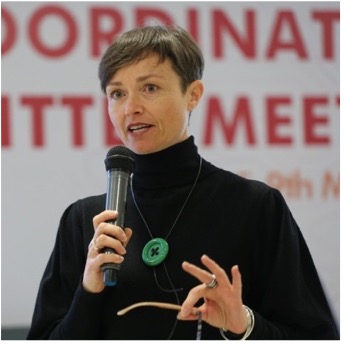
Dr Sophie JUSTICE
Commission Member
Sophie Justice is a geologist and Director of the Chablais UNESCO Global Geopark, France. An international geodiversity and geoheritage expert, Sophie is a member of the UNESCO Global Geopark Council (2026-2030) and an IUCN advisor for World Heritage criterion (viii). A member of the Geoheritage Commission for the Auvergne Rhone Alpes, France, she served as the elected Coordinator of the 113 UNESCO Global Geoparks located in 28 European countries (2022-2026).
An international expert on geodiversity conservation and management, education and communication. Sophie brings a pragmatic systems approach to her thinking and to positioning all peoples within our understanding of nature for innovative new approaches.
Recently, Sophie has been working to explicitly include geodiversity for stronger natural heritage management. This includes supporting capacity building for a full and integrated understanding of nature (biodiversity and geodiversity) for policy and decision makers.
Sophie's international experience brings geodiversity expertise to a range of protected and managed area approaches. Director of the Chablais UNESCO Global Geopark since 2015 and Scientific Advisory Board Member since 2008, Sophie has been appointed to the UNESCO Global Geoparks Council for the period 2026-30. She was the elected Coordinator of the European Geoparks Network which brings together 113 UNESCO Global Geoparks from 28 countries (2022-2026) and is both a Senior Evaluator for UNESCO Global Geoparks having conducted missions throughout the world since 2018 and an IUCN field evaluator for sites nominated to the World Heritage List, criterion (viii). Sophie’s other responsibilities include her membership of the Regional Commission for Geological Heritage, France and her geoheritage oversight for the Haute-Savoie Department, France. She is member of an EU Action Group working on Ecosystems, Geodiversity and Biodiversity within the EuroGEO program, supported by the European Commission. She is a regular speaker at international workshops and conferences.
Sophie’s early career in international finance focused on the renewable energy sector in Europe and North America. She brought together finance, sustainability, ESG and climate change in policy discussions and was appointed board member to the UNEP Sustainable Finance Initiative and the London Energy Partnership. She holds a PhD in Geophysics from the University of Liverpool and BSc in Earth Sciences from Imperial College, London.
A British-French national Sophie speaks fluent English and French.
Sophie Justice is a geologist and Director of the Chablais UNESCO Global Geopark, France. An international geodiversity and geoheritage expert, Sophie is a member of the UNESCO Global Geopark Council ...
If you are interested in joining this group, please contact the Co-chairs for further information.
Description
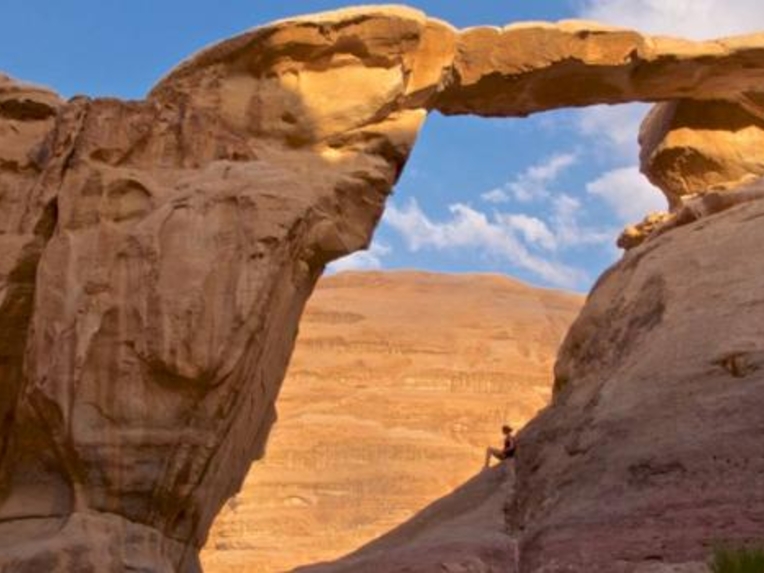
Nature must be viewed as an entire system where the combination of living and non-living components in ecosystems is essential to effective functioning. Geodiversity refers to the variety of the non-living elements of nature such as minerals, rocks, soils, fossils, landforms, and active geological and geomorphological processes. Together with biodiversity, geodiversity constitutes the natural diversity of planet Earth.
Geodiversity is an integral part of natural diversity and geoheritage an integral part of natural heritage.
Geodiversity and geoheritage are both fundamental for the UN Sustainable Development Goals, including those associated with terrestrial and marine biodiversity, human wellbeing, climate change, disaster risk reduction, and sustainable use of natural resources. They both contribute to adaptation measures under the Paris Accord on Climate Change as well as delivering the targets of the Global Biodiversity Framework such as conserving, managing and restoring ecosystems on land, in water and the seas, building resilience to climate change and maintaining natures contribution to people. The integration of geoconservation across a range of IUCN programs is important, to ensure that natural systems work as a whole.
Resources
IUCN publications
The meaning of Nature: Clarification for strengthened protection and management (2025)
Key Geoheritage Areas: scoping study and guidelines (2025)
Guidelines for geoconservation in protected and conserved areas (2020) (available in English, French, Portuguese, German, Arabic versions)
IUCN Resolutions (2008-2025)
7.074 Geoheritage and protected areas (2020)
7.088 Conservation of the natural diversity and natural heritage in mining environments (2020)
6.083 Conservation of moveable geological heritage (2016)
5.048 Valuing and conserving geoheritage within the IUCN Programme 2013–2016 (2012)
4.040 Conservation of geodiversity and geological heritage (2008)