Explainer brief

Regenerative Blue Economy

  • A Regenerative Blue Economy is an economic model that combines rigorous and effective regeneration and protection of the ocean and marine and coastal ecosystems with sustainable, low or no-carbon economic activities, and fair prosperity for people and the planet, now and in the future.
  • It seeks to reduce the impact of economic activities on biodiversity, promote the circular economy, decarbonisation, Nature-based Solutions and sustainable practices aligned with global commitments, while excluding destructive practices. 
  • It prioritises the needs of island states and Indigenous Peoples’ rights, traditions, stewardship and leadership in coastal and marine resource management and development.
  • Achieving a Regenerative Blue Economy on a global scale will only be possible through global cooperation and a broad transformation spanning multiple economic sectors.

What is it?

The regenerative Blue Economy is an emerging concept of an economic model that actively protects and restores marine and coastal ecosystems whilst benefitting society. Based on IUCN’s work, a proposed definition of a Regenerative Blue Economy is “an economic model that combines rigorous and effective regeneration and protection of the ocean and marine and coastal ecosystems with sustainable, low or no-carbon economic activities, ensuring fair prosperity for people and the planet, now and in the future”.

The ocean supports over 3 billion people and contributes $2.6 trillion annually to the global economy (OECD 2025). Yet, economic activities in marine and coastal areas, known as the Blue Economy, have traditionally prioritised economic growth over sustainability. This has often led to resource overexploitation and marginalised vulnerable communities, particularly in Small Island Developing States.

Marine ecosystems are facing severe threats, largely induced by human activities. Every day, between 9 and 14 million metric tons of plastic enter the ocean (UNEP 2021). A third of global fish stocks are overfished (FAO 2024), while approximately 50% of mangroves and 30% of wetlands have been lost due to habitat destruction (IPBES 2025). Warmer temperatures are causing ocean acidification, with up to 99% of corals at risk under a 2°C warming scenario (IPCC 2019).

Offering an alternative to the business-as-usual model of the “brown” Blue Economy and going beyond the “sustainable” Blue Economy model, which seeks to reduce the environmental impact of traditional maritime sectors, a Regenerative Blue Economy aims for the highest level of sustainability. It presents a shift from exploitation to conservation, promoting restoration and revitalisation, while restricting activities deemed incompatible with climate and biodiversity goals, such as oil exploration and deep-sea mining.

Five founding principles underpin the IUCN Regenerative Blue Economy definition:
• protecting, restoring and regenerating marine and coastal ecosystems;
• creating an innovative, inclusive, equitable and solidarity-based economic model;
• adopting inclusive and transparent governance;
• decarbonising activities while generating positive impacts on ecosystems and advancing circular economy; and
• acting for and with island states, Indigenous Peoples and coastal communities.
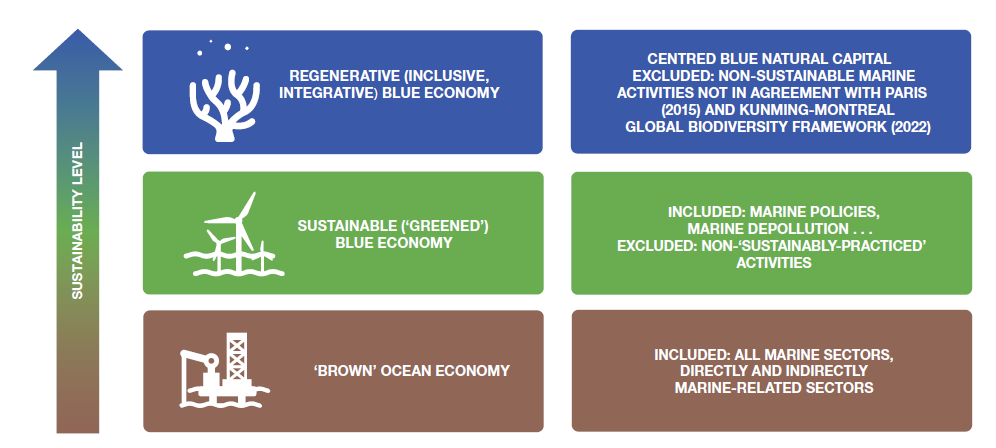
Possible sectors and scope of the Blue Economy, sustainable Blue Economy and Regenerative Blue Economy. Source: IUCN
Possible sectors and scope of the Blue Economy, sustainable Blue Economy and Regenerative Blue Economy. Source: IUCN

What are the benefits?

A Regenerative Blue Economy model balances economic opportunities, such as sustainable fisheries, aquaculture, tourism, renewable energy generation and job creation, with conservation and ecological restoration of marine ecosystems. Such a combination enhances biodiversity, supports human health and well-being, and enables economic prosperity, as communities depend on marine and coastal environments for food production, shoreline protection, nutrient cycling, carbon sequestration and recreational opportunities.

By emphasising social equity, a Regenerative Blue Economy ensures the fair sharing of benefits from economic development and the empowerment of Indigenous Peoples and local communities. The concept also aligns with multiple international biodiversity commitments such as Sustainable Development Goal 14 “Life below Water”, the Biodiversity Beyond National Jurisdiction (BBNJ) Agreement, the Kunming-Montreal Global Biodiversity Framework, the Paris Climate Change Agreement and the proposed Global Plastics Treaty.

What are the challenges?

Achieving a Regenerative Blue Economy requires a broad transformation of industries that are harmful to the marine environment, supported by integrated management efforts spanning multiple economic sectors. Best practice examples and business models that can be replicated at various scales are essential in this process. Although these are currently available in sectors such as fishing, aquaculture and tourism, others are far from being defined, such as those relating to blue carbon – carbon dioxide that is captured and stored by marine and coastal ecosystems. 

Another difficulty relates to transboundary issues, such as pollution, migratory species and climate change, or to environments that are not subject to the jurisdiction of any single country, like the high seas. International cooperation, extending beyond national borders and economic zones, is key to progress. However, collaboration might be challenging to orchestrate due to the diversity of interests and views on the Blue Economy among different groups of states, economic players and local communities. In this context, a clear, unified definition and principles are needed to integrate sustainable, decarbonised and fair economic practices within global ocean governance.

What's next?

At the 2025 IUCN World Conservation Congress, IUCN Members adopted Resolution 8.030 providing a comprehensive framework for a Regenerative Blue Economy. It encompasses the IUCN definition of the concept and five founding principles to ensure that marine conservation, ecosystem restoration and social equity are at the core of blue economic activities. Beyond this, the concept’s successful implementation hinges on decisive action in the following areas:

Restoring and protecting marine ecosystems 
Marine protected areas must be expanded to achieve the 30x30 goal as defined in Target 3 of the Kunming- Montreal Global Biodiversity Framework and to foster investments in Nature-based Solutions such as low trophic aquaculture projects.

Promoting inclusive, transparent and accountable governance and partnerships
Collaborative frameworks that adopt an inclusive, regenerative approach must be expanded to promote collaboration among coastal communities, governments, the private sector and NGOs. A prominent example is the Great Blue Wall, a multi-stakeholder platform endorsed at the 2021 IUCN World Conservation Congress and subsequently launched at UNFCCC COP26 in Glasgow, aimed at creating interconnected protected and conserved marine areas that counteract the effects of climate change.

Financing sustainable economic activities
Subsidies to harmful industries such as oil extraction and deep-sea mining should be abolished. Official development assistance, public and private financial investment mechanisms should be clearly redirected towards supporting regenerative practices, including key sectors such as fisheries, aquaculture, tourism and marine renewable energies. In parallel, finance instruments such as sustainable investment blue funds and community-based projects should be promoted, as well as public-private partnerships.

Investing in scientific research and development, enhancing monitoring and accountability
There is a need to further document the marine and coastal ecosystems and to propose key performance indicators in order to track the ecological, social and economic progress of new initiatives, allowing for their evaluation and continuous development. Data systems must be science-based, harmonised, robust and transparent.

Strengthening national and local capacities
The expansion of capacity-building programmes can support local participation and co-management of maritime and coastal resources. Topics covered should include technical support, marine spatial planning, ecosystem-based management, policy development, integrated governance, monitoring, reporting, and technical and financial aspects.

Where can I get more information? 

Le Gouvello R. et al. (2023). The IUCN Global Standard for Nature-based Solutions™ as a tool
for enhancing the sustainable development of marine aquaculture.

Le Gouvello, R. & Simard, F. (2024). Towards a regenerative Blue Economy. Mapping the Blue
Economy. (Funded by AFD as part of the 2021- 2025 France-IUCN partnership)

OECD (2025). The Ocean Economy to 2050.

Builders vision, ORRAA, Katapult Ocean and WEF (2025). Making Waves in the Regenerative &
Sustainable Ocean Economy: Transformative Ocean Investment Opportunities.