IUCN Statement to the 48th Session of the World Heritage Committee
IUCN Regional Director for Asia and Hub Director for Oceania Dindo Campilan delivered IUCN's statement to the 48th session of the World Heritage Committee in Busan, Republic of Korea on 21 July 2026. Read the full statement below.
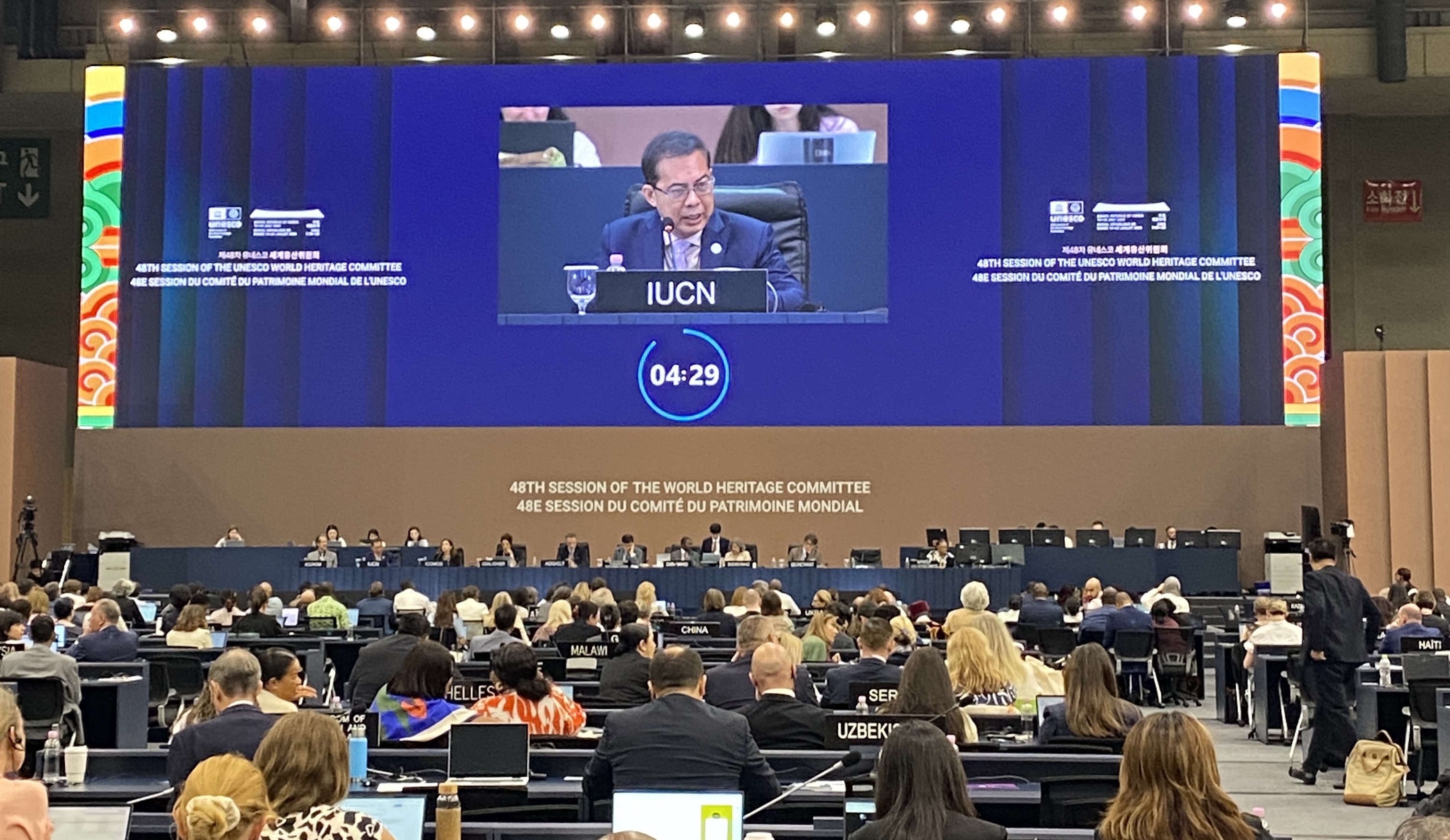
Thank you, Mr Chair.
On behalf of IUCN’s entire Union constituency, I would like to thank the Republic of Korea for hosting this session of the World Heritage Committee.
IUCN’s technical advisory role capitalises on its global network of regional and country offices associated with key Parties to the Convention. Thus, as IUCN’s Regional Hub Director for Asia and Oceania, I am honored to represent and speak on behalf of IUCN’s 11 regions across the Asia-Pacific, Africa, Europe and the Americas.
IUCN’s report under this item reflects another year of significant technical work in support of the Convention, which is delivered through the diverse expertise from across IUCN – coordinated through the World Heritage Team who are here in Busan – but also through our global network of Secretariat offices, our expert Commissions, and our wider Union of Members in over 170 countries.
This regional foundation matters. The challenges facing World Heritage properties are increasingly complex. They are global challenges, but they are experienced by communities and countries. Effective responses therefore depend on local, national and regional expertise and sustained engagement.
This is why IUCN is especially pleased that its new four-year Programme for 2026-29 includes for the first time a specific World Heritage result. This places World Heritage clearly within IUCN’s priorities as a global Union to achieve effective and equitable conservation.
The World Conservation Congress in Abu Dhabi last October gathered over 10,000 participants, demonstrating IUCN’s power of the Union to tackle urgent conservation challenges.
The fourth IUCN World Heritage Outlook, launched at that Congress, underlines why the nature-climate nexus matters. It reveals that climate change is now the most prevalent threat to natural World Heritage, affecting 43% of properties, while invasive alien species, financing gaps and uneven management effectiveness continue to place many sites under pressure.
In this context, IUCN will continue to work with UNESCO, the Advisory Bodies, States Parties and the International Indigenous Peoples’ Forum on World Heritage to turn global standards into practical conservation outcomes. Through the World Heritage Leadership Programme, the WCPA World Heritage Specialist Group, work on international designations supported by the Republic of Korea and the Province of Jeju, and our engagement on climate action, IUCN is committed to strengthening World Heritage as a beacon for conservation.
Mr Chair, IUCN maintains that the priorities identified through the Open-ended Working Group now need to be translated into coherent action. IUCN stands ready to support this work.
Thank you Mr Chair.

The Bangladesh Forest Department (BFD) and IUCN Bangladesh, with support from Agence Française de…

Each year, International Women's Day is an opportunity to recognise the women advancing change in…

On 14 January 2026, in Dhaka, the Bangladesh Forest Department and IUCN Bangladesh formally signed…