How a small grass seed banking group cultivated hope in arid lands
Supported by the Green Climate Fund (GCF)-funded Towards Ending Drought Emergencies (TWENDE) project, the Kaume B Grass Seed Banking Group in Marimanti Ward, located in Kenya's Tharaka Nithi county, is rewriting its narrative from one of adversity to one of resilience, innovation, and community triumph.
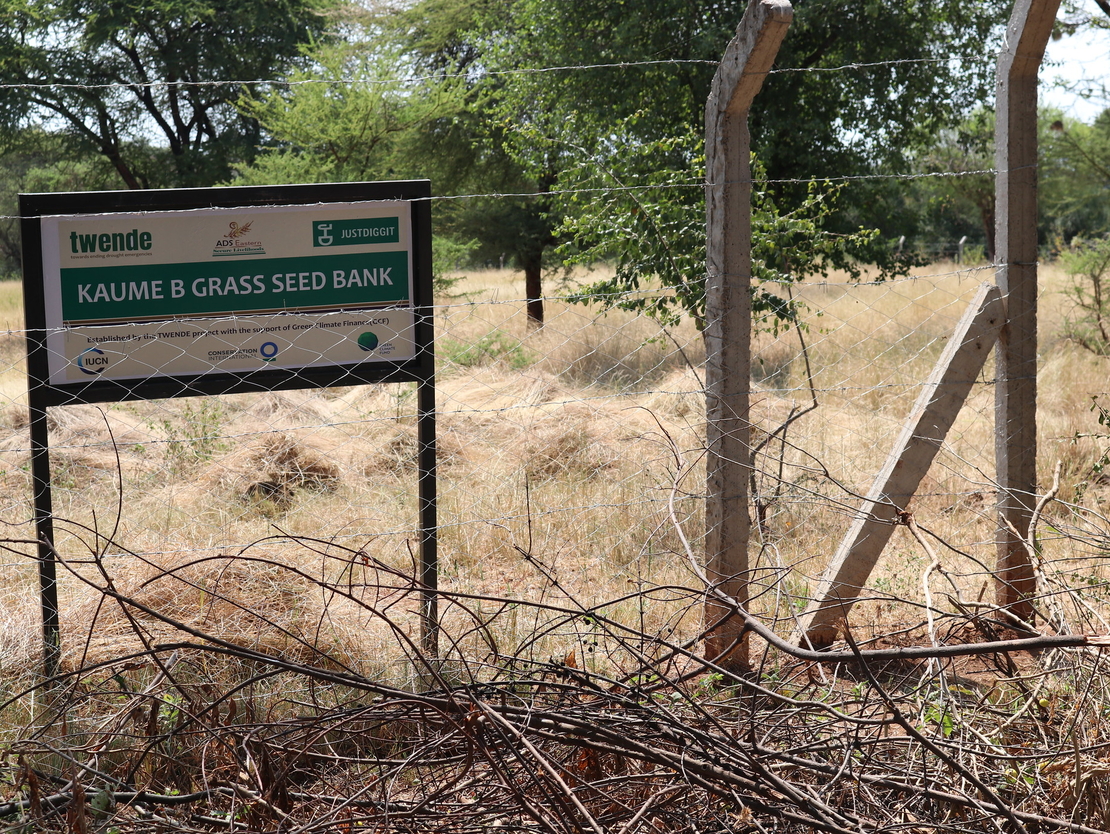
In the rugged terrain of Marimanti Ward in Tharaka Nithi County in Kenya, an extraordinary transformation is unfolding amidst what many would consider impossible conditions. The Kaume B Grass Seed Banking Group has written a new narrative - one of resilience, innovation, and community triumph. When the group first came together in 2023, their circumstances mirrored those of countless rural communities across Kenya's drylands. Reliant on rain-fed green gram cultivation, they faced constant uncertainty as crops failed season after season. Children's school fees went unpaid, meals became less certain, and the future appeared increasingly bleak. Yet within this group of 28 farmers (19 women and 9 men) envisioned a different path, one where they could work with their challenging environment rather than be defeated by it.

The turning point arrived when they envisioned an innovative solution of creating a communal grass seed bank as a sustainable alternative to traditional farming. Recognizing that drought-resistant (indigenous) fodder grasses could not only survive their harsh climate but actually regenerate the degraded landscape, they developed a visionary proposal. This concept captured the interest of key partners Justdiggit and Mt. Kenya Hub - implementing partners of the TWENDE project. Their support transformed abstract ideas into tangible reality, and by March 2024, the group's ambitious plans began springing to life across their once-barren fields.
Tractors ploughed through the hardened soil, breathing life into 10 acres of long-neglected land. The rhythmic pounding of fence posts marked the creation of protective barriers against wandering livestock. A sturdy hay barn was built and most importantly, certified grass seeds found their way into the revitalized earth, each one carrying the promise of a better tomorrow.

Nature would test their resolve. The first planting failed when anticipated rains never came. Yet where others might have surrendered, Kaume B adapted. They replanted, applying their new knowledge of sustainable land management. Their perseverance was rewarded with an abundant harvest of 480 bales of nutritious hay and 400 kilograms of precious grass seed. The land that had been written off as barren now teemed with life, its vibrant green shoots standing as living proof that even the most challenging environments can flourish with proper care and technique.

The ripple effects of this agricultural success have touched every aspect of community life. Women members, who once struggled to provide for their families, now stand taller with the confidence that comes from financial independence. The hay sales have become a reliable source of income, ensuring children's education continues uninterrupted and medical needs can be met. Young people, who might have abandoned their ancestral lands for uncertain urban opportunities, now see viable futures in agriculture. Neighbouring farmers, initially skeptical, now come seeking knowledge, eager to replicate Kaume B's model on their own plots.
Beyond economic benefits, the environmental impact has been profound. The group's harvested seeds now contribute to large-scale land restoration efforts, being planted in carefully constructed half-moon bunds across degraded rangelands. Areas that once knew only erosion and dust now retain moisture and support vegetation. The group has become living proof that environmental rehabilitation and economic prosperity can grow from the same root.
Today, Kaume B's vision continues to expand with their Village Savings and Loan Association (VSLA) strengthening community financial resilience, turning small, regular contributions into meaningful opportunities. Plans are underway to provide each member with a goat, further diversifying their livelihoods. An additional 10 acres awaits cultivation, promising even greater impact.

The story of Kaume B Group is testament that the most powerful transformations begin with a simple decision to see potential where others see only limitation. These farmers have demonstrated that with appropriate support, shared vision, and unwavering determination, communities can indeed turn adversity into advantage. Kaume B Group has shown that when people unite behind a common purpose, when knowledge meets opportunity, and when perseverance outlasts difficulty, even the most challenging environments can become places of abundance. Their journey continues to inspire, proving that the seeds of change, once planted with care, can grow beyond what anyone thought possible.
The Towards Ending Drought Emergencies (TWENDE) project, a Green Climate Fund (GCF)-funded initiative with a total of $34.5 million ($23,152,082 GCF financing & $11,390,900 co-financing), is a collaborative effort aimed at reducing the economic burden of climate change-induced drought on Kenya's national economy. This is achieved by increasing the resilience of the livestock and other land-use sectors through the restoration and effective governance of rangeland ecosystems. The project is implemented by the International Union for Conservation of Nature (IUCN) and executed by the National Drought Management Authority (NDMA), the Ministry of Agriculture and Livestock Development (MoALD), and Conservation International. These three entities lead the project's components on climate change-adapted planning for drought resilience, restoration of rangeland landscapes for ecosystem-based adaptation, and climate change-resilient ecosystem management for investments, respectively. Other key partners supporting implementation include JustDiggit (JDI), the Water Resources Authority (WRA), ICRAF, KEFRI, and the Mt. Kenya Hub (MKH).


The Bangladesh Forest Department (BFD) and IUCN Bangladesh, with support from Agence Française de…

Each year, International Women's Day is an opportunity to recognise the women advancing change in…

On 14 January 2026, in Dhaka, the Bangladesh Forest Department and IUCN Bangladesh formally signed…