Roundtable Reflections: The ICJ Climate Change Advisory Opinion and the BBNJ Agreement
This is a summary report of the “Roundtable Discussion on the ICJ Advisory Opinion on Climate Change and the BBNJ Agreement” held Tuesday 26 August 2024, 1:15-2:30 pm, UN Headquarters, Conference Room 2 during the Second Meeting of the Preparatory Commission for the Agreement under the United Nations Convention on the Law of the Sea on the conservation and sustainable use of marine biological diversity of areas beyond national jurisdiction.
Photo: Bianca Ortero
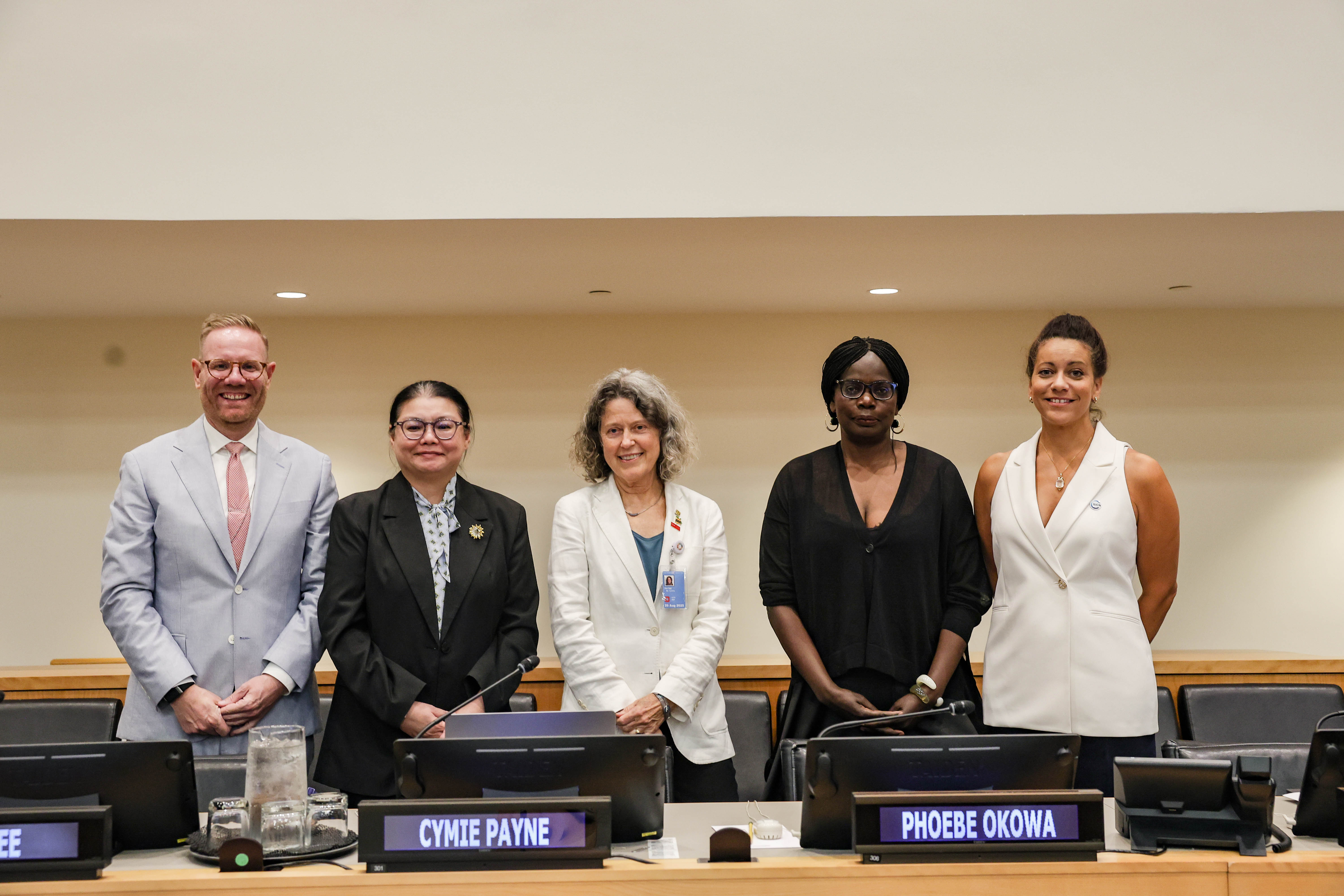
Photo: Bianca Ortero

Photo: Bianca Ortero

Photo: Bianca Ortero

Photo: Bianca Ortero

Photo: Bianca Ortero

By Cymie R. Payne (Professor, Rutgers University; Chair, IUCN-WCEL Ocean Law)
Three distinguished international lawyers discussed the July 2025 International Court of Justice (ICJ) Climate Change Advisory Opinion during the Preparatory Commission for the marine Biodiversity Beyond National Jurisdiction (BBNJ) Agreement. Ambassador Rena Lee (former president of the BBNJ Agreement negotiations), Professor Phoebe Okowa (member of the UN International Law Commission), and Professor Bryce Rudyk (legal advisor to the Alliance of Small Island States (AOSIS)), moderated by Professor Cymie Payne (IUCN-WCEL Ocean Law Chair), reflected on their experience as legal counsel in this case and spoke to the synergy between the Advisory Opinion and the BBNJ Agreement. To capture its significance, a group of lawyers who had argued before the Court gathered for a roundtable to reflect on the outcome and synergies with the BBNJ Agreement.
As Ambassador Lee noted, this opinion comes at an interesting time: the BBNJ Agreement is anticipated to enter into force in early 2026 and the Preparatory Commission is now working hard on developing its institutional mechanics and details. The ocean is crucial to moderating the effects of greenhouse gas emissions, and the BBNJ Agreement is essential for conservation of the two-thirds of the marine environment that lies outside the control of any one State.
When the UN General Assembly asked the International Court of Justice (ICJ) to issue an advisory opinion on States’ obligations to protect the climate system and the consequences of failing to do so, the request was hailed as historic. Following opinions from the International Tribunal for the Law of the Sea (ITLOS) and the Inter-American Court of Human Rights, the ICJ’s decision was widely anticipated.
Highlighting that this was the first time many States and climate-vulnerable countries had represented themselves directly before the Court, Professor Okowa observed that the broad participation and agreement on many points in the submissions provided a clear pathway for the Court’s bold findings.
The ICJ’s unanimous opinion strikingly found that a state can be in breach of its obligation to take measures to mitigate GHG emissions, engaging its state responsibility. The message was that treaties must be read as part of an interlinked system of law, and the climate change treaties cannot be treated in isolation—they must be read in the context of UNCLOS, other environmental treaties, and customary law. The ICJ rejected the argument of some States that only the UN Framework Convention on Climate Change and the Paris Agreement establish climate change obligations, and that Nationally Determined Contributions are not enforceable or justiciable.
The ICJ reaffirmed the need for states to take “all necessary measures” and to do “their utmost” to prevent climate change harm, guided by the best available science. This is a demanding due diligence standard, Professor Okowa emphasized, the Court was clear: states don’t have unlimited discretion and science sets the benchmark.
Another key finding, highlighted by Ambassador Lee, was the Court’s statement that the duty to cooperate is not a matter of choice. It is a pressing need and a legal obligation. States seeking to operationalize the advisory opinion should look to the BBNJ Agreement’s many provisions that establish obligations to cooperate with other BBNJ Parties, stakeholders and other relevant international frameworks and bodies. The BBNJ Agreement embeds this principle throughout, including the need to cooperate on marine scientific research and transfer of marine technology.
Cooperation begins at the national level with internal coordination across different agencies, which in turn drives international cooperation. Ambassador Lee described the internal inter-agency process that Singapore used to develop its argument for the ICJ, a concrete example of an approach that States can use to coordinate their national positions across other relevant institutions, frameworks, and bodies, such as the FAO, IMO, and ISA.
For lawyers representing AOSIS members, the Court’s treatment of sea-level rise was especially significant. Professor Rudyk commented that the Court’s statement that baselines remain fixed, and that loss of territory does not automatically mean loss of statehood, increases legal stability. He noted that this holding also strengthens the BBNJ Agreement by reinforcing the continuity of states’ legal identities and responsibilities.
Not everything was settled. The roundtable wrestled with the Court’s silence on specially affected states and cumulative impacts, and its cautious treatment of historical emissions. Significant uncertainty remains about when exactly the obligation to act began—1992 with the UNFCCC, or earlier. Attribution science complicates the timeline, and the Court avoided that minefield.
The final theme was dynamism. The lawyers agreed that the Court treated treaties as living instruments. “What really struck me,” said one participant, “was the statement that COP decisions are relevant to treaty interpretation. That keeps agreements like BBNJ alive and adaptable.” Another concluded: “There’s a symbiotic relationship here. BBNJ decisions will influence customary law, and customary law will, in turn, shape how BBNJ is understood. That is a powerful legacy of this opinion.”
The roundtable ended with a sense of cautious optimism. The ICJ’s advisory opinion did not resolve every controversy, but it provided clarity where clarity was needed most: climate change is not only a political challenge but a matter of law.
Acknowledgements:
- The event was co-sponsored by the Permanent Mission of Kenya to the United Nations, the Permanent Mission of Singapore to the United Nations, and the Alliance of Small Island States
- Funding from the Government of Sweden made this event possible
Additional information:
Full texts:
- ICJ Advisory Opinion on the obligations of States in respect of Climate Change (https://www.icj-cij.org/sites/default/files/case-related/187/187-20250723-adv-01-00-en.pdf)
- ITLOS Advisory Opinion (https://www.itlos.org/en/main/cases/list-of-cases/request-for-an-advisory-opinion-submitted-by-the-commission-of-small-island-states-on-climate-change-and-international-law-request-for-advisory-opinion-submitted-to-the-tribunal/)
- Inter-American Court of Human Rights Advisory Opinion (https://www.corteidh.or.cr/docs/opiniones/seriea_32_en.pdf)
IUCN contributed at all stages of the proceedings for the climate change advisory opinions at the International Court of Justice, the International Tribunal for the Law of the Sea, and the Inter-American Court of Human Rights. (All IUCN submissions are publicly available. Click on the name of each tribunal to access the IUCN written submissions).
Themes: Climate Change, Governance – Law and Rights, Ocean, Governance
Topics: Climate change impacts on nature, Ocean health
NATURE 2030 PRIORITIES: (/nature-2030/climate).
IUCN Commission: WCEL
IUCN Secretariat: Ocean Team, Marine Biodiversity of Areas Beyond National Jurisdiction (BBNJ)

The Bangladesh Forest Department (BFD) and IUCN Bangladesh, with support from Agence Française de…

Each year, International Women's Day is an opportunity to recognise the women advancing change in…

On 14 January 2026, in Dhaka, the Bangladesh Forest Department and IUCN Bangladesh formally signed…