Please find the download link to learn more about the casebook
https://www.nmhms.org.cn/details/1b1aVid-E.html
For more information, please contact:
IUCN China, [email protected]
Building on the first batch released in 2023, the Ministry of Natural Resources (MNR) of the People’s Republic of China and the International Union for Conservation of Nature (IUCN) unveiled the second batch of the International Applications of Ecosystem-based Disaster Risk Reduction in Coastal Areas at the opening of the 2025 Global Coastal Forum on 24 September in Yancheng, China.
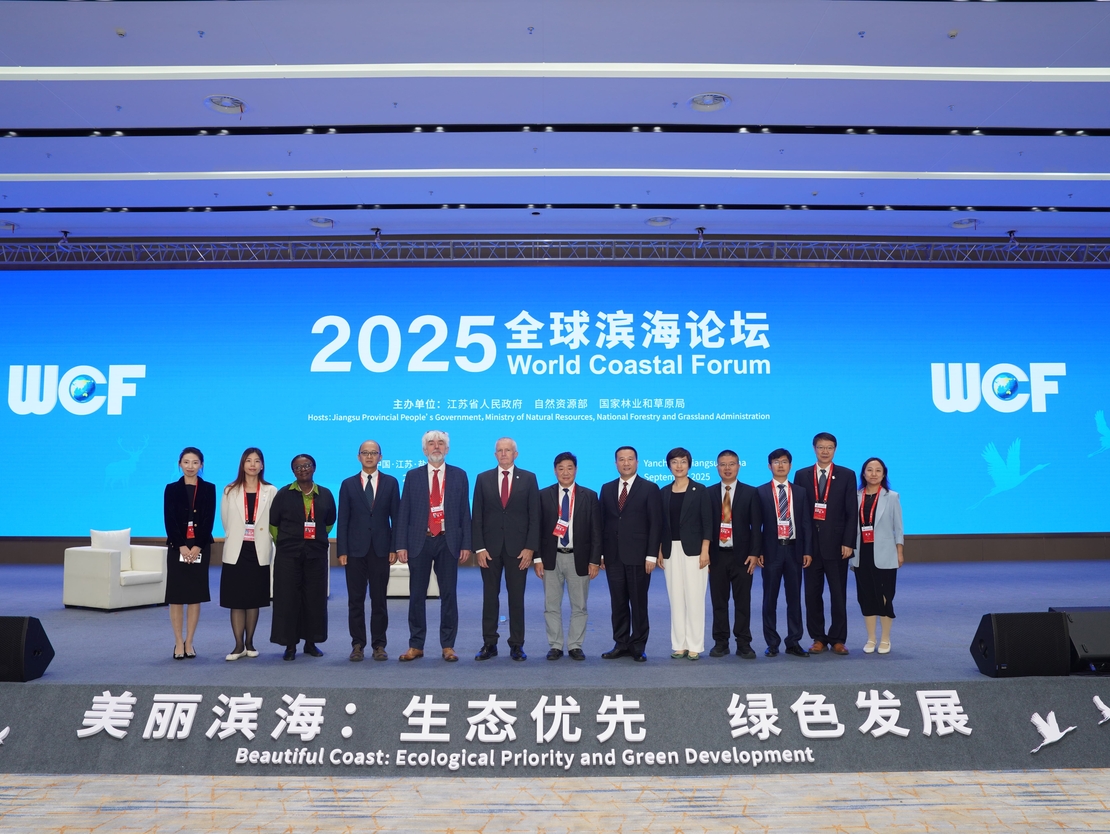
IUCN and MNR delegates at 2025 World Coastal Forum
Amid global climate change, rising storm surges, waves, and coastal erosion threaten both human safety and the sustainable development of the marine economy. To bolster resilience, MNR has implemented a series of coastal protection and restoration projects, leveraging the natural functions of mangroves, salt marshes, sandy shores, seagrass beds, and oyster reefs to dissipate waves, stabilise shorelines, and safeguard beaches.
These practices not only help to build more resilient and safer coasts but also draw upon traditional Chinese ecological approach of “following the ways of nature.” At the same time, they echo IUCN’s emphasis on Nature-based Solutions (NbS), achieving co-benefits in ecological conservation and disaster risk reduction.
In 2023, MNR and IUCN jointly released the first batch of the International Applications of Ecosystem-based Disaster Risk Reduction in Coastal Areas. This publication provided valuable practical references for integrating ecological conservation, safety, and economic development in coastal regions.
In 2024, the “Xiamen Declaration", adopted at the East Asian Seas (EAS) Ministerial Forum, elevated the practice of Eco-DRR into a framework for regional cooperation. In the same year, Xiamen and 11 other Chinese cities jointly launched an initiative to further apply the China’s approach of “Ecological Civilisation”, promoting context-based NbS and exploring optimal pathways for ecological protection and restoration.
In 2025, MNR and IUCN once again collaborated to select and publish nine representative Eco DRR case studies as follows:
● Tianjiaoshan Coast, Huludao City, Liaoning Province, China
● Qilihai Lagoon, Qinhuangdao City, Hebei Province, China
● Chaoyang Port Lagoon, Haoyunjiao, Weihai City, Shandong Province, China
● Hua’ao lsland, Ningbo City, Zhejiang Province, China
● Sandy Coast in Dongtou District, Wenzhou City, Zhejiang Province, China
● Qinzhou Bay, Guangxi Zhuang Autonomous Region, China
● Coastal Dune Restoration and Disaster Mitigation in Taeanhaean National Park, Republic of Korea
● Coastal Mangrove Restoration in Demak District, Indonesia
● Beach-Dune-Lagoon Restoration and Disaster Mitigation in La Pletera, Spain
These cases cover the restoration of mangroves, salt marshes, and sandy coasts, as well as the ecological enhancement of seawalls. They also highlight innovative approaches such as mobilising private sector investment, strengthening community participation, and piloting carbon accounting and trading. Taken together, they demonstrate multiple co-benefits in disaster risk reduction, ecological functions, climate adaptation and mitigation, and socioeconomic development.
The release of this second batch of case studies aims to share knowledge, build consensus, and contribute to the implementation of the Sustainable Development Goals (SDGs), the UN Decade on Ecosystem Restoration, and the Sendai Framework for Disaster Risk Reduction. It reinforces the principle of placing “ecological priority and green development” at the centre of coastal management, and calls for collective efforts to create resilient coasts where people and nature thrive in harmony.
Please find the download link to learn more about the casebook
https://www.nmhms.org.cn/details/1b1aVid-E.html
For more information, please contact:
IUCN China, [email protected]

The Bangladesh Forest Department (BFD) and IUCN Bangladesh, with support from Agence Française de…

Each year, International Women's Day is an opportunity to recognise the women advancing change in…

On 14 January 2026, in Dhaka, the Bangladesh Forest Department and IUCN Bangladesh formally signed…