Uniting for Grasslands, Savannahs, and Rangelands: A Call to Collective Action for IUCN Members and Partners
This week at the IUCN World Conservation Congress 2025, the IUCN Forest and Grasslands Team brought together a diverse group of high-level speakers, technical experts, and community representatives for the event “Uniting for Grasslands, Savannahs and Rangelands: A Call to Collective Action for IUCN Members and Partners.” The session promoted discussion on collective action for the conservation, restoration, and sustainable management of these critical ecosystems, elevating them at the IUCN Congress and building momentum for the improved recognition and sustainable management of them going forward.
Photo: Katherine Poe/IUCN
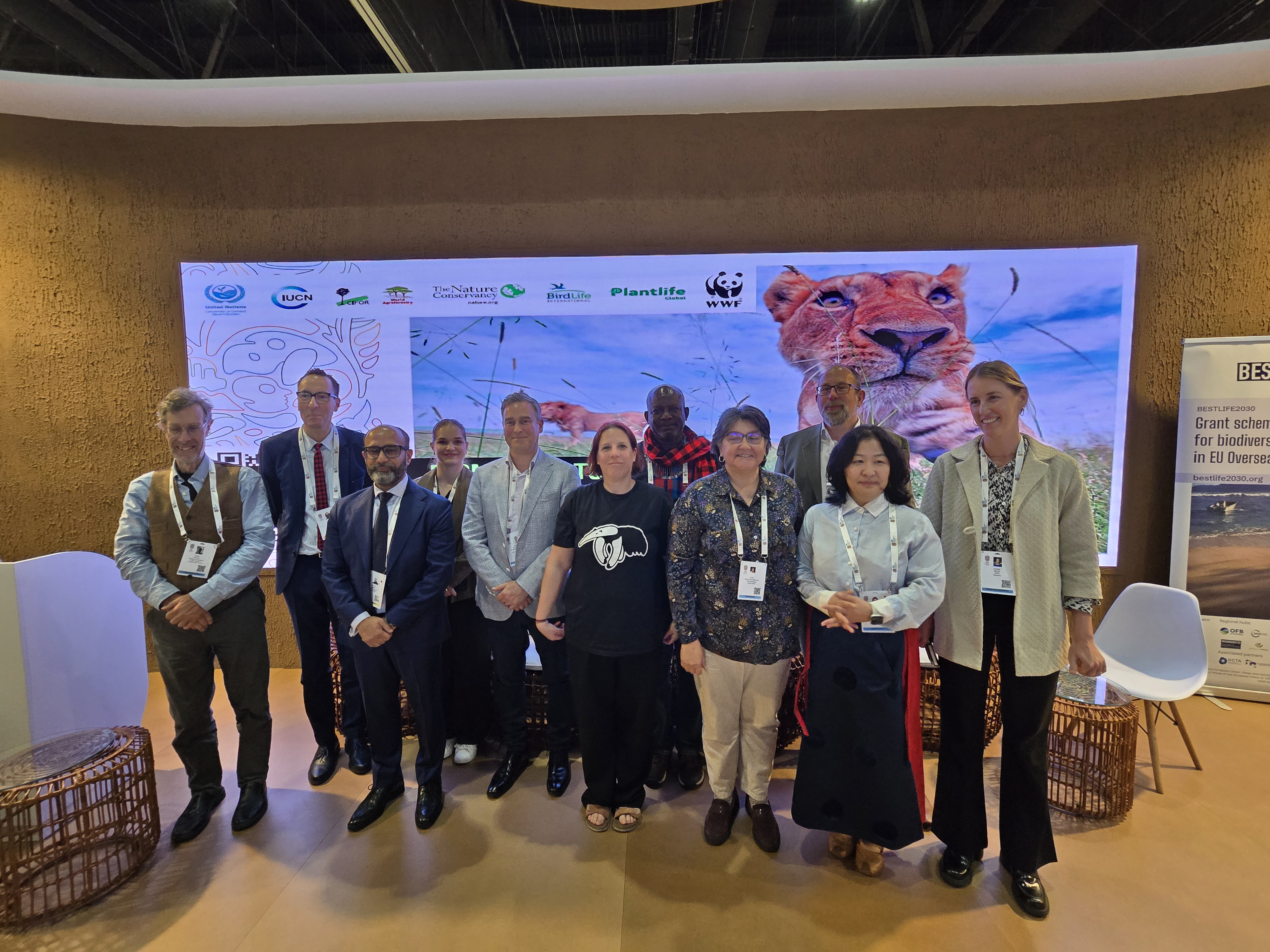
Photo: Katherine Poe/IUCN

Photo: Katherine Poe/IUCN

Photo: Katherine Poe/IUCN

Photo: Katherine Poe/IUCN

Photo: Katherine Poe/IUCN

Photo: Katherine Poe/IUCN

Photo: Katherine Poe/IUCN

The event convened IUCN members, partners, conservation leaders, policymakers, and community representatives to strengthen global collaboration for the protection, sustainable management, and restoration of grasslands, savannahs, and rangelands. The session highlighted ongoing work on integrating grassland, savannah, and rangeland conservation into biodiversity and climate commitments, as well as efforts to strengthen restoration initiatives, promote sustainable pastoralism, and mobilize investment to support long-term ecosystem resilience and local livelihoods.
The session showcased diverse experiences and innovations from across sectors, highlighting practical approaches and lessons learned. Speakers shared examples from policy, community, practice, and investment perspectives, demonstrating how integrated and multifunctional solutions in grassland and rangeland management—including pastoralism—can simultaneously deliver benefits for biodiversity, climate resilience, and local livelihoods. The discussion inspired collaboration among IUCN Members, partners, and stakeholders, identifying concrete opportunities to strengthen cooperation and scale up impact from local to global levels.
As the world looks ahead to the 17th Conference of the Parties to the United Nations Convention to Combat Desertification (UNCCD COP17), set to take place in Mongolia next year, as well as the International Year of Rangelands and Pastoralists (IYRP) in 2026, the was a step forward in building momentum towards bringing grasslands, savannahs, and rangelands to the forefront of the global conservation and climate agendas.
Setting the Global Agenda for Grasslands and Rangelands
Moderated by Chetan Kumar, Global Head of the IUCN Forest and Grasslands Team, the session featured opening remarks from Ariuntuya Dorjsuren, Director General of the Policy, Planning and Resource Mobilization Department at the Office of the COP17 National Committee.
In his keynote address, Oliver Conz, Director General at Germany’s Federal Ministry for the Environment, Nature Conservation, Nuclear Safety and Consumer Protection (BMUKN), emphasised that grasslands, savannahs, and rangelands are still undervalued and overlooked despite their widespread global distribution. “From the green meadows of Europe to the vast grassland and savannah ecosystems in the Argentine Humid Chaco and Pampas, the Colombian Orinoquia and the Paraguayan Chaco-Pantanal and the resilient arid lands of the Emirates, rangelands remind us of both nature’s diversity and our shared responsibility,” he said. “Let us work together to ensure these landscapes continue to sustain life on Earth for generations to come.”
Andrea Meza Murillo, UNCCD Deputy Executive Secretary, highlighted the need for a more comprehensive approach that centers people and livelihoods: “Rangelands are the green heart of our planet—feeding people, storing carbon, sustaining wildlife and nurturing cultures. By restoring them, we do not only restore the land but also the hope and resilience of millions of people.”
Carlos Drews, WWF Biodiversity Practice Leader, called for enhanced coordination to leverage opportunities across policy and global conventions as the mechanism for scaling up conservation of these vital ecosystems. “Our path to healthy grasslands demands bold, coordinated policy action: from supporting UNCCD Land Degradation Neutrality goals and integrating grasslands across the Rio conventions to removing harmful subsidies and empowering pastoralist communities through participatory land use planning,” he said. "Only with strong legislation, sustained funding, local capacity building, and respect for Indigenous peoples' and pastoralists' rights can we restore and conserve these vital ecosystems for people and wildlife alike.”
The high-level segment concluded with a message from Stewart Maginnis, IUCN Deputy Director General. He emphasised the real-life impacts of land degradation on people who directly depend on natural resources for subsistence and food security. He urged the Union to leverage this pivotal opportunity in time to mobilize resources for grassland, savannah, and rangeland conservation and restoration. “IUCN has demonstrated how science, policy, and practice can be aligned to deliver impact on the global scale,” he emphasised. “That capacity must be applied to bring grasslands, savannas, and rangelands from the margins to the center of conservation—recognising them as ecosystems vital to confronting the biodiversity, climate, and desertification crises.”
Together, these speakers set the stage for how governments and international organizations can use UNCCD COP17 and the upcoming International Year of Rangelands and Pastoralists to raise global ambition and strengthen collaboration in support of these often-overlooked ecosystems.
Launch of a Global Report Highlighting Pathways for Grassland Investment
The event also marked the launch of the global report “From Roots to Riches: Priority Policy and Investment Decisions for Grasslands and Savannahs,” presented by Nigel Dudley of Equilibrium Research and Mirja Stoldt from the UNCCD Secretariat, who summarized key findings and policy recommendations for scaling up investment and action.
The report highlights that discussions around ecosystem services from grasslands and savannahs have largely centred on food security, overlooking their equally vital roles in water regulation, disaster risk reduction, climate mitigation and adaptation, human health, and cultural well-being. The report calls for consolidating knowledge on the broader ecosystem values of natural grasslands and fostering more partnerships with pastoralists and ranchers to develop joint solutions.
“To catalyse meaningful action and attract investment, we must first understand what’s at stake: the drivers of degradation, the people most affected, and the grasslands and savannas most at risk. This report helps us do exactly that,” said Mirja Stoldt, Junior Professional Officer at UNCCD.
“Grasslands have been the poor relation in conservation policy for far too long. Great to see things finally changing,” said Nigel Dudley, Consultant and Researcher at Equilibrium Research and lead author of the report.
From Knowledge to Action: Stakeholder Perspectives Panel
A multi-stakeholder panel followed, bringing perspectives from across sectors and regions. Maria Eugenia Periago, Strategy and Impact Program Coordinator at Fundación Vida Silvestre, shared experiences from Argentina’s Pampas on balancing beef production and conservation through the Protect–Manage–Restore (PMR) framework. “Grasslands have been overlooked in conservation agendas and lack proper protection and resources,” she said. “Yet they are vital for carbon storage, water cycles, and rural livelihoods. As we confront climate change and biodiversity loss, we must act now to protect, manage, and restore these unique and irreplaceable ecosystems. We celebrate the resolutions approved by the IUCN World Congress 2025 in Abu Dhabi, UAE.”
Ruth Tiffer-Sotomayor, Senior Environment Specialist at the World Bank, discussed opportunities to increase financial flows and policy support for rangeland restoration. “Grasslands, rangelands and savannahs are central to economic growth, especially for rural communities that depend on them,” she said. “The World Bank is supporting countries across regions—to restore these vital ecosystems, improve agricultural land use practices, and promote investments and policies to address land degradation, climate change, pollution and biodiversity loss. Together with countries and partners, we can scale up actions that protect and restore nature while advancing sustainable development.”
Mark Schauer, Senior Advisor, Economics of Land Degradation (ELD) Initiative, and Head of Sector Program, Resilient Rural Areas, GIZ, presented new research demonstrating the economic case for investing in rangelands. “Investments in rangelands pay off, but it is a multi-partner effort: rangeland restoration succeeds when governments create space, investors take risks, communities co-own solutions, and researchers build the evidence. Let’s bring this forward together,” he said.
James Fitzsimons, Senior Advisor for Global Protection Strategies at The Nature Conservancy (TNC), highlighted lessons from Australia on integrating traditional fire management and market-based conservation approaches. “Temperate native grasslands are amongst the most threatened and least conserved of the world’s ecosystems,” he said. “We need specific strategies that focus on native grasslands as part of implementing 30x30. In Australia, land purchase, conservation covenants with long-term stewardship payments and conservation tenders have all been utilised but more needs to be done to protect these unique ecosystems.”
Mali Ole Kaunga, Founder and Director of IMPACT Kenya, provided a community perspective, ending the session by emphasising the importance of securing pastoralist rights and knowledge systems within restoration agendas and recognising the unique contributions of Indigenous peoples, local communities, and rights-holders.
Grasslands, Savannahs, and Rangelands at the IUCN Congress: Turning Priorities into Action
Motions are the mechanism by which IUCN Members influence third parties and guide the policy and Programme of IUCN. As the only international conservation forum that brings governments, civil society and indigenous peoples’ organisations to the same table, the IUCN Members’ Assembly at the IUCN Congress carries a powerful mandate. Members vote to approve motions, and once adopted, they become Resolutions and Recommendations, and therefore the body of IUCN’s general policy.
IUCN Members voted on and passed three Resolutions concerning grasslands, rangelands, and savannahs at the IUCN World Conservation Congress 2025.
First, IUCN Members adopted a Resolution on the “Conservation and sustainable management of rangelands and pastoralism.” This Resolution recognises the important role of rangelands in biodiversity conservation, climate action, and human wellbeing, and it declared IUCN’s support for the International Year of Rangelands and Pastoralists.
IUCN Members also adopted a Resolution on the “Protection of biomes and ecosystems threatened by native vegetation conversion.” The Resolution highlights the overwhelming conversion of native vegetation in grassland and rangeland ecosystems and urges IUCN Members to prioritize landscape-style management and more effective governance.
Finally, IUCN Members adopted a Resolution on the “Protection and restoration of diverse native grasslands.” This Resolution recognises the importance of grasslands for the wellbeing of the planet and the organisms and people inhabiting it, encouraging greater research on and conservation of these ecosystems.


The Bangladesh Forest Department (BFD) and IUCN Bangladesh, with support from Agence Française de…

Each year, International Women's Day is an opportunity to recognise the women advancing change in…

On 14 January 2026, in Dhaka, the Bangladesh Forest Department and IUCN Bangladesh formally signed…