Lotus fiber training promotes sustainable livelihoods for women in Tây Ninh Province
From October 14 to 19, 2025, at Ca No Hamlet, Tan Hung Commune, Tay Ninh Province, IUCN in collaboration with the Lang Sen Wetland Reserve organised a lotus fiber extraction training course for 15 women from Tan Hung and Vinh Chau Communes in the buffer zone of the reserve. This activity is a part of the project “Developing a sustainable value chain of products from lotus silk to support the flood storage strategy in the Mekong Delta” funded by The Coca-Cola Foundation.
Photo: Local women attended the training on lotus fiber extraction and yarn spining in Tay Ninh Province © IUCN Viet Nam
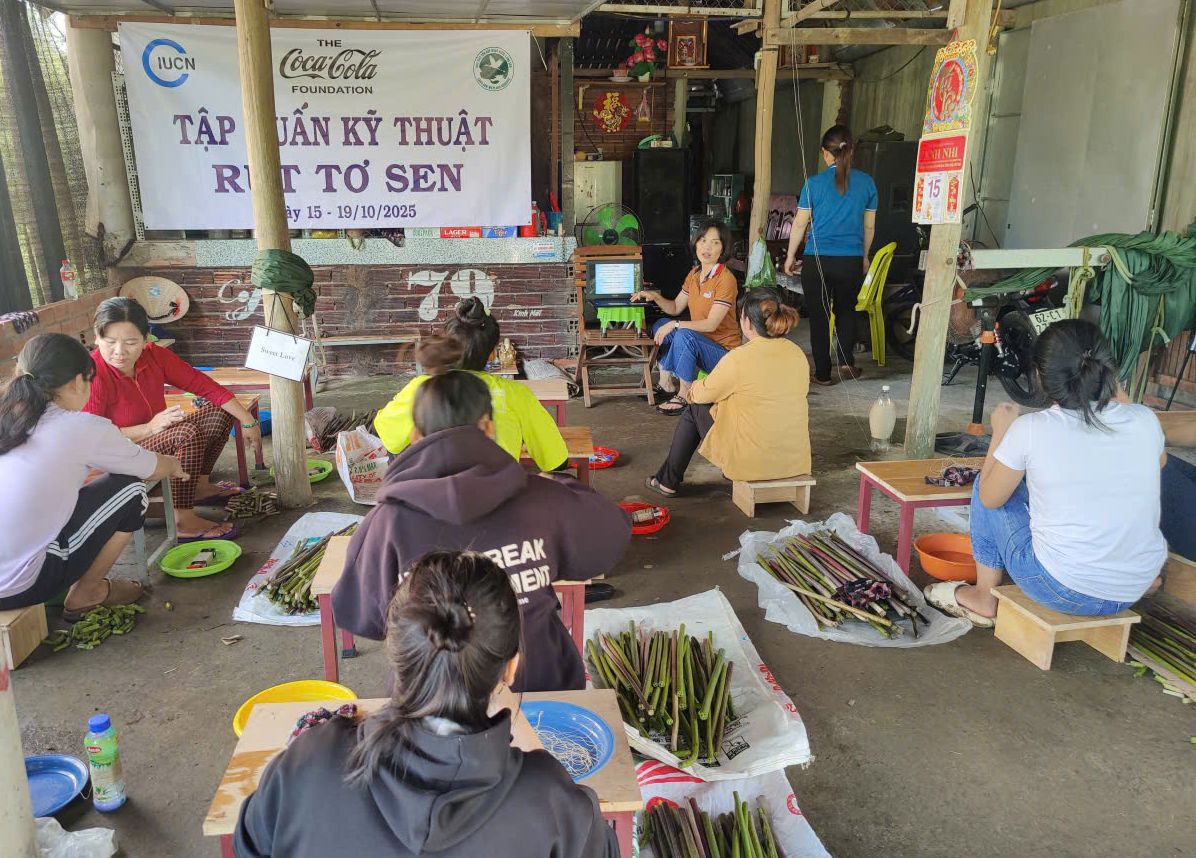
Photo: Local women prepared lotus silk stems for fiber extraction at the training © IUCN Viet Nam

During the training, participants were introduced by experts to the history, context, and process of extracting lotus fiber from lotus stems, a by-product often discarded after harvest, but which can be turned into a valuable raw material to produce natural lotus silk. The course provided hands-on guidance in fiber extraction, yarn spinning, and silk weaving, and helped local women gain a deeper understanding of the economic, cultural, and environmental value of the lotus plant—a species closely associated with the daily lives of people in the Mekong Delta.
The training aims to diversify livelihoods for farmers living in flood-prone areas, providing them with additional income during the dry season, while reducing pressure on natural resources during the flood season. Using lotus by-products not only helps reduce agricultural waste but also promotes circular economy in agriculture.
“Besides household chores and taking my children to school, I use my free time during the day to extract lotus fiber from the stems that my husband brings home. I can earn about 3-4 million VND per month,” shared by Ms. Phan Nhu Thao who attended this year and last year’s training.
The training aims to promote a sustainable value chain for lotus-based products, while also contributing to the flood retention strategy and climate change adaptation in the delta. Through this initiative, local women can earn additional income and are introduced to a sustainable, eco-friendly livelihood model with the potential to establish a new handicraft profession. This is a promising direction for rural areas where communities can earn income from nature while helping to conserve their natural resources.


The Bangladesh Forest Department (BFD) and IUCN Bangladesh, with support from Agence Française de…

Each year, International Women's Day is an opportunity to recognise the women advancing change in…

On 14 January 2026, in Dhaka, the Bangladesh Forest Department and IUCN Bangladesh formally signed…