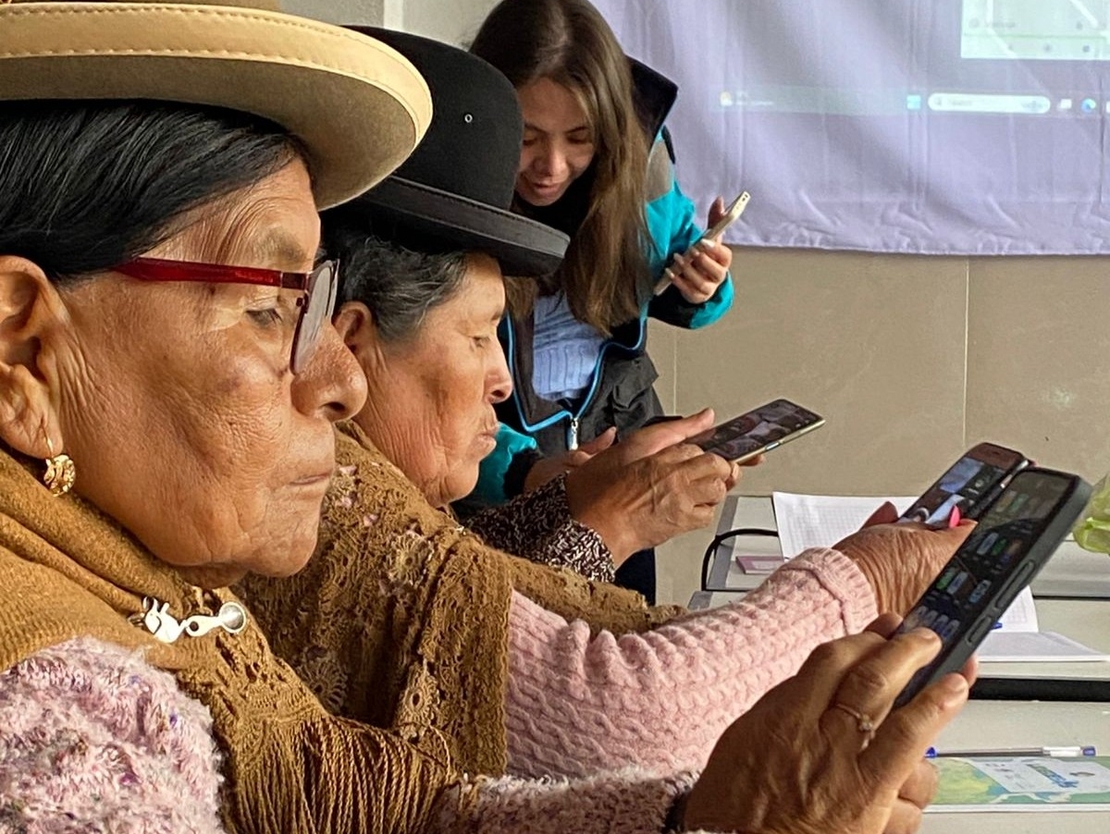
In a context where the climate crisis and pollution increasingly threaten freshwater sources across Latin America, rural communities face the challenge of protecting their territories with limited resources and scarce access to technological tools. Even where access to digital technology is limited, new initiatives in Bolivia show how innovation can adapt to local realities and become a strategic ally for environmental protection and collective rights.
In the communities that surround Lake Titicaca, technology is no longer a distant echo: today it has a voice, strength, and the face of women. In places, where internet signals are intermittent and defending water is part of daily life, rural women leaders are demonstrating that artificial intelligence (AI) is not a far-off privilege, but a powerful tool in service of life. Far from displacing ancestral knowledge, AI walks alongside it. It becomes an ally, a source of momentum, and a tool for clarity—helping women organize more effectively, act with greater confidence, and firmly defend the territory they love. When traditional knowledge meets innovation, a transformative force emerges. When women gain access to clear legal information and practical tools, their capacity for leadership and advocacy within their communities is strengthened.
Through the “Seeds of Advocacy” project, led by Agua Sustentable in Bolivia with the support of the International Union for Conservation of Nature (IUCN) and it’s BRIDGE programme grants and in partnership with Mujeres Unidas para la Defensa del Agua, these women leaders are now adopting the digital tool "Copilota del Agua", with financing from the Swiss Agency for Development Cooperation (SDC).

Written in simple and accessible language, this AI based platform allows women to better understand their rights, draft complaints, record evidence, and follow up on their actions without relying on intermediaries. In essence, the platform translates legal information into clear steps and practical tools that support environmental defense at the community level. Technology does not replace their leadership—it strengthens it, amplifies it, and carries it forward. It also reinforces women’s community leadership, particularly in contexts where their participation in reporting processes or public management has often been limited.
Ongoing training through the Women Leaders School includes 20 women preparing to confront challenges such as wastewater discharges, open garbage dumps, and damage to wetlands. Six of them will be certified as community paralegals, ready to accompany and guide others in environmental conflicts. Every step of the process places safety and care at the centre - because innovation also means protection.
This journey will culminate in a dialogue space with municipal authorities and the Binational Authority of Lake Titicaca, aiming to transform the evidence collected into concrete commitments.
In a territory where water is synonymous with life, the union between artificial intelligence and rural women’s leadership opens a tangible hope: when technology is placed at the service of women leaders, it becomes a bridge, a collective voice, and a real possibility for change.


