Reimagining Conservation Action through Rights-Based Governance: How the IUCN CEESP NRGF Advances Assessment, Monitoring, Redress and Reconciliation
The IUCN CEESP Natural Resource Governance Framework (NRGF) is a powerful tool for reimagining conservation actions. It is a transformative instrument that challenges the status quo and positions justice, equity, and meaningful partnership at the heart of conservation. By systematizing the assessment and monitoring of governance quality, and by embedding pathways for redress and reconciliation, the NRGF provides a practical means to ensure that conservation actions do not replicate historical harms but instead actively work to repair them.
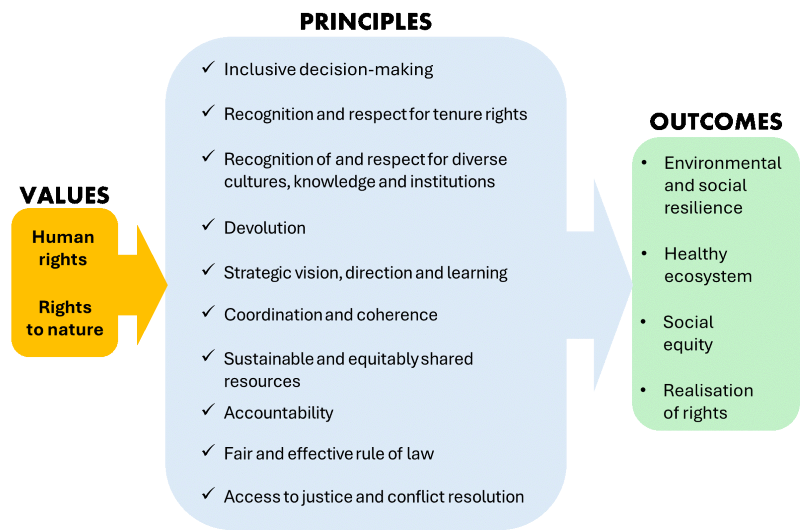
The IUCN Commission on Environmental, Economic, and Social Policy (CEESP) champions approaches that challenge the status quo in conservation by prioritizing justice, equity, and inclusion. The Natural Resource Governance Framework (NRGF), developed by the IUCN CEESP NRGF Working Group, embodies this ethos. It is uniquely aligned with CEESP vision to prioritize dialogue, mutual respect, and local stewardship. It offers a transformative tool that operationalizes a rights-based approach (RBA) to conservation assessment, monitoring, redress and reconciliation. As the global conservation community grapples with historical inequities and the urgent need for inclusive action, the NRGF provides a structured yet adaptable tool to ensure that conservation initiatives are equitable, effective, and just. Monitoring under the NRGF also prioritizes outcome-based indicators (e.g., social equity, healthy ecosystems) rather than just output metrics (e.g., hectares restored). This aligns with the "living with nature" ethos of the framework, which measures success through both ecological health and human wellbeing. In doing so, the NRGF directly responds to the CEESP call to reimagine conservation action that fosters genuine partnership, mutual respect, and stewardship among local communities.
A Governance Framework Rooted in Justice
The NRGF was created through an inclusive global consultative process, explicitly designed to address the power imbalances and inequities that have historically plagued conservation practice. By systematically integrating human rights principles into conservation governance, the NRGF provides both a philosophical foundation and a practical set of tools to assess and improve the quality of governance at local, national, and landscape scales.
The framework’s roots in rights-based values (human rights and rights of nature) make it uniquely suited to redress harms. For example, the NRGF Policy Paper on drought management in Kenya (see NRGF Policy Paper 1) recommended devolving decision-making to women’s groups to address gendered impacts of climate crises, a form of restorative justice.
Thus, the NRGF plays a vital role in promoting justice and reconciliation in conservation actions. It responds to cases where conservation has displaced communities or violated rights, as seen in Uganda’s Mount Elgon and Colombia’s post-conflict zones. By embedding access to justice and conflict resolution, the NRGF ensures grievances are heard, conflicts are mediated, and historical harms are addressed. It shifts accountability from local communities to all actors, including governments and private partners. The NRGF thus builds pathways for healing and invites long-term, equitable partnerships with Indigenous peoples and local communities.
The framework identifies ten key governance principles grounded in rights-based values: inclusive decision-making, respect for tenure rights, recognition of diverse knowledge systems, devolution of power, strategic vision, coordination and coherence, equitable resource sharing, accountability, rule of law, and access to justice. Each principle is supported by measurable criteria, allowing for structured assessment and iterative learning.
NRGF Principles: Centering Rights and Equity
The NRGF’s ten governance principles operationalize a RBA that translates abstract concepts like equity and participation into measurable criteria. For example:
- Principle 1 (Inclusive Decision-Making) ensures assessments prioritize the voices of marginalized groups, such as Indigenous peoples and local communities (IPLCs), through participatory methods like community dialogues and stakeholder mapping.
- Principle 2 (Tenure Rights) advocates for the recognition of customary land rights, as this helps rectify displacement and dispossession, a critical step in reconciliation; a positive example of this was observed in Rwanda’s land tenure reforms.
- Principle 3 (Respect for Diverse Knowledge) validates non-scientific knowledge systems, ensuring assessments integrate traditional ecological knowledge alongside scientific data.
- Principle 5 (Strategic Vision, Direction and Learning) and Principle 8 (Accountability) ensures that monitoring processes are adaptive and transparent. For instance:
- The "NRGF First Look Governance Questionnaire" (NRGF Brief Note 6) offers a rapid self-assessment tool to track governance quality, enabling communities and institutions to monitor progress in real time.
- In the Great Limpopo Transfrontier Conservation Area (NRGF Policy Paper 3), the NRGF highlighted the need for clear accountability mechanisms, such as annual public reports from park coordinators and grievance redress systems.
- Principle 10 (Access to Justice and Conflict Resolution) supports initiatives that seek healing for historical injustices, redress, and reconciliation, for instance:
- The NRGF ROAM assessment gave high marks to Colombia’s post-conflict ROAM process, where community concerns were integrated into restoration planning.
NRGF Assessment and Monitoring: Centering Local Voices and Systematizing Equity
The NRGF is a powerful assessment tool that evaluates governance in conservation, as shown in its application to the IUCN/WRI Restoration Opportunities Assessment Methodology (ROAM) guidance for forest landscape restoration. The NRGF assessment of rights-based governance in ROAM was carried out through case studies research in Colombia, Indonesia, Malawi, and Rwanda. The framework’s gap analysis methodology reveals systemic governance weaknesses such as exclusionary policies including poor community participation and tenure insecurity; it identified power imbalances; and observed concerns about benefit-sharing. The ROAM study also provides actionable insights to address the governance gaps.
The NRGF brings the CEESP vision to life by advancing meaningful, community-led conservation. It showcases where local communities are defining their own conservation priorities and are leading decision-making, such as in Indonesia’s ROAM process, where communities developed their own restoration plans and rejected external proposals that didn’t meet their needs. In Malawi, gendered and culturally sensitive methods ensured local knowledge shaped restoration priorities, moving away from colonial practices. This participatory approach leads to more successful, long-lasting conservation action.
Unlike traditional conservation focused only on species survival, the NRGF promotes multi-dimensional monitoring that includes social, cultural, and political indicators. This approach redefines conservation success by ensuring governance quality is continuously monitored and remains accountable to local rights-holders throughout project life cycles. By using the NRGF as an assessment tool, practitioners can identify gaps in conservation programs and align them with international commitments like the Kunming-Montreal Global Biodiversity Framework (GBF), which mandates a human rights-based approach (see NRGF Brief Note 1).
Conclusion: A Tool for Reimagining Conservation Action
The NRGF is a powerful tool for reimagining conservation actions. It is a transformative instrument that challenges the status quo and positions justice, equity, and meaningful partnership at the heart of conservation. By systematizing the assessment and monitoring of governance quality, and by embedding pathways for redress and reconciliation, the NRGF provides a practical means to ensure that conservation actions do not replicate historical harms but instead actively works to repair them. It shifts conservation from a model of exclusion and control to one of shared authority, mutual learning, and social equity.
In this way, the NRGF answers IUCN CEESP’s call to showcase bold, visionary approaches that reimagine conservation action, by offering a grounded, tested, and adaptable approach that ensures conservation efforts are not only ecologically sound but also socially just. The NRGF is more than a tool; it is a manifesto for conservation action that is equitable, resilient, and rooted in justice. By adopting its principles, practitioners can move beyond tokenistic participation to genuine co-governance that heals the relationships between people and the planet.
A starting point for using the NRGF tool is the “NRGF First Look Governance Questionnaire” (FLGQ) in the NRGF Brief Note 6, designed for rapid governance assessments.
Interested in seeing how the NRGF was used in practice? Check out the next issue of Policy Matters, coming October 2025.

Disclaimer
Opinions expressed in posts featured on any Crossroads or other blogs are those of the authors and do not necessarily reflect the opinions of IUCN or a consensus of its Member organisations.

The Bangladesh Forest Department (BFD) and IUCN Bangladesh, with support from Agence Française de…

Each year, International Women's Day is an opportunity to recognise the women advancing change in…

On 14 January 2026, in Dhaka, the Bangladesh Forest Department and IUCN Bangladesh formally signed…