Youth voices push for ambition as Global Plastics Treaty negotiations enter final days
Today, on International Youth Day, the United Nations’ office at Geneva, the Palais des Nations is alive with calls for courage, inclusion, and ambition as youth from around the world press negotiators to deliver an ambitious treaty capable of ending plastic pollution.
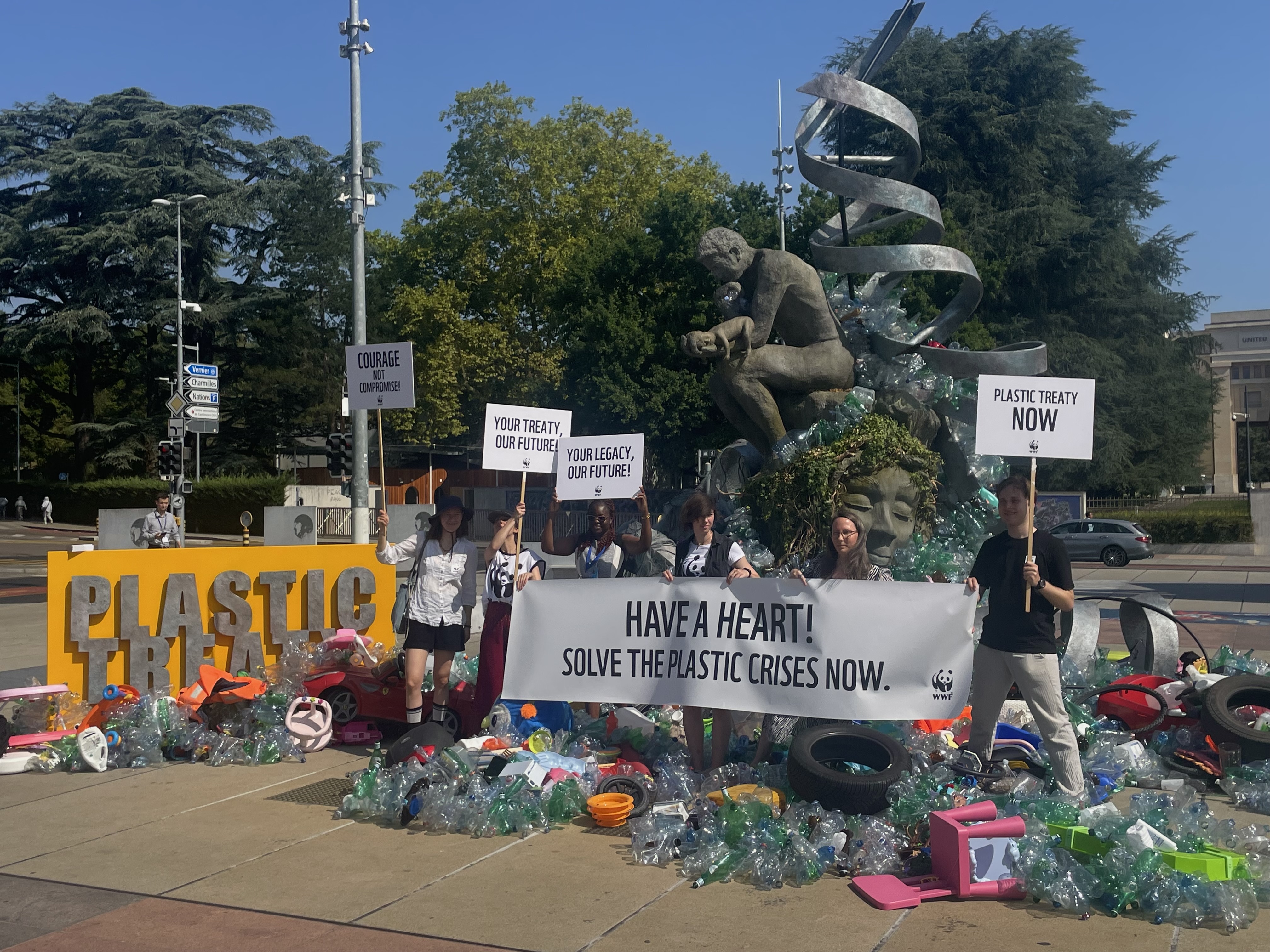
WWF’s Youth Mosaic installation in front of Benjamin von Wong's sculpture, "Thinker's Burden", at the Place des Nations, Geneva, during INC-5.2, August 2025
Photo: IUCN
International Youth Day side event at INC-5.2, 12 August 2025
Photo: IUCN

The second part of the fifth session of the Intergovernmental Negotiating Committee (INC-5.2) is now in its eighth day. Progress on the draft text remains slow: out of 32 articles from the Assembled Chair text, only two have been sent to the legal drafting group. Ministers from over 60 nations arrive today for the final stretch.
For youth present, the stakes could not be higher. This once-in-a-generation agreement will shape their lifetimes and those of generations to come. Plastic pollution is not just an environmental problem; it is a crisis that affects biodiversity, health, human rights, and livelihoods. Youth delegates have made it clear: they will not settle for a treaty negotiated without them.
“We are not here to observe; we want to have a voice in the treaty,” said one youth from the International Indigenous Peoples Forum on Plastics. “The work must be done with us, not for us.”
Indigenous and youth Perspectives on the frontline of the plastics crisis
The day opened with “Our Future in this Treaty – Youth Voices for a World Beyond Plastic Pollution”, co-hosted by the Youth of the International Indigenous Peoples Forum on Plastics and the Chemicals and Waste Youth Platform. The session began with traditional songs, grounding the discussion in cultural heritage and the lived experiences of communities already facing the impacts of plastic pollution.
Although the room was not filled with youth alone, the audience included a broad spectrum of negotiators and observers. The testimonies were both urgent and deeply personal:
- “If our sacred waters are full of microplastics, then our bodies are full of microplastics.”
- “Plastics suffocate the land that feeds us.”
- “My esteemed delegates, as you are negotiating this treaty, remember the image of children playing on beaches full of plastics.”
From the Pacific, Camari Divuniwaqa, Pacific Youth Coordinator of the Global Youth Biodiversity Network (GYBN) Pacific Chapter, delivered a clear challenge: “Choose courage over compromise. Our islands cannot wait. Our generation cannot wait. We want a treaty that listens to youth.”
Several youth speakers stressed the need for a full lifecycle approach — tackling plastics from extraction to disposal — and for recognition of Indigenous Peoples’ rights as human rights.
Visual advocacy in the heart of Geneva
Outside the Palais on the Place des Nations, WWF’s Youth Mosaic installation – just in front of the sculpture called the “Thinker’s Burden” by artist Benjamin von Wong – attracted many visitors with a large photographic artwork highlighting the worldwide problem of plastic pollution. The message was clear: “Have a heart, stop the plastic crisis.” Each picture served as a reminder that behind the numbers are communities, ecosystems, and species at risk.
Youth priorities for a plastic pollution-free future
The second major youth-led event, “Youth for a Plastic Pollution-Free Future: Local Action, Global Impact”, brought together diverse perspectives from around the globe. Speakers emphasised that the plastics treaty is not a single-issue agreement but a platform that must integrate climate action, biodiversity protection, public health safeguards, and intergenerational equity.
Shellan Saling, Interim Chair of the Youth Plastic Action Network, summed up the evolution of the process: “This treaty has evolved from simply being about plastics and waste to something much bigger. It covers climate change, biodiversity, health, economics, children, and youth. While differences remain, it is clear the majority of countries want an ambitious treaty.”
She outlined three top priorities for negotiators:
- Embed human rights and intergenerational equity throughout the treaty’s operative text, guaranteeing the right to a clean, healthy, and sustainable environment; protecting livelihoods; and ensuring equitable transitions.
- Ensure inclusivity, transparency, and accountability at all stages of the treaty’s development and implementation, including a strong governance structure that upholds observer participation beyond consultative status.
- Adopt a full lifecycle approach covering raw material extraction, polymer production, distribution, use, end-of-life management, and legacy pollution.
Linking youth demands with IUCN’s position on biodiversity and One Health
The youth agenda aligns closely with IUCN’s priorities for international cooperation, biodiversity conservation and ecosystem protection, and the One Health approach, to be included as specific language in a future treaty, especially in its Article 19 on “Health”.
Karine Siegwart, IUCN Head of Delegation to the Plastics Treaty Negotiations, said: “Plastic pollution, biodiversity loss, and human health are interconnected issues that require coordinated, just and inclusive responses within the Treaty language and take care of the perspectives of future generations.”
Thus, the objective of IUCN’s proposed language in Article 19 would be to promote circular economy solutions and chemical regulations that are nature-positive, safe, toxic-free and aligned with the outcomes of the Biodiversity COP 16 Convention on Biological Diversity (CBD COP 16) decisions. And such treaty language would ultimately assure Indigenous peoples’ rights and local communities', informal sector, businesses, science and youth involvement, which all are necessary for a planet living in harmony with nature and people.
A call to action for delegates
As Ministers prepare to join the negotiations, youth are clear: the future is being written in the treaty text right now. They urge negotiators to match their words with action and ambition.
“The future is not out of reach; it is being shaped right now. If you believe in protecting future generations, show us, in your decisions, in your words, in the text of this treaty,” a representative from the International Indigenous Peoples Forum on Plastics said.
Building youth capacity for global environmental negotiations
Today’s events are also a reminder of the preparation needed for meaningful youth participation. Initiatives like the Bootcamp on Multilateral Environmental Agreements for YOUth and the IUCN Academy Introduction to Plastic Pollution Hotspotting Assessments are equipping the next generation with the technical skills and policy knowledge to influence complex negotiations.
Looking ahead
With just two days left in INC-5.2, the outcome remains uncertain. But: struggle and hope are also intertwined. IUCN and IUCN’s World Commission on Environmental Law (WCEL), together with many Civil Society Actors including the youth presence in Geneva, underscores what is at stake. IUCN and its WCEL stand ready to support negotiators in the endeavour to deliver a treaty that will protect the planet for those who will inherit it.
Links for more info
Intergovernmental Negotiation Committee on Plastic Pollution | IUCN
IUCN Youth Strategy
IUCN’s global work on plastics
IUCN World Conservation Congress
Youth Summit | IUCN World Conservation Congress


Disclaimer
Opinions expressed in posts featured on any Crossroads or other blogs are those of the authors and do not necessarily reflect the opinions of IUCN or a consensus of its Member organisations.
In Kashkadarya, Khorezm and the Republic of Karakalpakstan, local communities are helping turn…
The third in a five-part series, this webinar brought together speakers from across West and…

This week, the Yerevan Municipality hosted the inaugural ceremony marking the establishment of the…