IUCN at the 2025 UNESCO Global Geoparks Conference
As a strong supporter of geodiversity conservation and a member of the UNESCO Global Geoparks Council, IUCN was honoured to participate in the 11th Global Geoparks Conference organized under the auspices of the Kütralkura UNESCO Global Geopark in Chile.
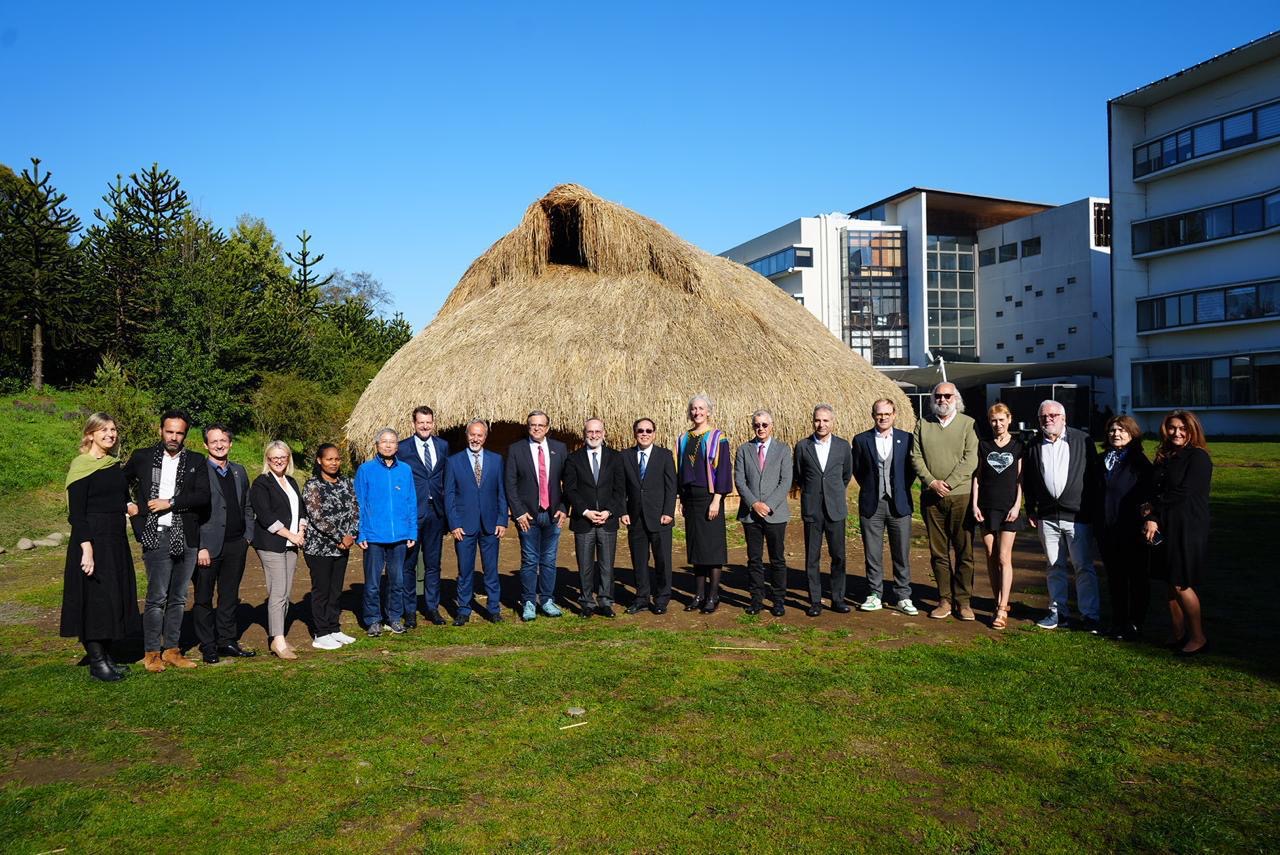
Visit to a Ruka, a traditional Mapuche house.
Photo: © Kütralkura UNESCO Global Geopark

UNESCO Global Geoparks Council
Photo: © UNESCO


A Monkey Puzzle tree (Araucaria araucana) in the Kütralkura UNESCO Global Geopark (Chile).
Photo: © Robbert Casier

From raising awareness about why nature conservation should also consider geodiversity, to preparing tools for managing and protecting both geodiversity and biodiversity, identifying which geological themes are not represented on the World Heritage List, developing tools for nature-based tourism, or supporting protected areas and local communities on the ground, IUCN supports Geoparks in several ways.
IUCN strives towards a just world that values and conserves nature. Natural diversity includes not only biodiversity but also geodiversity, although the latter is sometimes still overlooked. A recent IUCN WCPA paper “The Meaning of Nature” looked at how Global Geoparks and World Heritage sites helped to broaden the recognition of nature and heritage in all its facets, and proposed to reference geodiversity more explicitly in the long-standing IUCN definition of nature. At the upcoming IUCN World Conservation Congress, members will also discuss a motion on Key Geoheritage Areas.
12 new Geoparks and 44 existing Geoparks evaluated
The UNESCO Global Geoparks Council determines whether new applications meet the required Geopark criteria. The Council counts 12 members appointed by the UNESCO Director-General, along with 4 ex-officio members representing IUGS, IUCN, the Global Geoparks Network (GGN) and UNESCO. During the 10th session, held on 5 and 6 September 2025 under the auspices of the Kütralkura UNESCO Global Geopark in Chile and with nearly 150 observers from 32 Member States, the Council approved nine new applications, deferred three applications, and granted 38 green cards and 6 yellow cards for the 44 existing geoparks that were up for revalidation. Should UNESCO’s Executive Board endorse this decision when it meets next year, this would expand the network to 241 Geoparks around the world, including Joyce Country and Western Lakes (Ireland), Mt. Siguniang (China) and Lenggong (Malaysia).
From ancestral knowledge towards future Geoparks
Organized every two years, the International Conference on UNESCO Global Geoparks brings people together from across the world to share the latest findings and experiences on a wide variety of topics, from geological research to sustainable tourism, education, or participative management for sustainable development. It is the most important meeting for the managers of UNESCO Global Geoparks and members of the Global Geoparks Network to meet and exchange knowledge and experiences on Geopark building and operation.
The 11th edition took place from 8 to 12 September in the city of Temuco, the entrance to the Kütralkura UNESCO Global Geopark. Global Geopark management teams shared case studies on topics such as geotourism, conservation, education, nature-based solutions, or managing climate change impacts. Most Geoparks are also important for biodiversity conservation, and management teams discussed how drone imagery can be used to map cactus habitat, how IUCN Red Listed species can be monitored, or how Geoparks can improve biodiversity conservation in areas not formally protected, for example.
Overlapping Designations
There are currently well over 3,500 Internationally Designated Areas (IDAs) recognized by various UN Agencies or multilateral organizations. Several of the new Global Geopark applications as well as a third of existing Global Geoparks overlap with other designations such as natural and cultural World Heritage sites, Biosphere Reserves, Ramsar sites, and Globally Important Agricultural Heritage Systems. IUCN is currently updating a 2016 guidance manual which highlighted recommendations for site managers, authorities and international bodies on how to benefit from the opportunities that come with multiple designations, or manage potential challenges.
Global Geoparks Network
The Global Geopark Network (GGN) is a non-profit International Association which is the official partner of UNESCO for the operation of the UNESCO Global Geoparks. Founded in 2004, it supports networking and collaboration among Global Geoparks, including through Regional and National Geopark Networks. During the 11th International Conference on Global Geoparks, the GGN Assembly elected new members of its Executive Board, and discussed strategic priorities going forward, including enhanced cooperation with IUCN. It was also decided that the 12th International Global Geopark Conference will take place in 2027 in the Oeste UNESCO Global Geopark (Portugal)
About the Kütralkura UNESCO Global Geopark
Kütralkura was recognized in 2019, becoming Chile’s first UNESCO Global Geopark. Its name comes from Mapudungun – the language of the Mapuche people and means "stone (kura) of fire (kütral)". This name refers to the intense volcanism that occurs in this territory, and which has been inhabited by for at least 2,000 years. The Geopark covers over 300 million years of geological history, counts 6 volcanoes, 110 geosites, 2 Key Biodiversity Areas, and several national parks. It is home to over 100 native resident bird species, the endangered Monkey Puzzle tree (Araucaria araucana), and many other species. The Geopark is managed by an association made up of 7 municipalities which strives to protect, valorize and promote the natural and cultural heritage, with special emphasis on geological heritage, deepening and disseminating scientific knowledge, developing educational programs, and promoting tourism and sustainable development.


Disclaimer
Opinions expressed in posts featured on any Crossroads or other blogs are those of the authors and do not necessarily reflect the opinions of IUCN or a consensus of its Member organisations.

The Bangladesh Forest Department (BFD) and IUCN Bangladesh, with support from Agence Française de…

Each year, International Women's Day is an opportunity to recognise the women advancing change in…

On 14 January 2026, in Dhaka, the Bangladesh Forest Department and IUCN Bangladesh formally signed…