From Waste to Opportunity: Saint Kitts and Nevis Explores Circular Business Models Aimed at Repurposing Plastic Waste
A two-day Circular Sprint Workshop brings together stakeholders from government, private sector, civil society, and academia to identify innovative solutions to tackle plastic pollution in the Caribbean Island.
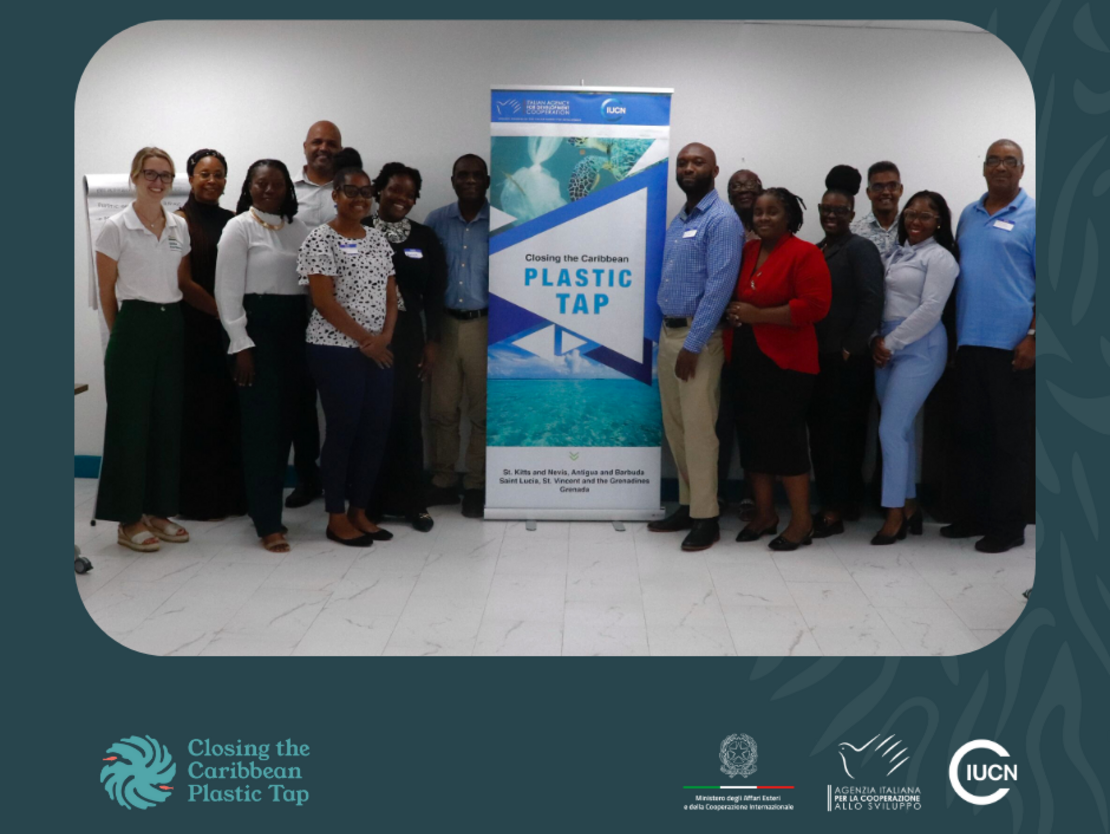
Basseterre, Saint Kitts and Nevis, July 23, 2025. Surrounded by ocean, Caribbean Small Island Developing States (SIDS) face direct and growing impacts from marine plastic pollution. Limited recycling and disposal systems, combined with economic dependence on waste-heavy industries like tourism and fisheries, lead to significant plastic pollution and leakage, which damages critical ecosystems like coral reefs and coastlines and affects local livelihoods and food safety. For the Caribbean region, addressing plastic pollution is an ecological, economic, and social priority.
In this context, the Closing the Caribbean Plastic Tap initiative, funded by the Italian Ministry of Foreign Affairs and International Cooperation (MAECI) and the Italian Agency for Development Cooperation (AICS), and implemented by IUCN (International Union for Conservation of Nature), aims to tackle plastic waste leakage in Caribbean SIDS by improving waste management, supporting legislative reforms, and creating new economic opportunities for women, youth, and local communities through the repurposing of plastic waste.
According to the National Plastic Quantification and Partnership Analysis recently conducted under the Closing the Caribbean Plastic Tap initiative, Saint Kitts and Nevis generates an estimated 32,892 tonnes of municipal solid waste per year, with plastic waste primarily originating from residential sources (85.8%). An estimated 84.8% of plastic leakage into the environment also stems from households. Between 2022 and 2023, plastic collection rose significantly- from 3.2 tonnes to 37 tonnes-, showing progress but also highlighting the need for scalable waste management systems.
A two-day Circular Sprint Workshop held in July brought together stakeholders from government ministries, waste management authorities, fisher and farmer cooperatives, civil society organizations, academia, and entrepreneurs to collaboratively explore these challenges and co-design context-appropriate, and commercially viable circular business models.

“This project is more than a waste management intervention, it is a call to reimagine our economies, rethink production and consumption patterns, and embrace the opportunity to transform plastic waste from a burden into a resource,” - said Ms. Colincia Levine, Permanent Secretary of the Ministry of Environment, Climate Action and Constituency Empowerment, in her opening remarks. “By uniting diverse actors across society, the initiative aims to co-develop practical and scalable solutions that not only close the tap on plastic leakage but also unlock circular business opportunities, particularly for women, youth, and grassroots communities.”
Among the outcomes of the workshop was the identification of several high-potential value chains for repurposing plastic waste. Through a participatory dot-voting exercise, participants prioritized options such as outdoor furniture, garden pavers, ICF (insulated concrete forms) for construction, hydroponic systems, agricultural tubing and pots, and craft-based products like jewelry and costumes. Working in assigned groups, attendees developed preliminary business model canvases around these themes, integrating circular design, local material sourcing, and inclusive employment opportunities.

“This workshop has been very educational and provides the encouragement and support that crafters like me need,” shared Ms. Marilyn Pemberton, owner of Craft Esperance in Nevis. “It also gives me the confidence to continue the work I am doing by reusing [materials] to reinforce that what we are doing is a step in the right direction to protecting our environment.”
For the academic sector, the workshop offered deeper insights into how the circular economy intersects with built environments and education. “As a lecturer in the Architecture and Timber programs at CFBC, I see firsthand how plastic waste intersects with the built environment,” said Fidel O’flaherty, a workshop participant. “This workshop was valuable in highlighting the broader ecosystem around plastic waste and reinforcing the importance of integrating circular economy principles into both curriculum and practice. The level of engagement was high, and what stood out was the collective desire to move beyond talk. Almost every participant echoed the same sentiment: the time for action is now.”

The event was not only a space for learning and networking, but a platform to mobilize implementation. Moving forward, participants committed to refining their models with technical support from IUCN and local partners and engaging relevant ministries to explore pilot opportunities.
The government of Saint Kitts and Nevis, through the Ministry of Environment and in partnership with regional and international agencies, aims to ensure that the workshop outcomes feed into broader policy development and national waste management strategies.
As the Closing the Caribbean Plastic Tap initiative continues, the momentum from this workshop underscores the potential for Saint Kitts and Nevis to lead in circular innovation within the Caribbean.


The Bangladesh Forest Department (BFD) and IUCN Bangladesh, with support from Agence Française de…

Each year, International Women's Day is an opportunity to recognise the women advancing change in…

On 14 January 2026, in Dhaka, the Bangladesh Forest Department and IUCN Bangladesh formally signed…