Restoring Our Future: Lessons and Innovations to Achieve Global Restoration Goals
At the IUCN World Conservation Congress 2025, the IUCN Forest and Grasslands Team organised an event titled “Restoring Our Future: Lessons and Innovations to Achieve Global Restoration Goals” to showcase best practices on ecosystem restoration and to discuss how strategic partnerships are accelerating and amplifying the impact of restoration efforts. The session brought together policymakers, donors, practitioners, scientists, and community stakeholders to discuss progress towards restoration goals, successes, barriers, and recommendations on best practices.
Photo: Katherine Poe/IUCN
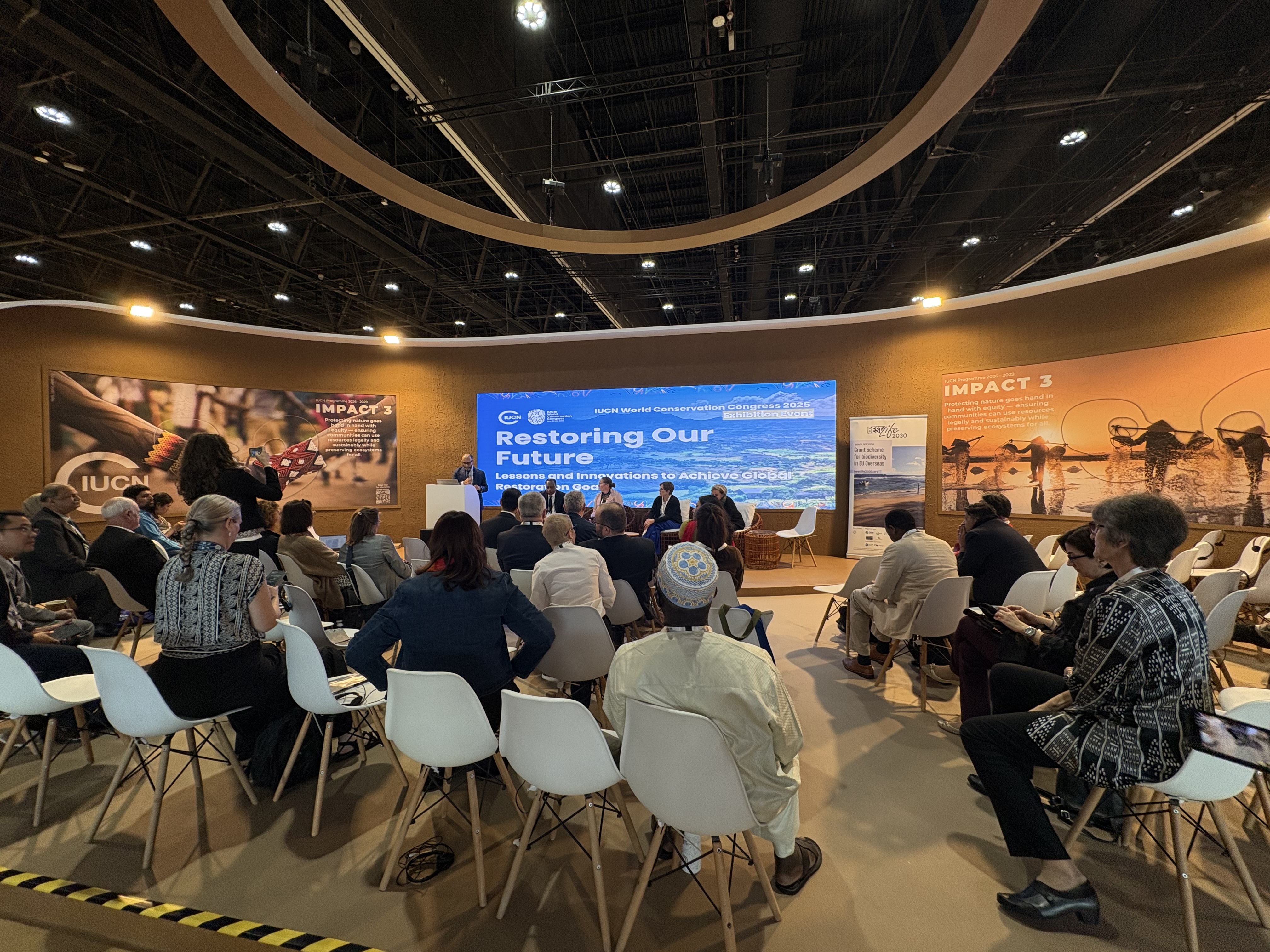
Photo: Katherine Poe/IUCN

Photo: Katherine Poe/IUCN

Photo: Katherine Poe/IUCN

The event, held in the IUCN Programme Pavilion, brought together a diverse group of speakers offering unique perspectives on restoration across scales. The session discussed topics ranging from the Target 2 under the Convention on Biological Diversity (CBD), to financial mechanisms and instruments for restoration, to social equity and rights-based approaches to restoration. Ultimately, the session recognised existing restoration successes while also highlighting remaining challenges and barriers faced by communities, as well as solutions for overcoming them. Speakers emphasized that ecosystem degradation and deforestation, driven by unsustainable human activity, continue to undermine biodiversity, ecosystem functioning, and adaptive capacity in the face of intensifying climate change. Restoration, they agreed, must be at the centre of solutions; linking environmental integrity, social inclusion, and economic opportunity.
Ecosystem degradation is a global threat affecting all habitat types. Current estimates indicate that 20% – 40% of the world’s land is degraded, harming the well-being of approximately 3.2 billion people. In recognition of these challenges, several global restoration goals have been established. Target 2 of the Kunming-Montreal Global Biodiversity Framework (KM-GBF) aims to ensure that 30% of the total area of degraded terrestrial, inland water, and marine and coastal ecosystems is under effective restoration by 2030.
Similarly, the Bonn Challenge aims to bring under restoration 150 million hectares of degraded and deforested land by 2020 and 350 million hectares by 2030. Furthermore, the UN Decade on Ecosystem Restoration, lasting from 2021 through 2030, is a global movement aiming to support and scale up global restoration efforts while raising awareness of the importance of multi-scale restoration. Together, these rallying calls are driving global progress on restoration—but challenges and barriers remain.
Raising and Sustaining Ambition at the National Level
The session began with high-level remarks from H.E. Hambardzum Matevosyan, Minister of Environment of Armenia, where he discussed Armenia’s role as Presidency of the 17th meeting of the Conference of the Parties (COP17) to the Convention on Biological Diversity (CBD), set to take place in 2026. The Minister laid out Armenia’s commitment to advancing biodiversity conservation and ecosystem restoration and supporting the aims of the CBD under the Kunming-Montreal Global Biodiversity Framework (KM-GBF), including Target 2. The Minister highlighted Armenia’s integrated approach to restoration as a cornerstone of its climate and sustainable development strategies, underscoring new afforestation and reforestation programs, improved forest data transparency, and stronger links between protection and restoration. The Minister’s intervention came just after the announcement of Armenia joining IUCN as a new State Member, concurrently highlighting Armenia’s commitment to raising ambition for nature.
Mr. Oliver Conz, Director General at Germany’s Federal Ministry for the Environment, Climate Action, Nature Conservation and Nuclear Safety (BMUKN) followed with a keynote address, discussing Germany’s history of commitment to supporting restoration efforts globally. Mr. Conz reaffirmed Germany’s continued leadership and partnership through the Bonn Challenge, combining financial, technical, and policy support for restoration worldwide. “The Bonn Challenge promotes forest landscapes restoration as a key contribution to deliver on the 2030 goals of the Rio Conventions and the Sustainable Development Goals. The Bonn Challenge promotes synergies between climate protection and biodiversity conservation translating commitments into concrete action,” said Mr. Conz.
Leveraging Finance and Conventions to Amplify Impact
The session then transitioned to a panel where a diverse set of decisionmakers and stakeholders convened to share their unique perspectives on ecosystem restoration and progress towards global restoration goals, with institutional leaders and international partners expanding on the enabling conditions for large-scale restoration. Finance and inclusion emerged as recurring themes in need of urgent attention.
Valerie Hickey, Global Director, Climate Change Group at the World Bank began by setting the stage for discussion on financial mechanisms and instruments which can be leveraged to support restoration efforts across scales. Ms. Hickey noted that de-risking investment and addressing systemic barriers such as insecure land tenure, especially for women, are essential to unlocking private capital for restoration. Without finance being unlocked and directed to communities to support restoration and reward nature-positive practices, she emphasised, restoration goals cannot be met.
“Ecosystem restoration is key to the reversal of biodiversity loss – and central to achieving Target 2 and indeed the entirety of the Kunming-Montreal Global Biodiversity Framework,” said Olivier Rukundo, Senior Programme Management Officer, Head of Peoples and Biodiversity Unit at the CBD Secretariat, underscoring the need to move beyond pledges and accelerate practical implementation toward the post-2020 Global Biodiversity Framework’s Target 2. “To accelerate action on ecosystem restoration, in particular strengthening Parties to report on the headline indicator for Target 2, the CBD Secretariat, FAO and other partners have launched a global capacity-development programme, the ‘Target 2 Roadmap.’”
“For restoration efforts to be successful, we need to start with the people who live in the area in question. Gender equality and social inclusion are essential. This means recognizing and honouring the unique strengths, needs and challenges of women and men, jointly removing barriers to participation and ensuring that everyone can contribute their skills and knowledge and have their voice heard,” said Chantal Felder, Head of Section Climate, Disaster Risk Reduction and Environment, Swiss Agency for Development and Cooperation (SDC). Ms. Felder further emphasised the importance of local ownership, participatory processes, and gender equality, arguing that sustainable restoration begins with people and must deliver long-term benefits for communities.
“The restoration economy has the potential to bring jobs, economic development, health, social, biodiversity, climate and ecosystem services dividends in real ways. It bridges sectoral siloes and offers smart investment choices, but only if we get out of the conservation bubble for meaningful partnerships,” said Doreen Lynn Robinson, Deputy Director, Ecosystem Division at the United Nations Environment Programme (UNEP), stressing that restoration must be embedded at the heart of development policy, aligning with economic and social frameworks to unlock the 'restoration economy' and its potential for equity, gender, and employment dividends.
Government, Civil Society, and Community Perspectives Intersect at the Heart of Restoration
Scientific, technical perspectives were also elevated. “To achieve restoration at scale, we must bridge science and practice. Evidence from landscapes around the world shows that restoration succeeds when local knowledge, strong data, economics and inclusive policies come together. Collaboration across disciplines and sectors is essential if we are to restore ecosystems that sustain both people and the planet,” said Dr. Robert Nasi, Director General, CIFOR and Director of Science, CIFOR-ICRAF, highlighting the need to apply behavioural and social sciences to better understand the drivers of degradation and make scientific knowledge actionable at local levels.
Several panellists stressed, however, that restoration goals cannot be achieved without integrating social equity concerns and gender-responsive approaches, nor without including smallholders and local community members who act as land stewards but who often are overlooked. “True restoration is not only of lands, waters and ecosystems,” said Mrinalini Rai, Director, Women4Biodiversity. “It is also the restoration of rights, recognition, and resources to women who sustain them. Financing gender-responsive, community-led restoration is not charity—it is an investment in resilience, justice, and the planet’s future.”
“Indigenous Peoples have restored their territories for generations and continue to do so. The objective of restoration should not be to respond to donors but more importantly to restore balance between man and nature,” said Minnie Degawan, Managing Director, FSC Indigenous Foundation (FSC-IF), underlining that Indigenous Peoples, women, and local communities are not only beneficiaries but essential knowledge-holders whose perspectives must guide planning, decision-making, and implementation.
Pedro de Castro Cunha e Menezes, Director of Protected Areas at the Ministry of Environment of Brazil and Raúl Jiménez Rosenberg, Executive Secretary of El Comisión Nacional para el Conocimiento y Uso de la Biodiversidad (CONABIO) of Mexico offered additional country perspectives, laying out successes from their countries as well as challenges they are working to overcome. Both Mr. Castro and Mr. Jimenez explained how restoration is being embedded in their countries’ national policies, from identifying priority sites and integrating restoration into planning frameworks to promoting research, innovation, and nature-based tourism through initiatives such as long-distance ecological trails. They then expanded on how other countries can learn from their experiences with ecosystem restoration, and they underscored why national and regional ambition are essential to achieving global goals.
The session ended with a virtual intervention from Richard Verbisky, Senior Advisor at Natural Resources Canada and Head of the International Model Forest Network (IMFN) Secretariat. IMFN is a voluntary global community of practice whose members and supporters work toward the sustainable management of forest‐based landscapes and natural resources through the Model Forest approach. Mr. Verbisky highlighted how partnership networks like IMFN can bridge the gap between the many dimensions outlined by other speakers—connecting local communities to global resources and enabling them to support progress towards national, regional, and global targets, while also ensuring restoration is locally-relevant and conscientious of equity and rights concerns. Mr. Verbisky’s full intervention is available to view below.
Across the session, a clear consensus emerged: achieving global restoration goals requires shared learning, inclusive participation, and innovative approaches to policy, finance, and implementation. Restoration is not only a technical or ecological imperative, but a human one—a pathway to resilience, equity, and renewed connection with nature.
The discussion was moderated by Chetan Kumar, Global Head of Forest and Grasslands at IUCN.


The Bangladesh Forest Department (BFD) and IUCN Bangladesh, with support from Agence Française de…

Each year, International Women's Day is an opportunity to recognise the women advancing change in…

On 14 January 2026, in Dhaka, the Bangladesh Forest Department and IUCN Bangladesh formally signed…