One year on: Indo-Burma countries report significant progress against their wetlands conservation plan
A flock of ducks take flight at Van Long Wetland Nature Reserve
Photo: Manh Hiep Nguyen / IUCN Viet Nam

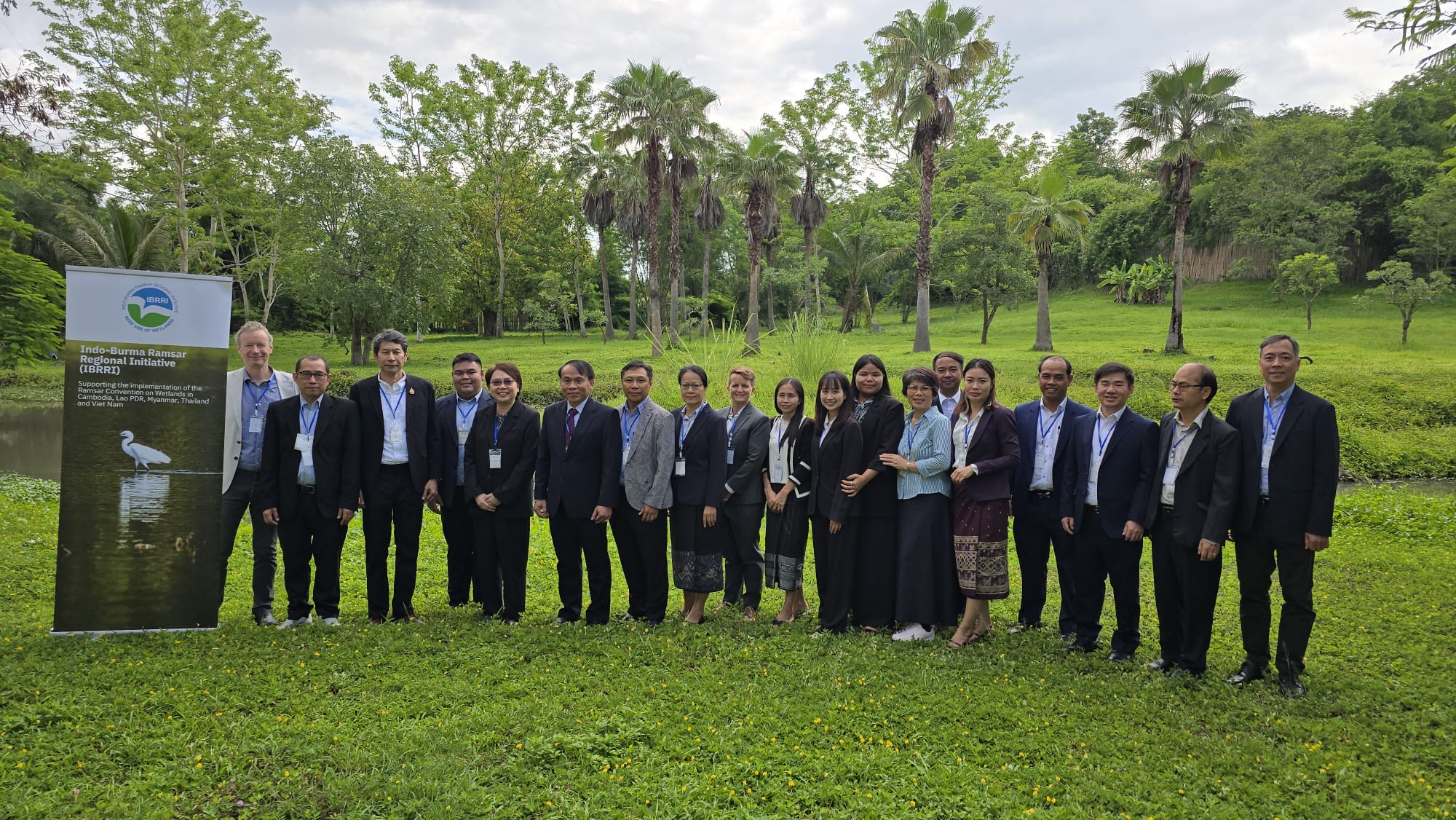
Representatives from Member countries gathered in Luang Prabang for the 9th annual IBRRI meeting
Photo: IUCN Asia
With one new designated Ramsar Site, which recognises wetlands of international importance, and three more planned for nomination, the Indo-Burma countries have made significant progress against their strategic plan in the last 12 months.
The Indo-Burma Regional Ramsar Initiative (IBRRI) coordinates action to protect and conserve wetlands across its five Member countries: Cambodia, Lao PDR, Myanmar, Thailand and Viet Nam, with IUCN as its Secretariat. Guided by the IBRRI Strategic Plan 2025-2030, Member countries meet annually to report progress on enhancing wetland management, strengthening policies, building capacity, leveraging finance, as well as ensuring sustainable governance of the initiative itself.
The 9th annual IBRRI meeting brought countries together in Luang Prabang, Lao PDR, from 9–10 June 2026, alongside representatives from local civil society organisations, academia and regional partners, to take stock and chart the path ahead. "We are confident that our discussions over the coming days will further strengthen cooperation, promote knowledge exchange, and contribute to the effective conservation and management of wetlands across the region," said Oudomsack Philavong, Director General of the Department of Water Resources, Government of Lao PDR, at the opening.
Progress in the last year includes strengthened monitoring of some of the world’s most threatened waterbirds: Sarus Cranes and black-tailed godwits at Prek Toal Ramsar Site in Cambodia, as well as spoon-billed sandpipers and Baer's Pochard in Myanmar. In Lao PDR, fish catch data and rapid biodiversity assessments span its lakes and floodplains from Nong Loup Ian, an urban wetland in the capital, to Xe Champhone Ramsar Site which has also been designated a national protected area. In Viet Nam, Van Long Wetland Nature Reserve, celebrated for the endangered Delacour’s langur found only in the northern limestone karst mountains, has been added to the Tentative List for UNESCO World Heritage status as a bio-cultural landscape.
The communities who depend on these wetlands are also gaining a stronger stake in protecting them. One example is through Cambodia's Mini Trust Fund, established by IUCN, which has been expanded from the Mekong River and Tonle Sap Lake into Koh Kong province where 10,000 USD in seed funding has been put behind each of three new community conservation areas.
IBRRI's strength lies in connecting local realities to basin-wide decisions. In Cambodia's Stung Treng Ramsar Site, the Culture and Environment Preservation Association (CEPA) has been working with communities to monitor fish biodiversity. This work takes on urgency as a newly launched study by Stimson Center and IUCN found that at least 18% of Stung Treng's flooded forest has been lost since 2018 due to upstream dams raising dry-season water levels and depriving forests of the low-flow conditions they need to survive.
Immediately upstream lies Siphandone where the Mekong fans out into a labyrinth of channels and islets. This site faces the same threats from altered river flows. With the Government of Lao PDR planning to nominate Siphandone as a Ramsar Site in the future, the need for a cross-country evidence base becomes even more crucial to ensure these ecosystems are effectively protected. “It is precisely this kind of cross-border evidence, shared through IBRRI, that allows countries to make informed decisions about where and how to act,” said Jake Brunner, Head of IUCN Asia’s Lower Mekong Subregion.
As IBRRI approaches its tenth annual meeting, the progress of the last year reflects what five countries can achieve when they act together. IUCN remains committed to supporting these efforts, building partnerships, evidence and community-level foundations that will define the next decade of wetland conservation across the Indo-Burma region.
About IBRRI
The Indo-Burma Ramsar Regional Initiative (IBRRI) was jointly developed by the Ramsar National Focal Points of the five countries (Cambodia, Lao PDR, Myanmar, Thailand, and Viet Nam), and the IUCN Asia Regional Office, based on specific needs identified in these countries. It was endorsed by the 52nd meeting of the Ramsar Convention Standing Committee in June 2016. IBRRI aims to support the coordinated implementation of the objectives of the Strategic Plan of the Ramsar Convention. IUCN serves as the Secretariat for the Initiative under the leadership of the Steering Committee, which includes representatives from the five governments and the Ramsar Convention Secretariat as an observer. IBRRI is supported by IUCN’s BRIDGE (Building River Dialogue and Governance) Project, which aims to build water governance capacities through learning, demonstration, leadership, and consensus building, funded by the Swiss Agency for Development and Cooperation.

The Bangladesh Forest Department (BFD) and IUCN Bangladesh, with support from Agence Française de…

Each year, International Women's Day is an opportunity to recognise the women advancing change in…

On 14 January 2026, in Dhaka, the Bangladesh Forest Department and IUCN Bangladesh formally signed…