Addressing biodiversity conservation and plastic pollution in Ghana
Plastic pollution is one of the fastest-growing drivers of biodiversity loss, undermining all ecosystems and ocean health, human health and well-being, the potential of a circular plastics economy and a sustainable blue economy. Two new reports funded by NORAD highlight the work that IUCN continues to do within the plastic pollution, ocean conservation and biodiversity interlinkages, assessing the situation of plastic pollution and biodiversity impacts in Ghana.
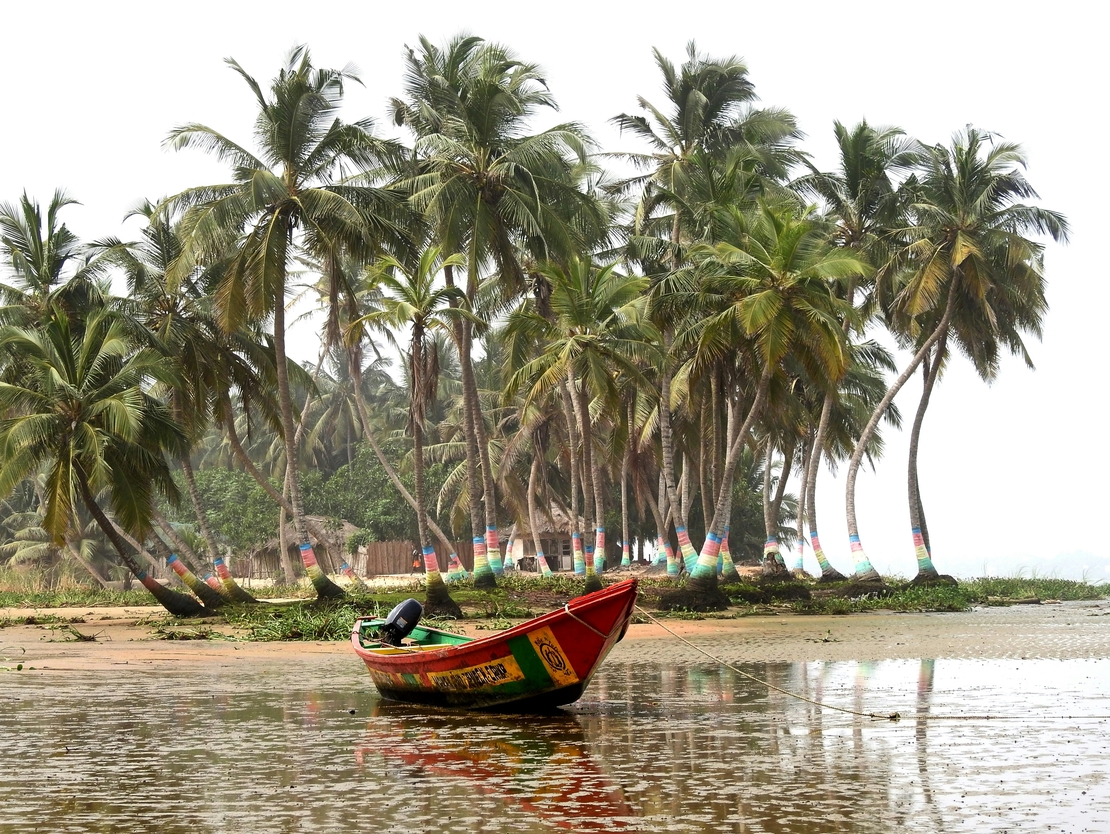
Plastic pollution has emerged as a critical environmental, economic, and governance challenge in Ghana, particularly across coastal and periurban systems where plastic leakage directly threatens biodiversity, fisheries productivity, public health, and the foundations of the blue economy. Ghana’s coastal and marine ecosystems underpin national food security, livelihoods, climate resilience, and economic growth, forming a core pillar of the country’s Blue Economy agenda. Lagoons, estuaries, mangroves, sandy beaches, and nearshore waters support high biodiversity value and provide essential ecosystem services, including fish nursery functions, shoreline protection, carbon storage, and cultural and recreational benefits. These ecosystems are increasingly threatened by plastic pollution, rapid urbanisation, coastal modification, and climate-related stressors, which together undermine ecological integrity and long-term development outcomes.
Against this background, two new publications, funded through NORAD, seek to scaling up ocean conservation by addressing plastics in marine ecosystems and to advancing the transformative concept of a Regenerative Blue Economy, taking the example of Ghana. They complement IUCN and IUCN World Commission on Environmental Law (WCEL) policy and legal publications on Gaps and synergies between proposals for a Global Plastics Treaty and existing Multilateral Environmental Agreements (MEAs) and on the “Source-to-Sea” (S2S) approach to address marine plastic pollution. With these reports, IUCN aims to bridge international law, global policy, regional and local conservation action, and regenerative economic models—helping countries and communities to achieve healthy, resilient ecosystems and a just transition toward a nature positive circular and regenerative future.

The first report, A Rapid Plastic Pollution Assessment and Material Flow Analysis in the Greater Accra, Central, and Western Regions of Ghana, provides field-based evidence from nine assessed sites and reveals a consistent national pattern dominated by consumer packaging products—particularly sachet water packaging, plastic bags, expanded polystyrene (EPS) food containers, and lightweight plastic bottles.
The second report, A Rapid Assessment of Biodiversity and Plastic Pollution Impacts, brings an ecological lens to the analysis, examining where and how plastic pollution intersects with biodiversity, ecosystem condition, and ecosystem services. It includes maps highlighting overlaps between plastic accumulation zones and internationally important biodiversity areas, including Ramsar sites and Key Biodiversity Areas. The assessment is designed as an indicator-based, high-level diagnostic rather than a comprehensive ecological inventory.
Preliminary findings suggest that there is a substantial overlap between plastic accumulation zones and internationally important biodiversity areas, including Ramsar sites and Key Biodiversity Areas. Priority hotspots such as Sakumo Lagoon, Densu Delta, Komenda (Susu Lagoon) and Shama, require immediate, integrated action. In contrast, relatively intact systems such as Amanzuri, Akwidaa, and Muni–Pomadze represent opportunities for preventive conservation.
Both reports offer priority policy recommendations including integrating plastic–biodiversity risk evidence into coastal and marine planning frameworks; prioritising restoration and protection of biodiversity–pollution hotspots, particularly wetlands, lagoons, mangroves, and turtle nesting beaches; and establishing an Integrated, long-term monitoring framework to support regenerative coastal management.
As IUCN looks ahead to rolling out the 2026–2029 Programme and gets ready to implement the recently adopted IUCN Resolution 8.058 on “Advancing actions to end plastic pollution to protect human health, biodiversity and the environment”, IUCN and its WCEL will continue to play a catalytic role in supporting Member States and stakeholders in legal and policy discussions, including in the next steps of the Plastics Treaty Negotiations (cf. Roadmap of the INC Chair), scaling up conservation solutions, and integrating plastics into the emerging paradigm of a Regenerative Blue Economy, while advocating for a comprehensive, ambitious Plastics Treaty and helping countries meet obligations across multiple international frameworks, including the Kunming-Montreal Global Biodiversity Framework and its Target 7 in particular.

The Bangladesh Forest Department (BFD) and IUCN Bangladesh, with support from Agence Française de…

Each year, International Women's Day is an opportunity to recognise the women advancing change in…

On 14 January 2026, in Dhaka, the Bangladesh Forest Department and IUCN Bangladesh formally signed…