Finding Nature in Cities: How Nature-based Solutions Can Address Climate-Related Loss and Damage
As climate impacts intensify in urban areas worldwide, cities are increasingly confronting a difficult reality: some climate impacts can no longer be fully prevented through mitigation or adaptation alone. Floods, heatwaves, ecosystem degradation, displacement, and infrastructure failures are already generating significant climate-related loss and damage — particularly for the most vulnerable urban communities.
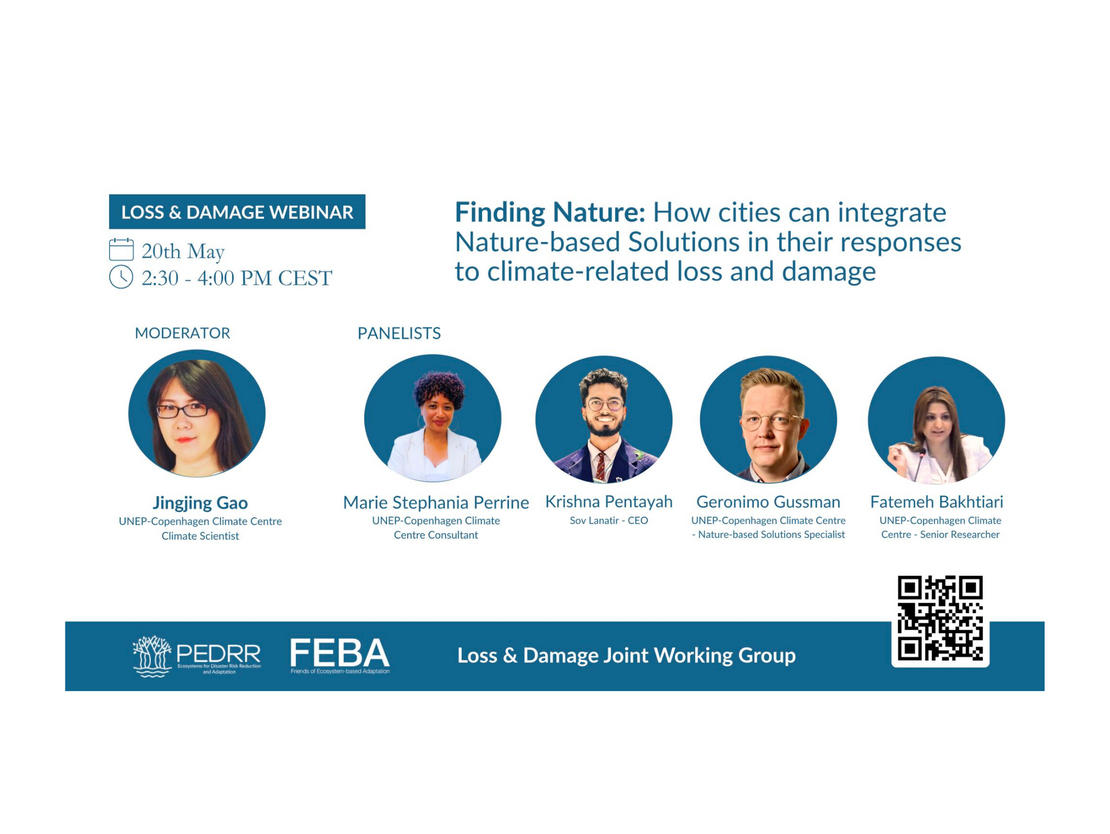
Against this backdrop, the third webinar in the PEDRR–FEBA Joint Working Group series on biodiversity and ecosystem-related loss and damage explored a critical question: “How can cities integrate Nature-based Solutions (NbS) into their responses to climate-related loss and damage?”
The session brought together experts working across policy, research, urban planning, and community implementation to examine how ecosystems can help cities strengthen resilience while addressing both economic and non-economic losses.
Moving Beyond Adaptation
Opening the discussion, Chawanangawa Nyirenda from UNEP introduced the work of the PEDRR–FEBA Joint Working Group, which aims to strengthen understanding of biodiversity- and ecosystem-related losses while advancing Ecosystem-based Adaptation (EbA) and Nature-based Solutions (NbS) in climate responses.
The webinar built on previous sessions focused on understanding ecosystem-related losses and moving from evidence to action. This third session shifted attention specifically to urban areas — spaces where climate risks, social vulnerability, and ecosystem degradation increasingly intersect.
Fatemeh Bakhtiari from the UNEP Copenhagen Climate Centre (UNEP-CCC) began by clarifying where climate-related loss and damage fits within the broader climate response continuum.

“Loss and damage occurs when climate impacts exceed adaptation limits,” she explained. “These are impacts that can no longer be fully prevented or absorbed.”
She highlighted that loss and damage includes both sudden disasters, such as floods and storms, and slow-onset processes like sea-level rise, ecosystem degradation, heat stress, and water scarcity.
For cities, the stakes are especially high. “Climate impacts create cascading failures across transport, water systems, energy, education, housing, and health systems,” she noted. “Nature should be viewed as core urban infrastructure, a strategic resilience tool, and essential for future cities.”
Bakhtiari emphasized that urban climate impacts extend far beyond direct economic damage. Participants discussed how floods and heatwaves increasingly generate non-economic losses, including mental health impacts, displacement, loss of cultural identity, biodiversity decline, and erosion of social cohesion.
Drawing on case studies from India, Mauritius, and Zambia, she stressed that urban loss and damage is often repetitive and cumulative, with repeated climate shocks steadily eroding resilience and increasing psychological stress.

Why Nature Matters in Urban Resilience
Geronimo Gussmann from UNEP-CCC shared lessons from urban NbS pilot projects in Lusaka, Zambia, where interventions focused on flood management, green infrastructure planning, and urban parks.

He emphasized that successful NbS implementation depends on strong coordination between local governments, municipal agencies, and national ministries, alongside investment in flood mapping, heat assessments, and green coverage analysis. “Visible examples build public trust, political acceptance, and wider uptake” he explained.
Urban parks, he argued, can serve as especially effective pilot spaces because their benefits are visible to communities and political resistance is often lower.
At the same time, Gussmann cautioned against viewing NbS as standalone solutions. “Nature-based Solutions are powerful, but not a silver bullet,” he said. “They must complement drainage systems, existing infrastructure, and engineering solutions.”
He also acknowledged growing concerns around “green gentrification”, where environmental improvements unintentionally increase housing costs and displace lower-income residents. Addressing these risks, he noted, requires housing affordability policies, social protection systems, and neighbourhood-scale implementation approaches.
Urban Vulnerabilities in Small Island States
Marie Stephania Perrine, a Loss and Damage consultant and researcher, brought the discussion into the context of Small Island Developing States (SIDS), focusing on Mauritius and the growing climate vulnerabilities facing Port Louis.
She described how the city’s coastal location, steep terrain, aging infrastructure, and dense urban development make it highly exposed to flash floods and climate extremes.
Referring to the devastating 2013 flash floods and Cyclone Belal in 2024, Perrine highlighted how climate impacts continue to expose weaknesses in drainage systems, urban planning, and ecosystem protection.
At the same time, she emphasized that many losses remain invisible within official systems.

“Communities reported anxiety, displacement, loss of dignity, interrupted livelihoods, and education disruption,” she explained.
Perrine argued that existing assessment systems still focus too heavily on economic losses while failing to capture the cultural, social, and psychological dimensions of climate impacts. “Community experience is often missing from policy,” she said.
To address this gap, she called for more participatory approaches to loss and damage assessments, including storytelling, interviews, focus groups, and ecosystem valuation tools.
She also stressed that capacity-building must go beyond technical training alone. “Capacity building must include governance, institutional coordination, community ownership, and long-term learning,” she said.
Perrine further highlighted that SIDS urgently need improved access to climate finance, stronger technical support, and better systems to track displacement and non-economic losses.
Putting Communities at the Centre
Krishna Pentayah, CEO of Sov Lanattir, grounded the discussion in community-led action from Mauritius, sharing experiences from mangrove restoration and ecosystem regeneration projects near Port Louis.

A recurring message throughout his intervention was that communities should not simply be consulted: they should actively shape and co-design solutions. “Communities should co-design, not just be consulted on projects,” he stressed.
Working alongside fisher communities, scientists, government agencies, and youth groups, Pentayah’s organisation has integrated traditional ecological knowledge into restoration efforts.
“Fisher communities identified the best planting locations and long-term ecological patterns,” he explained. “Traditional knowledge aligned closely with scientific data.”
He outlined a participatory process centred on mapping local knowledge, co-designing solutions, integrating cultural contexts, and involving communities directly in monitoring.
Importantly, Pentayah challenged participants to rethink how culture is valued in resilience planning.
“Culture should be treated as infrastructure,” he said.
He also emphasized the importance of youth leadership, local financing access, and meaningful participation. “Youth and local actors already hold many of the solutions,” he said. “They should not only be trusted, but funded and scaled.”
A Broader Understanding of Loss and Damage
Throughout the discussion, speakers repeatedly emphasized that climate-related loss and damage cannot be reduced to economics alone.Participants explored how ecosystems provide far more than physical protection: they support identity, mental well-being, livelihoods, recreation, social cohesion, and cultural continuity.
One audience question explored the distinction between adaptation-focused approaches such as EbA, Eco-DRR (Disaster Risk Reduction), and broader climate adaptation measures versus NbS in the context of loss and damage.
In response, Perrine explained that while adaptation primarily aims to reduce future risks before impacts occur, NbS in the context of loss and damage also supports response, recovery, and management of unavoidable impacts that are already taking place.
The webinar also highlighted ongoing governance and financing challenges. Speakers noted that fragmented institutions, limited technical capacity, weak data systems, and restricted access to finance continue to hinder implementation — particularly in vulnerable urban areas and SIDS.
Looking Ahead
As climate impacts accelerate globally, the webinar reinforced that NbS are no longer optional additions to urban planning — they are becoming essential infrastructure for resilience.
But successful implementation depends on more than planting trees or restoring wetlands. It requires inclusive governance, long-term financing, local ownership, technical coordination, and recognition of the social and cultural dimensions of climate impacts.
Ultimately, the session highlighted that responding to climate-related loss and damage in cities means rethinking how urban systems value nature, communities, and resilience itself.
You can watch the full recording here.
The PEDRR-FEBA webinar series will continue on 1 July 2026 with a fourth session exploring policy and financing solutions for biodiversity- and ecosystem-related losses.
Register here.


Since 2024, IUCN has been collaborating with the International Model Forest Network (IMFN) to…

The conservation and sustainable livelihood initiatives of Model Forests from around the world…

In early February, representatives from IUCN attended the 2026 Annual Advisory Committee Meeting of…