
Food systems transformation cannot be accomplished without the private sector. IUCN provides standards, metrics and frameworks to assist the private sector, and works in partnership with a range of companies.

IUCN’s value for business

Leading companies are already committing to build resilient and sustainable supply chains, strengthen regulatory compliance and prepare for emerging nature-related disclosures such as the Task Force for Nature-related Disclosures and the EU deforestation regulation. Through this work companies can unlock new market opportunities and secure raw materials sustainably. 

IUCN helps design and implement credible, science-based nature-positive strategies that are practical and actionable for the private sector. Through our global conservation leadership and deep science expertise, we support companies to:

Advance Nature-Positive strategies to guide corporate transformation, inform rapid high-integrity action, set targets, and monitor progress toward Global Goals for Nature as established under the Kunming-Montreal Global Biodiversity Framework and the Sustainable Development Goals.

Apply the STAR Metric to quantify species threat reduction — from risk assessment and baseline setting to monitoring impact and identifying conservation / restoration priorities – towards delivery of Rapid, High Integrity Nature-positive Outcomes.

Use the Land Health Monitoring Framework (LHMF) to measure land health at field, landscape, or national levels.

Leverage the IBAT gold standard for trusted, validated biodiversity data for company spatial risk assessments and supply chain planning. See more

Convene multi-stakeholder platforms, aligning business, policy, and community interests for shared impact. See more

Agricultural transformation depends on a range of stakeholders working together to achieve change. The Private Sector is a key partner for change, and IUCN works with a number of programmes which involve private sector participants.

IUCN delivers impact together with companies such as:

Nespresso: Supporting regenerative coffee supply chains, enhancing farmer resilience, and restoring ecosystems (see below)

Ferrero: Promoting regenerative practices in hazelnut orchards across Turkey, Italy, and Chile (see below)

DSM-Firmenich: Integrating biodiversity and nature-positive standards into global sourcing.

Nestlé Waters: Strengthening watershed stewardship and local community partnerships
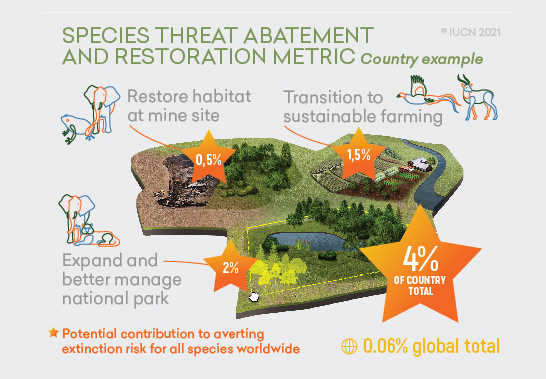
Towards delivery of rapid, high integrity, nature-positive outcomes

Drawing from the comprehensive global assessments provided through the IUCN Red List of Threatened Species, IUCN derives the Species Threat Abatement and Restoration (STAR) metric, which allows any actor to measure their potential contributions towards global goals for extinction risk reduction by specific actions in specific places. Both the data and the tools to support the Private Sector in applying the approach are served through the Integrated Biodiversity Assessment Tool (IBAT). Methods are also under development to incorporate methods to complement these species data with data on risk of ecosystem collapse from the Red List of Ecosystems; and also to allow application of STAR through value chains.

IUCN

Working with Nespresso

IUCN and Nestlé Nespresso, the international coffee brand and subsidiary of Nestlé, have worked together since 2010 on a range of sustainability issues. See more by clicking the links: 


Working with Ferrero

IUCN collaborated with Ferrero, an international confectionery and chocolate manufacturing company – specifically with the Hazelnut Company division – on the identification of regenerative best practices for hazelnut orchards in Turkey, Italy and Chile.

A guide to investing in landscape restoration to sustain agrifood supply chains

IUCN in collaboration with the Food and Land Use Coalition (FOLU), as part of the IKI funded ReSupply project, developed a guide to investing in landscape restoration to sustain agri-food supply chains to support agribusinesses aiming to tackle land degradation in their supply chains and scale investments into landscape restoration.

This guide - subtitled reducing risks, raising resilience, reaping returns – examines why it is important for agribusinesses to engage in nature-positive business practices, and why landscape restoration is an effective solution to issues related to degradation of landscapes and natural capital that agribusinesses depend on. This guide outlines key steps to consider when developing a business case for restoration in supply chains, and why this matters.


Contributions for Nature Platform

The Contributions for Nature platform is a digital tool which encourages IUCN constituents to document and visualise conservation and restoration efforts, aligning them with global targets like the Global Biodiversity Framework, SDGs, and Paris Agreement. The platform shows each initiative on a map and analyses its potential benefits in conserving and restoring biodiversity, and in mitigating climate change. Private Sector initiatives, for example from agricultural companies, are eligible for documentation in the platform where they are conducted in partnership with IUCN Members, IUCN Commissions, or the IUCN Secretariat.

You can access the platform home page here   
 

Contributions especially relevant to Food and Agricultural Systems include: